Brave Search AI is the set of answer features that Brave builds on top of its own web index, and it behaves differently from most AI search products because the index underneath is not borrowed from Google or Bing. That one design choice shapes everything a publisher can do about it. This overview explains what the system is made of, how pages get in, how the AI layer picks sources, and where the honest gaps in public knowledge sit.

What Brave Search AI actually is
Brave Search is a search engine from the company behind the Brave browser. Beside the classic list of links it offers AI-generated output. Brave's help page "AI in Brave Search" names four user-facing features:
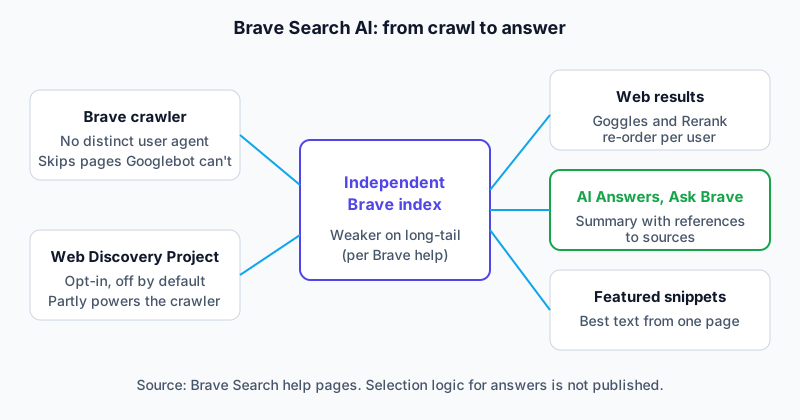
- AI Answers: a concise summary with references to the sources behind the key claims. Brave says parts of this feature use open-source language models.
- Ask Brave: longer answers, follow-up chat, a Deep Research mode, and enrichments such as videos, news and products.
- Featured Snippets: for some questions Brave extracts the most relevant text from a single page, based on pages in its index (Featured snippets).
- AI-powered descriptions: result descriptions generated by a question-answering model.
Brave states that this AI is built in-house on its own models and algorithms (source: AI in Brave Search). Some third-party articles call the product "Brave Answer with AI" or mention the Leo assistant. Brave's current help page uses the names above, so this guide uses them too. Product names in this area change quickly, and that is worth remembering when you read older guides.
How pages get into the index
Everything starts with the crawler. According to Brave's crawler documentation, Brave Search's bot will not crawl a domain or page that Googlebot cannot crawl. The same page says the crawler does not advertise a differentiated user agent, because Brave wants to avoid discrimination from sites that only let Google in (source: Brave Search Crawler).
Two consequences follow. First, a robots.txt that allows Googlebot and blocks "unknown bots" is the typical way to stay invisible. Second, advice to "allowlist Bravebot" circulates in vendor articles, but Brave says there is no separate agent name to allow. That advice, from the vendor CapstonAI, is unconfirmed and conflicts with Brave's own page.
The second input is the Web Discovery Project (WDP). Brave describes it as an off-by-default, opt-in, privacy-preserving system in the browser's search settings, with mechanisms that stop Brave from knowing who contributes what, and open source for inspection. The crawler is "partially powered" by this information (same crawler page). Brave's Search API page adds that the index is built from anonymous contributions of real browser and search users. A trade article summarizing the Brave help text lists the kind of data involved, such as queries, clicks and visited URLs. That exact list does not appear in the help text reviewed, so it is not relied on here.
Independent index: what that does and does not mean
Brave markets the independence heavily. Its Search API page says the index is "crawled, ranked, and served end to end" and that long-tail queries are answered from its own index without a handoff to another engine. That is a Brave claim about its own product and could not be tested from outside.
The picture is less clean on the consumer side. Brave's help page on Google fallback mixing says the index is still being refined, especially for long-tail queries, and offers an opt-in setting where the browser anonymously checks Google when Brave's results lack depth (source: Google fallback mixing). So "independent" describes the index, while one optional consumer feature still mixes in Google results in the browser. Both statements come from Brave, and they are compatible.
| Question | What Brave says | Where |
|---|---|---|
| Own crawler? | Yes, with no distinct user agent | Crawler help page |
| Depends on Google or Bing for the API? | "Zero dependencies" | Search API page |
| Does it ever show Google results? | Optional opt-in fallback in the browser | Google fallback help page |
| Is there a webmaster console? | Not mentioned in the help articles reviewed | Help center index |
How the AI layer picks sources
This is where public information runs thin. Brave says AI Answers cite their sources and that provenance is central. It does not publish a source-selection algorithm. The description here comes from the Search API documentation, which exposes the same index to developers.
The API has an LLM Context endpoint that returns ranked, extracted passages from pages, with a token budget configurable from 1k to about 33k tokens and a threshold setting (strict, balanced or lenient). It also has an Answers endpoint compatible with the OpenAI chat format, with citations (source: Brave Search API). Brave presents these as the grounding layer for AI products. It is reasonable to infer that Brave's own answers rely on a similar retrieve-and-extract step. That is an inference, not a Brave statement.
If that inference holds, the unit that matters is the passage, not the page. A page needs to be indexed first, and then one clear passage must answer the question on its own. A worked example shows the difference.
Before (weak passage):
Our platform offers a wide range of solutions. Many customers ask us about indexing. We think it is a great question and we work hard to help.
After (citation-ready passage):
Brave's crawler will not fetch a page that Googlebot cannot fetch. To check this, request your page with a Googlebot user agent and confirm a 200 status. Remove any rule that blocks Googlebot, then wait for Brave to re-crawl.
The second version states one fact, gives one action, and carries no filler. It also matches how featured-snippet extraction is described by Brave: pick the most relevant text from one page.
Ranking customization changes what "ranking" means
Brave lets users modify ranking themselves. Goggles are sets of rules and filters that act as a custom re-ranking on top of Brave's index. Anyone can write one, host it (GitHub, Gist or GitLab), and share it. Brave says it has no claim on Goggle ownership and does not require sign-up (source: Goggles). Rerank is a lighter version: a user raises or discards domains, stored as cookies, and Brave builds an ephemeral Goggle on each request. Raised domains get a bump, discarded domains are not candidates (source: Rerank). The Search API also supports Goggles, which Brave sells as control over "which sites ground your model".
For a publisher this has a blunt implication: there is no single Brave ranking, so there is no single position to chase. A technical community may publish a Goggle that boosts developer documentation and demotes content farms. You cannot optimize for every Goggle. You can only build a site worth following.
Brave compared with its neighbours
Brave sits in the independent-index group with Perplexity and Mistral, but the three work differently. See the guides to Perplexity AI search and Mistral Le Chat. For the Bing-based side of the market, compare Microsoft Copilot search.
| Point | Brave Search AI | Typical Bing-based assistant |
|---|---|---|
| Index owner | Brave | Microsoft |
| Crawler rule that matters | Googlebot must be allowed | Bingbot must be allowed |
| Webmaster tooling | None official found | Bing Webmaster Tools |
| User ranking control | Goggles and Rerank | Limited |
| Source display | Cited sources in AI Answers | Cited sources |
The Bing column reflects general industry knowledge and the Copilot guide on this site rather than a Brave source, so read it as orientation only.
What publishers can control
Given the above, the controllable list is short and technical.
- Make sure Googlebot can crawl every page you want indexed, since Brave inherits that permission.
- Keep content in the visible HTML so an extractor can read it.
- Use noindex, not robots.txt, to delist. Brave states that robots.txt is not used to stop indexing.
- Link pages together so a crawler can find them.
- Write answer-first passages that survive extraction.
The agency Pipeline Velocity (30 July 2026) reaches a similar list: it says no public list of Brave ranking factors exists, recommends Googlebot-crawlable pages, internal links, original content and answer-first passages, and calls backlinks "likely important", which is its inference rather than a Brave statement (Pipeline Velocity).
The companion guide, how to rank in Brave Search, turns these into an ordered checklist.
Reported traffic and visibility claims
You will see precise numbers in vendor material. One GEO vendor article (CapstonAI, May 2026) says Brave's AI search reached 14 million monthly searchers in March 2026, citing a Brave transparency report (CapstonAI). That figure does not appear in the Brave pages reviewed, so it is unconfirmed. The same article reports a customer panel where Brave citations rose from 2 to 14 over a quarter. That is one anonymized case with no published method, and it should not be generalized.
Brave's own page makes comparable claims in the other direction: it reports first place in an AIMultiple agent-quality test and average latency of 669 ms. Those numbers concern the API, not publisher visibility, and come from Brave's marketing page.
A community thread on the Brave Community forum gives the opposite flavour of evidence. One poster describes a page ranking first on Google but not on Brave and attributes this to backlinks. Another reports roughly eight months before a site ranked. Both are anecdotes, and the forum thread shows no staff confirmation. A third voice there points out that Brave does not rank or re-rank like other engines, and suggests the feedback button to report missing or outdated pages.
Frequently asked questions
Does Brave Search AI use Google or Bing results?
Brave says its index is its own and that its Search API has no dependency on Google or Bing. There is one optional consumer setting, Google fallback mixing, where the browser checks Google for thin queries. It is opt-in and described as anonymous.
Do I need to allow a special Brave bot?
Brave states that its crawler does not advertise a differentiated user agent. The practical rule is the reverse: if Googlebot is blocked on a page, Brave's bot will not crawl it either. Allow Googlebot.
Can I remove a page from Brave?
Yes. Add a robots noindex directive and let Brave re-fetch the page. Brave says robots.txt does not prevent indexing. A re-fetch request form and a not-found contact address exist on the crawler help page.
Is there a Brave Search Console?
None is documented in Brave's help center. Community members in a Brave forum thread say there is none and ask for one. Check manually by searching for your pages.
What are Goggles?
Goggles are rule sets that re-rank Brave results. Anyone can write and host one. Users follow them, and Brave stores followed Goggles in the browser's localStorage.
Does Brave Search AI cite sources?
Brave says AI Answers include references to the sources that back key claims, and that it always shows where information comes from. The exact selection logic is not published.
Limits of this guide
- Verified: crawler rules, the Web Discovery Project description, Goggles, Rerank, Google fallback, the AI feature list and the Search API endpoints, read on Brave's own pages on 29 October 2026.
- Reported, not verified: the 14 million searcher figure, the 2 to 14 citation case (both CapstonAI), the AIMultiple and latency claims (Brave marketing), and the forum anecdotes.
- Missing: a Brave ranking-factor list, a webmaster console, the source-selection logic of AI Answers, and the Brave transparency report. The comparison with Bing-based assistants is orientation, not a sourced benchmark. No hands-on video transcript exists for Brave, so there is no walkthrough analysis here and no first-hand citation test. Anything beyond Brave's documentation is labelled as inference. See the methodology for how evidence is graded.
If the action list is what you need, go to how to rank in Brave Search.
Sources
- Brave Search Crawler, Brave help center, read 29 October 2026
- AI in Brave Search, Brave help center, read 29 October 2026
- Goggles, Brave help center, read 29 October 2026
- Rerank, Brave help center, read 29 October 2026
- Google fallback mixing, Brave help center, read 29 October 2026
- Featured snippets, Brave help center, read 29 October 2026
- Brave Search API, Brave, read 29 October 2026
- Brave SEO Ranking, thread in Brave Feature Requests, Brave Community forum (opened 25 October 2022)
- How To Rank In Brave Search, Pipeline Velocity, 30 July 2026
- How to Rank in Brave Search AI 2026: Privacy-First Visibility, CapstonAI, May 2026