Mistral Le Chat is the assistant from the French company Mistral AI, and since May 2026 it has a new name, Vibe, though the product still lives at chat.mistral.ai and most people (and most SEO pages) still say Le Chat. For publishers the useful question is narrow: when it answers with a web link, how did your page get there, and what can you control?
What Mistral Le Chat is today
Le Chat launched in February 2024 as a demo front end for Mistral's models, according to Mistral's launch post. In November 2024 it gained web search with inline citations (TechCrunch, 18 Nov 2024). In May 2026 the whole product was folded into Vibe, which Mistral describes as one agent for work and code.
The Mistral Help Center page dated 12 August 2026 says Vibe has three modes: Work, Chat and Code. The turn-based conversation experience people knew as Le Chat survives as Vibe Chat. This guide keeps the old name in the headings because that is what searchers type, and says "Vibe" when the current product matters.
Why does the rename matter for SEO? Because documentation, crawler names and help pages now use "Vibe". If you search Mistral's docs for "Le Chat" you may miss the page that applies to you.
How a Mistral answer gets built
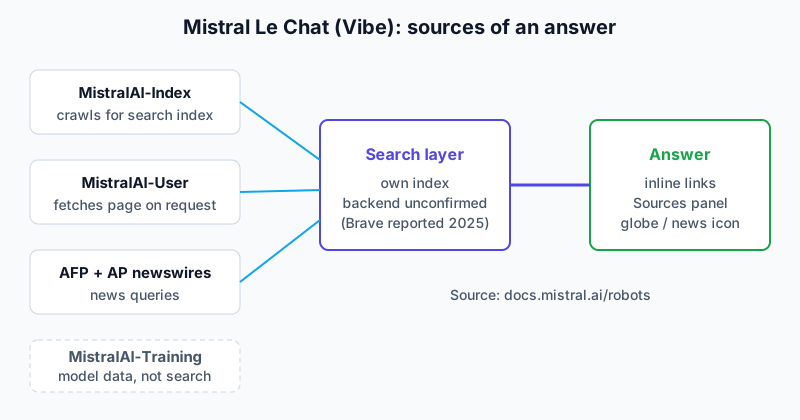
Mistral's docs describe three ingredients: model knowledge, a search layer, and the page the user may ask it to open. A fourth, news from agencies, is handled separately.
- The user asks a question with web search enabled.
- For general topics, the search layer returns pages. For news, the Vibe Work documentation says AFP and AP are the sources.
- If the user pastes a URL, the Open URL tool fetches that single page.
- The model writes an answer and attaches references.
The search layer itself needs care. TechCrunch reported in March 2025 that Brave and Mistral had announced Le Chat would use Brave's search API, citing a post from Brave. Mistral's current docs, however, describe its own crawler, MistralAI-Index, "for indexing purposes only" and say it "indexes content for Mistral search". No statement reconciling the two was found. Possibly both exist, possibly Mistral moved. The current backend is therefore unconfirmed. If you want to hedge, read how Brave Search AI works too.
The three crawlers, and what each one does
This is the most actionable part, and it comes straight from Mistral's crawler page.
| User agent | Purpose according to Mistral | Used for training? | Block it and you lose... |
|---|---|---|---|
| MistralAI-User | Fetches a page when a user's question or request needs it, and links the source | No | Live reading of your page in a conversation |
| MistralAI-Index | Automated crawling to index content for Mistral search | No | Presence in Mistral's search index |
| MistralAI-Training | Builds datasets to train Mistral models | Yes, that is its job | Nothing in search; only training exposure |
The "block it and you lose" column is an inference from the descriptions, not a Mistral statement. Still, the separation is clean: you can stay in Mistral search and answers while opting out of model training, because the training crawler has its own token.
Most agency pages mention only MistralAI-User. The Archipel page reviewed for this guide names that one alone, which is incomplete now that MistralAI-Index is documented. A robots.txt written from that list would leave the indexing crawler unaddressed.
Mistral publishes full user-agent strings (version 1.0 each) and IP address lists for the crawlers. That helps when your CDN or bot filter silently blocks traffic: you can allowlist by IP rather than trusting a user-agent string alone.
A starting robots.txt
# Allow Mistral search and live fetches, opt out of training
User-agent: MistralAI-User
Allow: /

User-agent: MistralAI-Index
Allow: /

User-agent: MistralAI-Training
Disallow: /
Whether you disallow training is a business decision, not an SEO one. Nothing in Mistral's documentation says training exposure affects citations.
News is a separate lane
In January 2025 Mistral announced a partnership with Agence France-Presse. The post says Le Chat gets AFP's newswire, reflecting 1,700 journalists and 2,300 wires a day in six languages: French, English, Spanish, Portuguese, German and Arabic. AFP's press release calls it a multi-year agreement.
The practical consequence is blunt. For breaking news questions, Mistral's documentation says the answer draws on AFP and AP. A small publisher is unlikely to be the cited source of a news fact there, so planning around news queries is not advisable. Evergreen, explanatory and product-comparison queries are a different matter, since these are not served by wire copy.
The partnerships go beyond news. In January 2026 Wikimedia Enterprise announced that Mistral would download Wikimedia project snapshots daily in several languages as an information source for its models. Wikipedia matters for entity facts about your brand, which the closing checklist returns to.
What citations look like to the user
The docs say a web-sourced response shows a globe icon, inline links to sources and a Sources button listing every reference in one panel. Mistral also states that a news icon appears when agency results are included.
That makes measurement straightforward in principle. You can run your target questions, open the Sources panel and note whether your domain is present. It is also manual, and results can vary by phrasing, language and day. For the same reason, one run should never be presented as a ranking.
The API tells a slightly different story that is still useful. The websearch tool documentation lists web_search and web_search_premium, the latter adding news via "integrated news provider verification". Reference chunks carry a title, URL and source. Organisation admins can also allowlist or blocklist domains, and filtered results vanish silently. So a page can be absent from an enterprise customer's answers for a reason that has nothing to do with your SEO.
Limits Mistral documents itself
Mistral's own help text on Open URL is candid:
- It fetches only the single page at the URL you provide and does not follow links.
- Pages behind a login or paywall cannot be accessed.
- Some highly interactive websites may load incompletely.
- Web search "can return outdated or incomplete content depending on what the source page exposes".
The last two points deserve a moment. If your content is rendered by JavaScript after load, a fetcher may see a thin shell. Server-rendered HTML with the answer near the top is the safer design, and that is ordinary technical SEO rather than a Mistral trick.
Who actually uses it: separating data from marketing
Agency pages make several claims about audience. The table weighs them.
| Claim | Source | Status |
|---|---|---|
| Le Chat is strongly used in France and across Europe | Archipel GEO agency | No figures given; unverified |
| Public bodies pick a European assistant for sovereignty | Archipel GEO agency | Plausible narrative; no data |
| Mistral models were downloaded over 12 million times on Hugging Face by mid-2025 | Keyword.com blog | Not verified; also about models, not the assistant |
| Open-weight models "don't respect robots.txt" | Keyword.com blog | Conflates model weights with the Le Chat product; Mistral documents crawlers that honour robots.txt tags |
| Mistral built its product with a documented multilingual focus | Mistral, Wikimedia post | Supported by Mistral's own statements |
The Keyword.com article, last updated 7 May 2026, is mainly about tracking brand mentions in applications built on Mistral's open models. That is a different problem from getting cited in Mistral's own assistant, and it recommends generic tactics like short paragraphs, Markdown and hreflang. Those are fine ideas. They are not evidence about how Le Chat chooses sources.
One more caution applies. Both agency pages sell something: tracking software in one case, a GEO retainer in the other. Neither shows a methodology, sample size or screenshot of Le Chat results. Read them as hypotheses.
Recommended order of work
This is editorial judgment based on the documented facts, not on any measured ranking factor:
- Check that your robots.txt, CDN and bot protection do not block MistralAI-User or MistralAI-Index, then decide separately on MistralAI-Training.
- Serve answers in HTML that does not need JavaScript to appear.
- Publish in the languages your buyers use. Mistral's AFP and Wikimedia deals both stress multilingual coverage, though that describes its data sources, not its ranking.
- Make sure Wikipedia and Wikidata facts about your brand are accurate if you qualify for an entry, since Mistral says it ingests Wikimedia data.
- Test a short list of questions by hand and log whether you appear in the Sources panel.
The step-by-step version, with an audit table and a test protocol, is in how to rank in Mistral Le Chat. For comparison, Perplexity AI search runs on a more visibly independent retrieval stack, and ChatGPT Search is the usual reference point for citation behaviour. The evaluation approach is described in the methodology.
Frequently asked questions
Is Le Chat the same as Vibe?
Yes. Mistral announced on 28 May 2026 that Le Chat became Vibe, keeping accounts, plans and conversations. The chat experience continues as Vibe Chat, and the app is still served at chat.mistral.ai.
Does Mistral Le Chat cite its sources?
According to Mistral's documentation, web-sourced responses include inline links and a Sources panel. The API returns reference chunks with title and URL. What the documentation does not say is how sources are ranked or selected.
Which crawler should I allow to appear in Mistral search?
Mistral says MistralAI-Index crawls for its search index and MistralAI-User fetches pages during a user's request. Allowing both is the straightforward route. MistralAI-Training is documented as a separate token for training data.
Does blocking MistralAI-Training remove me from answers?
Mistral describes that crawler as not used for search indexing or live answers. So the documentation implies no direct effect on citations. That implication has not been tested.
Can a small publisher be cited on news questions?
Mistral's docs say news queries use AFP and AP. That makes it harder, though not impossible, since not every query is classed as news. How the split is decided is not documented.
Does Mistral use Brave Search?
In 2025 TechCrunch reported a Brave and Mistral announcement to that effect. Mistral's current docs describe its own index crawler. Which of the two, if either, powers search today is unconfirmed.
Limits of this guide
- Verified against Mistral's own pages (read 29 October 2026): the rename to Vibe, the three crawlers, the AFP and AP news lane, the Sources panel and the Open URL limits. These can change.
- Reported, not confirmed: the Brave search API arrangement (TechCrunch, March 2025), and the Archipel and Keyword.com claims in the table above, which are marketing material.
- Missing: no video walkthrough of Mistral was available to this guide (the two reviewed sources are vendor web pages, not videos), no citation behaviour was measured, and Mistral publishes no ranking logic.
Sources
- Mistral crawlers, Mistral Docs
- Search the web, Vibe Work, Mistral Docs
- Websearch agent tool, Mistral Docs
- Vibe gets to work, Mistral AI, 28 May 2026
- Le Chat is now Vibe, Mistral Help Center, 12 Aug 2026
- Purr-fectly informed, Mistral AI, 16 Jan 2025
- AFP and Mistral AI press release (PDF), AFP, 16 Jan 2025
- Mistral AI partners with Wikimedia Enterprise, 27 Jan 2026
- Mistral unveils new AI models and chat features, TechCrunch, 18 Nov 2024
- Anthropic appears to be using Brave to power web search for Claude, TechCrunch, 21 Mar 2025
- Le Chat, Mistral AI, 26 Feb 2024
- Mistral SEO: Get Cited by Le Chat, Archipel GEO Agency (vendor page, updated 12 Oct 2026)
- How to Track and Optimize Your Brand Mentions in Mistral AI in 2026, Keyword.com blog (vendor page, last updated 7 May 2026)