Perplexity AI search is an answer engine that looks up the live web for most questions, writes a short synthesis, and attaches numbered links to the pages it used. That one fact explains most of what publishers need to know: a page that cannot be fetched cannot be cited, and a page that is hard to quote loses to one that is easy to quote.

What Perplexity AI search actually is
Perplexity describes itself, in its crawler documentation, as a service that collects data with "web crawlers and user agents that gather and index information from the internet", some running automatically and some in response to user requests (Perplexity crawler docs). Users ask a question in plain language. They get a written answer with citations, and they can ask follow-ups.
The practical difference from Google is the unit of success. Google gives ten blue links and you fight for a position. Perplexity gives one answer, and you fight to be one of the linked sources inside it. Search Atlas, an SEO software vendor, frames this as "earning citations" rather than "ranking" (Search Atlas). The framing is sound, even where some of that vendor's numbers are not.
For the how-to side of this topic, see how to rank in Perplexity. This page is the explanation; that one is the checklist.
The pipeline: from question to cited answer
Perplexity has not published a ranking algorithm. The description here comes from its crawler docs and from third-party analysis, so the diagram below marks which parts are documented.
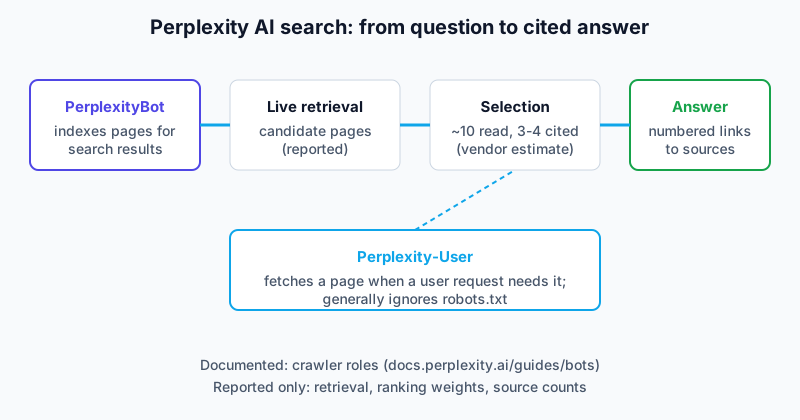
In order:
- Indexing. PerplexityBot visits pages so they can appear in search results.
- Retrieval. A question is turned into searches; candidate pages and passages come back.
- Selection. Some candidates are read in full, fewer are cited. GEO-Score, a Dutch GEO tool vendor, says Perplexity opens roughly ten pages per question and cites three or four (GEO-Score). That is a vendor estimate.
- Answer. A language model writes the response and links the sources.
- On-demand fetch. If a user's request needs a specific page, Perplexity-User fetches it live.
The video walkthrough reviewed for this guide describes the same retrieve-then-rerank logic for AI search in general, using a small ceramics studio as the example. It is analysed further below.
The two crawlers and what robots.txt does
This is the only part of Perplexity's behaviour that is fully documented, so it deserves care.
| Agent | Purpose (per Perplexity) | robots.txt | Published IP list |
|---|---|---|---|
| PerplexityBot | Surfaces and links sites in Perplexity search results | Respected; Perplexity recommends allowing it | perplexity.com/perplexitybot.json |
| Perplexity-User | Supports a user's request by visiting a page, then linking it | "Generally ignores" rules, since a user asked | perplexity.com/perplexity-user.json |
Two details matter. First, Perplexity states that PerplexityBot "is not used to crawl content for AI foundation models", so blocking it removes you from Perplexity search results without any effect on model training, by Perplexity's own account. Second, changes to robots.txt can take up to 24 hours to be reflected (Perplexity crawler docs).
If you want to be cited in Perplexity, allow PerplexityBot and make sure your firewall lets its published IP ranges through. The docs give Cloudflare and AWS WAF recipes that combine a user-agent match with the published IP ranges, and warn that user agents alone are not enough. A minimal robots.txt looks like this:
User-agent: PerplexityBot
Allow: /

User-agent: Perplexity-User
Allow: /
The second block is mostly cosmetic given the "generally ignores" note, but it documents your intent.
Analysis of the reviewed walkthroughs
One video walkthrough transcript was reviewed for this guide (one file in the Perplexity research folder). The narrator shows a small ceramics studio that never appears in AI recommendations for pottery classes in Vienna. The video is about AI search in general. It does not claim to show Perplexity screens, so it is used here only for the retrieval logic, not as proof about this engine. Its claims are the presenter's own.
What the transcript says, paraphrased:
- The question is converted into a meaning vector, and passages with similar meaning are retrieved, so wording does not have to match exactly.
- The initial pool holds about 40 to 50 passages from the studio's own site, competitors, TripAdvisor, Time Out and Reddit.
- A second model scores passages on relevance, specificity and factual detail. The studio's copy had no price, duration or group size, so it was dropped, while competitors with figures such as price, hours and group size survived.
- The fix proposed is to add proprietary facts, put the real query in the headline, write self-contained paragraphs, and add a named instructor with credentials.
That matches the advice from the written guides. It is a single walkthrough, though, not a controlled test.
What third parties say gets cited
Several vendor guides circulate. They are best read as hypotheses.
| Claim | Source | Status |
|---|---|---|
| Opens about 10 pages, cites 3-4 | GEO-Score | Vendor estimate |
| Links around 22 sources per answer | GEO-Score, citing a 2026 analysis it does not name | Unverified |
| 3 to 5 sources recommended per answer | Oscar Référencement (French agency) | Agency claim |
| About 5.28 sources per response on average | Search Atlas | Vendor claim, method not shown |
| 82% of citations on time-sensitive questions went to pages from the previous 30 days | GEO-Score, "one 2026 analysis" | Unverified |
| Adding statistics, quotes and citations gave visibility improvements of up to 40% in the paper's benchmark | Aggarwal et al., "GEO: Generative Engine Optimization" (2024), also cited by GEO-Score | Peer-reviewed study of generative engines in general, not Perplexity-specific |
| Citation frequency 35%, placement 20%, domain authority 15%, schema 10%, security 5% | Search Atlas | Vendor model, not from Perplexity |
Notice the conflict between "3 to 5", "about 5.28" and "about 22". They cannot all describe the same thing. Possibly some count sources shown and others count links across a whole conversation, but none of the pages reviewed explains the difference. A plan should not be built on any of these figures.
The Search Atlas article also reports claims such as content decay beginning 2 to 3 days after publication and a "first 30-minute window" of about 1,000 impressions. No Perplexity statement backing these was found, so they are not repeated as fact. Another agency, geoseoservices.ai, promises results in 2 to 4 months, which is a sales estimate.
Signals that several sources agree on
Strip out the numbers and a consistent core remains.
- Direct answer first. GEO-Score tells writers to answer in the first two sentences. The video says every section should lead with the claim.
- Concrete facts. The video's "answer unit" has a claim, context, proof and takeaway. Oscar Référencement asks for data and sourced figures.
- Freshness. GEO-Score, Search Atlas and the Search API's date fields all point the same way.
- Authority outside your site. Oscar Référencement recommends mentions in specialised media and presence on reference databases. Search Atlas says brand mentions and sentiment matter.
- Structure. Short paragraphs, headings, tables, FAQs.
Where do the sources diverge? On weights and thresholds. That is also where the marketing pressure is highest.
Follow-up questions and the "Pages" idea
Two more themes show up in agency material, and both deserve a caveat. The first is conversation. Oscar Référencement notes that Perplexity keeps context between questions, so a page that also answers the likely next question may stay useful as the user digs deeper. That is sensible editorial advice, best applied with an FAQ block, but the agency does not show how Perplexity handles it internally.
The second is Perplexity Pages, a feature the same agency describes as a native page hosted on Perplexity. Its current status was not verified in Perplexity's documentation, so it is left out of the recommendations. If you are weighing it, check Perplexity's own help pages first rather than relying on a marketing summary.
The Search API clue
Perplexity's developer documentation describes a Search API that returns "real-time, ranked web results as structured data", with fields for title, URL, snippet text, date and last_updated (Perplexity Search API quickstart). It supports domain filters (up to 20 domains) and a country parameter. This is a product for developers, not a description of the consumer answer engine, and nothing shows the consumer product uses identical ranking. Still, the fact that dates are first-class fields in what Perplexity exposes is a good reason to show an honest publication and update date on every page.
Perplexity next to other engines
Perplexity is one of several engines with its own retrieval layer. ChatGPT Search is often discussed alongside the Bing index, and Google AI Overviews draws on Google's own index. Among the independent-index engines in this series, see also Brave Search AI and Mistral Le Chat. The methodology page explains how documented facts are separated from vendor claims.
If your analytics show referrals from Perplexity, read the pages it cites for your topic and compare them with yours. Then follow the steps in how to rank in Perplexity. Start with crawler access, because everything else depends on it.
Frequently asked questions
Does blocking PerplexityBot remove me from Perplexity?
According to Perplexity, PerplexityBot is the agent that surfaces and links sites in search results, and it recommends allowing it. Blocking it would be expected to reduce your presence. Perplexity-User, which fetches pages on a user's request, generally ignores robots.txt.
Is PerplexityBot used to train models?
Perplexity's docs say it is "not used to crawl content for AI foundation models". That statement cannot be audited from outside, so it is Perplexity's own claim.
How many sources does Perplexity cite per answer?
Sources disagree. One agency says 3 to 5, GEO-Score says around 22, Search Atlas says about 5.28 on average. None shows its method clearly, so no figure is given here.
Do the percentage weights for ranking come from Perplexity?
No. The 35/20/15/10/5 split appears in a Search Atlas article. Perplexity has not published ranking weights in any page reviewed.
Does Perplexity favour fresh content?
Several guides say so, and Perplexity's Search API exposes date and last_updated. The exact freshness windows quoted online are unverified.
Can I check whether Perplexity cites me?
Yes, manually: ask the questions your customers ask and read the numbered sources. Paid tools also track citations; none was tested for this guide.
Limits of this guide
- Verified: the two crawlers, the robots.txt behaviour, the IP lists and the Search API fields, all read in Perplexity's own documentation on 29 October 2026.
- Reported, not verified: source counts, the 82% freshness figure, the weight table, decay and impression claims, and agency timelines. All are named in the body with their source.
- Missing: Perplexity publishes no ranking rules, and no citation tests were run for this guide. The single video transcript concerns AI search in general and showed no Perplexity output. One agency page (Oscar Référencement) is in French.
Sources
- Perplexity Crawlers documentation, Perplexity, read 29 October 2026
- Perplexity Search API quickstart, Perplexity, read 29 October 2026
- Ranking in Perplexity AI: Strategies for Citation and Visibility, Search Atlas
- Perplexity SEO: How to Rank in Perplexity AI Search (2026 Guide), GEO-Score
- Perplexity AI: Le Guide pour Dominer le GEO et le SEO, Oscar Référencement (French agency), 2025
- SEO for Perplexity AI Services: Rank in Answer Search, geoseoservices.ai
- GEO: Generative Engine Optimization, Aggarwal et al., arXiv, 2024
- Video walkthrough transcript, ceramic studio in Vienna example of AI search retrieval, third-party creator, reviewed 2026 (original URL not available)