Grok search is xAI's answer engine, and its defining feature is that it queries X (formerly Twitter) directly alongside the open web. Every other major assistant reads pages. Grok reads pages and public conversations, then writes one answer. That single difference shapes what you should publish, where you should show up and how much you should trust its citations.
What Grok search actually is
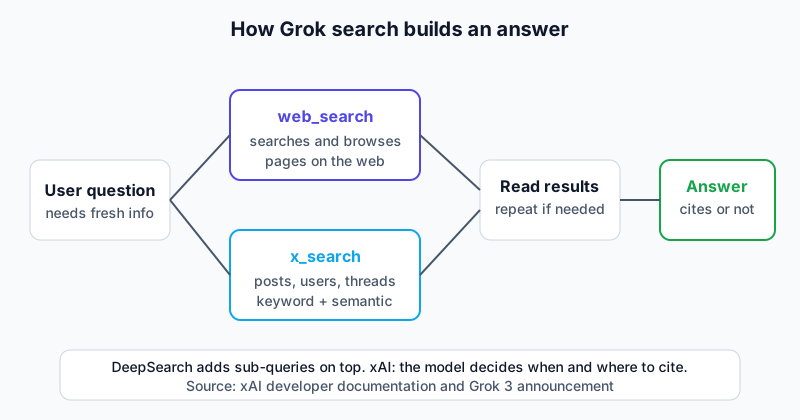
Grok is the assistant built by xAI and tied closely to X. When you ask it something current, it does not answer only from training data. It runs a short loop: work out what is needed, call a search tool, read what comes back, repeat, then write. xAI's developer documentation describes the web tool as one that lets Grok "search the web in real-time and browse web pages". That is retrieval, not memory.
Two consequences follow. First, freshness matters more than in a model that mostly recalls. Second, there is no single index you can submit to. Unlike a classic search engine, nothing here resembles a webmaster console for Grok. Your lever is being easy to find, read and quote at the moment a question is asked.
If you want the practical steps rather than the mechanics, jump to how to rank in Grok.
The two retrieval tools
xAI documents the tools in its developer pages. They are written for API users, but they reveal what the consumer product can do.
| Tool | What it searches | Documented controls | Why it matters to you |
|---|---|---|---|
web_search |
The open web, with page browsing | Up to 5 allowed or excluded domains | Your pages can be read in full, not just as snippets |
x_search |
X posts, profiles, threads | Up to 20 handles, date ranges | Posts about you can enter an answer |
| Inline citations | Links placed in the answer text | Model decides when to cite | A source can be read and still not named |
citations list |
Every URL the agent met | Returned by default | Wider than what the user sees |
Source for the table: xAI developer documentation on web search, X Search and citations.
Inside x_search
The X tool is not one function. xAI lists four: keyword search with X's advanced operators (sorted by Top or Latest), semantic search by meaning, user search, and thread fetch, which returns a post with its parents and replies. So Grok can find who is talking, not only what was said. It can also read a whole thread before summarising it.
The tool is billed in the API at $5 per 1,000 posts fetched and $10 per 1,000 profiles fetched, according to the same documentation. That is a developer cost, but it hints at design: fetching posts is a deliberate, metered action, not a free background lookup.
DeepSearch and how queries expand
xAI introduced DeepSearch with Grok 3 on 19 February 2025 and called it "our first agent". The company says it will take users "far beyond a browser search" and is built to "reason about conflicting facts and opinions". At launch it was available to X Premium+ subscribers.
For a publisher, the practical point is query expansion. A deep mode does not search the exact words the user typed. It breaks a task into sub-questions and searches each. The page that wins is often the one that answers a sub-question cleanly. That reading is an inference, not an xAI statement, but it fits how agentic search is described elsewhere. Write sections that answer one question each, under a heading that states it.
Academic work points the same way, with limits. The GEO paper (Aggarwal et al., 2024, arXiv 2311.09735) reports visibility improvements of up to 40% in the paper's benchmark for methods such as adding quotations and statistics, and says efficacy varies by domain. It did not test Grok.
How Grok decides what to cite
Here is the part that surprises people. Retrieval and citation are separate steps. xAI's citation page states that the full citations list holds every URL the agent encountered, and that not every one is used in the final answer. It adds that enabling inline citations "does not guarantee" the model cites sources on every answer; the model decides based on the query.
Being retrieved is not the same as being named. A page can be consulted, judged less relevant and dropped. A customer-facing answer from memory carries no sources at all, according to the agency Customer Impact, which says sources appear only when the search tools are actually called.
Citations can also point to X posts, not only web pages. xAI's SDK documentation distinguishes web citations from X citations. That is the clearest documented sign that a post can sit in the source list next to a news site.
What the evidence says about accuracy
The best independent data is older than the current model, so read it with care. In February 2025 the Tow Center for Digital Journalism at Columbia tested eight AI search tools with 1,600 queries (20 publishers, 10 articles each, 8 chatbots). Published in the Columbia Journalism Review on 6 March 2025, the study found:
- Collectively, the chatbots answered more than 60% of queries incorrectly.
- Grok 3 answered 94% incorrectly, against 37% for Perplexity.
- Of 200 Grok 3 prompts, 154 citations led to error pages.
- Grok 2 often linked to a publisher's homepage rather than the article.
- The crawlers of DeepSeek, Grok 2 and Grok 3 were "not publicly known".
The authors also note limits: one run per excerpt, answers vary, and the task (identify an article from a pasted excerpt) is not typical use. CJR additionally cites a Reuters report that Grok, despite encouraging X updates, "still overwhelmingly cites traditional news organizations".
Recommended approach: do not build a business case on a single assistant's citation behaviour. The test is old and models change monthly, yet the lesson holds. Check what Grok says about you, and check the link it gives.
Analysis of the reviewed walkthroughs
In the one video walkthrough reviewed for this guide (a third-party creator's transcript), the presenter says Grok 4.6 is xAI's new model for coding, agentic work and knowledge work, and argues Grok has become a real search engine that answers with sources. The method described is trend hunting: Grok is connected to X, so the presenter says it sees conversations "as they happen", while Google Trends and keyword tools lag by weeks or months.
The worked example in the transcript is the keyword "Grok bot versus Hermes agent", described as only days old. The presenter reports that content published on it reached page one of Google within 24 hours in several places (a Reddit post, the presenter's own site and another owned site), and that Grok pulled those sites into an answer as sources when asked the same query.
Three cautions. The result is self-reported, for one keyword. The transcript ends mid-example, so the announced four steps and indexing trick are not in the text. And a niche, brand-new keyword has almost no competition, which explains speed better than any Grok-specific trick. Treat it as a hint that fresh, trend-aligned pages can be picked up quickly, not as a repeatable ranking recipe. The methodology page explains how this kind of evidence is handled.
Where Grok differs from neighbouring engines
| Question | Grok | Perplexity | ChatGPT Search |
|---|---|---|---|
| Native social data | Live X posts, users, threads | Open web focus | Open web focus |
| Documented deep mode | DeepSearch | Not covered here | Not covered here |
| Public crawler docs | None found; crawlreadiness.com reports none from xAI | Crawler names public, per the Tow study | Crawler names public, per the Tow study |
| Citation rule | Model decides when to cite | See Perplexity | See ChatGPT |
The Tow Center notes that five of eight tools had made crawler names public while DeepSeek, Grok 2 and Grok 3 had not. The tracker crawlreadiness.com lists a community token, GrokBot, and reports that 53 of 569 top-1,000 sites with a robots.txt file blocked it on 12 October 2026 (its own count); xAI does not confirm the token. The social cousin on the list is Meta AI, which plays a similar role inside its own platforms.
Should you prioritise it?
It depends on your topic. Grok's strength is live topics: product launches, breaking stories, public reaction. If your audience argues about your field on X, Grok has material to quote and you can influence it. If you publish slow, evergreen explainers for a broad consumer audience, the same quality work is better aimed at engines with a bigger reach, and the effort carries over to Grok anyway.
Measurement is thin. xAI offers no publisher dashboard that this guide could find. The SEO Handbook reports that Google Analytics 4 added an "AI Assistants" default channel group in May 2026 that names Grok, so clicks can be grouped where they happen. Manual prompt sampling and a log of which sources appear remain the practical method. For the step-by-step version, read how to rank in Grok.
Frequently asked questions
Does Grok search use X posts as sources?
Yes, when its X Search tool is called. xAI documents keyword search, semantic search, user search and thread fetch on X. Those posts can appear as citations alongside web pages.
Does Grok always show sources?
No. xAI says the model decides when and where to cite. Answers produced without calling a search tool carry no source list.
What is DeepSearch?
It is the multi-step research mode xAI introduced with Grok 3 on 19 February 2025. xAI describes it as its first agent, built to reason about conflicting facts and opinions and return a concise report.
Can I submit my site to Grok?
No submission tool or webmaster console for Grok was found. The documented route is that Grok searches and browses the live web and X when it needs information.
Is Grok accurate when it cites news?
In the Tow Center test from February 2025, Grok 3 answered 94% of queries incorrectly and 154 of 200 citations went to error pages. That was an older model on a specific task, so recheck against current versions.
Which Grok model is current?
Sources disagree by date. The SEO Handbook reports Grok 4.6 shipping on 12 August 2026, while xAI's developer examples read in October 2026 call grok-4.7. Treat version names as short-lived.
Limits of this guide
- Verified against the source: the xAI tool and citation documentation, the Grok 3 announcement, the Tow Center figures and the arXiv GEO paper, all cited above.
- Reported, not verified: the
GrokBottoken and its blocking rate (crawlreadiness.com), model release dates and the GA4 channel group (SEO Handbook), and the agency view of sources (Customer Impact). - Missing: no controlled citation test was run for this guide. The only hands-on material is one third-party video transcript that is cut off before its main payoff, with self-reported results. xAI publishes no ranking specification, so recency and X weighting remain inference. The Tow Center data covers Grok 2 and Grok 3 in February 2025. API documentation describes developer tools; the consumer app may behave differently.
Sources
- Web Search tool, xAI developer documentation
- X Search tool, xAI developer documentation
- Citations, xAI developer documentation
- Grok 3 Beta: The Age of Reasoning Agents, xAI, 19 February 2025
- AI Search Has a Citation Problem, Tow Center, Columbia Journalism Review, 6 March 2025
- GEO: Generative Engine Optimization, Aggarwal et al., arXiv 2311.09735
- GrokBot crawler entry, crawlreadiness.com, data as of 12 October 2026
- Grok (xAI) Search Optimisation, The SEO Handbook, updated 2 September 2026
- How to Rank in Grok, Customer Impact, updated 20 October 2026
- Video walkthrough transcript on ranking in and with Grok 4.6, third-party creator, reviewed 2026 (1 transcript; original URL not available)
For the practical playbook, continue with how to rank in Grok.