To rank in DeepSeek you have to be retrieved by its search engine first and quoted by its model second, and only the first half is documented.

What it means to rank in DeepSeek
There is no results page with positions. DeepSeek's search layer returns a list of pages to a model, and the model writes an answer. "Ranking" therefore means two things you can observe separately: your page appears in the retrieved set, and your page or brand is named or linked in the final answer.
Those are different problems. Retrieval is about crawl access, index inclusion and the scoring DeepSeek documents. Citation is about whether your page contains a clean, quotable answer to the question that was asked. The recommended order is retrieval first, because it is a hard gate. If a page is not in the retrieved set, nothing else matters.
For background on how the engine works, read the DeepSeek search overview. This guide assumes the basics and gives an ordered to-do list.
Ground rules before you start
Three honest constraints shape everything below.
- DeepSeek publishes little. Its API docs describe the Search API fields, and outside analysts (Dejan, Known Agents, Menra) describe the crawler. There is no webmaster guide.
- Percentage-style weights are folklore. The Search Atlas guide (updated 2 March 2026) lists relevance 30%, reviews 25%, authority 20%, recency 15% and local 10%. No DeepSeek source supports them (details in the overview). Some of the advice is sensible on general grounds, but it is a vendor's hypothesis.
- The engine is new. Per Dejan, DeepSeek launched its in-house Search API on 17 October 2026. Behaviour will shift. Re-test monthly.
Statements labelled "editorial judgment" below are not documented DeepSeek rules.
The priority order at a glance
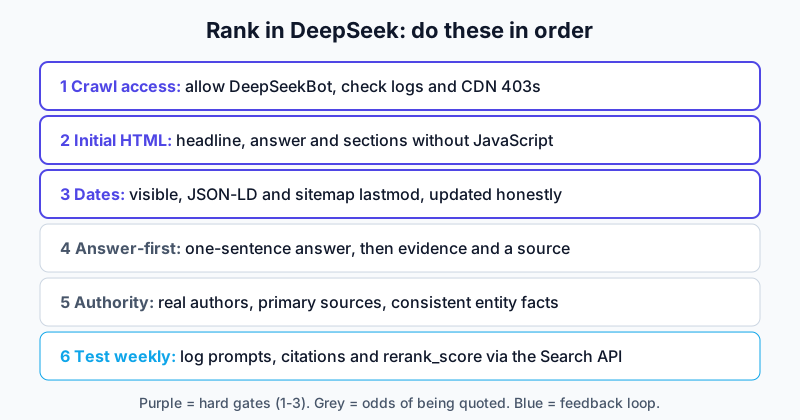
| Priority | Action | Why it comes here | Effort |
|---|---|---|---|
| 1 | Allow crawling and check logs | A blocked or unreachable page cannot be retrieved | Low |
| 2 | Put content in the initial HTML | Fetch returns page text as Markdown; empty shells yield nothing | Medium |
| 3 | Show dates and update honestly | The API returns date, and freshness feeds rerank_score |
Low |
| 4 | Write answer-first sections | The summary is 600 to 800 characters read by a model |
Medium |
| 5 | Build authority you can point to | authority is a documented 0 to 4 tier |
High |
| 6 | Test weekly with logged prompts | It is the only feedback loop you have | Low |
The six steps to rank in DeepSeek
Step 1: Make sure DeepSeek can reach you
Start with the boring part. Open your robots.txt and look for blanket disallows, then look for any rule that mentions DeepSeekBot.
DeepSeek's crawler string, per Known Agents and Dejan, is:
Mozilla/5.0 (compatible; DeepSeekBot/1.0; +https://www.deepseek.com/)
Known Agents reports that 11% of the top 1,000 sites block it and lists it as a training-data crawler with no direct effect on AI chat or search visibility. Dejan notes that DeepSeek has not named a separate bot for the search index. So blocking DeepSeekBot has an unclear effect on search. If you want visibility, do not block it.
A minimal, explicit policy looks like this:
User-agent: DeepSeekBot
Allow: /

User-agent: *
Disallow: /admin/
Sitemap: https://example.com/sitemap.xml
Then check your server logs for the string above and for blocked requests. Also check your CDN or firewall. Many bot-protection services return 403 to unfamiliar crawlers by default, and robots.txt will not tell you that is happening. Menra warns that DeepSeek publishes no verified IP ranges, so you cannot allowlist by IP with confidence. Allow by user agent and accept some uncertainty.
The Fetch API adds another door. DeepSeek's docs say fetching is subject to the target site's availability and access policies, and the API returns a 404 when a page is "blocked by site policy" or has no extractable content. Test with a plain curl from a clean network and confirm you get a 200 and real text.
Step 2: Put the content in the initial HTML
The Search Atlas guide claims DeepSeek crawlers read only server-delivered HTML and recommends server-side rendering. DeepSeek does not confirm that. Still, DeepSeek's own docs say Fetch "returns its content as Markdown", which implies a text extraction step. A page that is an empty <div id="app"> until JavaScript runs is a gamble.
Editorial judgment: ship the headline, the first answer, the main sections and the structured data in the HTML your server sends. This is cheap insurance, and it helps every other crawler too.
Quick check:
- Run
curl -s https://example.com/your-page | head -200and confirm your H1 and first paragraph are present. - Disable JavaScript in your browser and reload. If the article vanishes, fix that first.
- Keep headings in a clean hierarchy (one H1, then H2 and H3). Markdown conversion maps headings to
#levels, so a tidy outline survives intact. - Avoid putting key facts only inside images, tabs that load on click, or carousels.
Step 3: Dates and freshness, done honestly
The Search API returns date as an RFC 3339 UTC timestamp, or null when unknown. Its rerank_score combines relevance, authority and freshness, and the query syntax supports after: and before:. An agent asking for pages after:2026 cannot return a page whose date is unknown to the engine.
So give the engine a date it can find:
- Show a visible "Published" and "Updated" line near the top.
- Add
datePublishedanddateModifiedin JSON-LD, matching the visible text. - Put
lastmodin your sitemap and keep it truthful. - Only change "updated" when content changed. Cosmetic date bumps are a fast route to being filtered as manipulation.
How often should you refresh? Search Atlas says every 3 to 6 months and claims weekly updates correlate with stronger citations. The weekly claim should not be taken at face value; it is a correlation from a vendor with a product to sell. A quarterly review of facts, numbers and screenshots is a sane baseline for most pages, and monthly for fast-moving topics like pricing or model names.
Here is a minimal, honest JSON-LD block:
{
  "@context": "https://schema.org",
  "@type": "Article",
  "headline": "How to Rank in DeepSeek: A Practical 2026 Checklist",
  "datePublished": "2026-10-29",
  "dateModified": "2026-10-29",
  "author": { "@type": "Person", "name": "Mohamed CISSE" },
  "mainEntityOfPage": "https://seo-for-llm.com/how-to-rank/rank-in-deepseek/"
}
Step 4: Write sections a model can lift
The summary field is documented as 600 to 800 characters "intended to be read by a model", and snippet is 100 to 200 characters for display. In plain terms, the engine condenses your page into short chunks before the model sees it. If your best sentence is buried in paragraph nine, the condensation may drop it.
The fix is structure. Lead each section with its answer, then explain.
Before (typical):
Many marketers wonder about this topic. There are several factors, and over the years the situation has evolved. Let us look at the background first. Search engines have used many signals...
After (answer-first):
A DeepSeek
rerank_scoreruns from 0 to 3, and DeepSeek treats 1.5 or above as high quality. It combines relevance, authority and freshness, according to the API docs. The sections below show what you can influence.
The second version states a fact, names the source and defines the threshold inside two sentences. A model summarising that page has something exact to keep.
A repeatable section pattern:
- One-sentence answer that names the entity and the claim.
- One or two sentences of evidence with the source named.
- A table, list or example when the content is comparative or procedural.
- A date or version when the fact can change.
Add a real FAQ at the end of each page, with questions people actually ask, and mark it up only if the visible text matches. Do not invent questions to hit a schema quota. Search Atlas recommends FAQ schema; write the FAQ for readers first. For general evidence on such edits, the GEO study (Aggarwal et al., 2024, arXiv 2311.09735) reports visibility improvements of up to 40% in the paper's benchmark, which did not include DeepSeek.
On length: the Search Atlas guide suggests going beyond 2,500 words "where appropriate". Length is not a signal worth chasing. Cover the question completely, then stop. The 2026 DeepSeek index reportedly removes "low-quality AI-generated content", so padding is a liability.
Step 5: Build authority you can point to
authority is a documented tier from 0 to 4, where 3 or above means highly authoritative and -1 means unknown. DeepSeek does not say how it is computed. Dejan observes that DeepSeek's V4 model has special tokens for judging how authoritative a source a question needs, and that those match the API's authority field. So authority is plausibly a per-query judgement and not a single site-wide number. That is inference and is flagged as such.
What can you do that is concrete and honest?
- Name real authors with real credentials. Add an author page, link to profiles that exist, and state experience that can be checked.
- Cite primary sources. Link to documentation, papers and official announcements, and name them in the sentence.
- Be the primary source where you can. Original measurements, screenshots with dates and published methodology are things others quote.
- Earn mentions on established domains. Industry sites, documentation hubs and well-run forums. Search Atlas suggests technical forum participation; as general advice that is fine, but there is no evidence DeepSeek weights it.
- Keep entity facts consistent. Same brand name, description and key facts everywhere. Inconsistent names create ambiguity for any retrieval system.
What not to do: buy reviews, fabricate ratings, or add schema that does not match the page. Dejan's reading of DeepSeek's launch notes is that the index filters manipulation of generative engines. The filter cannot be inspected from outside, so the safe assumption is that detectable tricks will cost you.
Step 6: Test, log and compare
Because there is no rank tracker that DeepSeek endorses, build a small harness yourself.
A weekly prompt log
Pick 15 to 30 real questions your customers ask. Run each in DeepSeek with search enabled. Record the date, the exact prompt, whether your domain was cited, which competitors were cited, and the wording of the answer. A simple table works:
| Date | Prompt | Search on? | Cited? | Competitors cited | Notes |
|---|---|---|---|---|---|
| 2026-11-05 | "best way to ..." | Yes | No | siteA.com, siteB.com | Answer quotes siteA's table |
| 2026-11-12 | same | Yes | Yes (link 3) | siteA.com | Intro was paraphrased |
| 2026-11-19 | same | Yes | Yes (link 2) | siteA.com | After adding dates |
Run each prompt at least twice, because answers vary between runs. Keep wording identical week to week or you are measuring your phrasing.
Use the API if you have budget
DeepSeek's Search API lets you query with operators like site:yourdomain.com, and it returns rerank_score, authority and date per result. That is the closest thing to a diagnostic. Per the docs each endpoint costs $0.75 per 1,000 successful requests, and calls from DeepSeek Harness, Claude Code or Codex are free until 00:00 Beijing time on 1 November 2026. Check the current pricing before you build anything on it.
A test query might be how to rank in DeepSeek site:example.com lang:en after:2026. If your page returns, note its date, authority and rerank_score. If it does not return, you have a retrieval problem (steps 1 to 3). If it returns with a low score, you have a quality problem (steps 4 and 5).
Paid trackers
Search Atlas, Rankability, Keyword.com, Peec.ai and Otterly AI are listed in the Search Atlas article as tools for DeepSeek monitoring. None were tested for this guide. Their value depends on how they query DeepSeek, which they rarely disclose, so run your manual log alongside before trusting a dashboard.
Analysis of the reviewed walkthroughs
Three third-party video walkthrough transcripts were reviewed for this guide. They concern producing content with DeepSeek, not ranking in it, so use them for workflow ideas only. Traffic figures quoted by the presenters are self-reported and differ between the videos, so none are repeated here.
- A V4 AI SEO tutorial shows a prompt-driven pipeline: choose a trending keyword from Google Autocomplete, generate a draft in DeepSeek's "expert" mode with DeepThink and search on, then run a human checklist for E-E-A-T and search intent before publishing. The presenter says he prefers Claude for prose quality and that DeepSeek output needed editing ("the unvarnished truth" struck him as odd phrasing).
- A DeepSeek Harness tutorial describes grounding articles only in supplied case studies and using a "trajectory view" to confirm which files the agent read. The claim that Google does not penalise AI-written content for being AI-written is the presenter's and is not verified here.
- An R1 blog tutorial builds a post from a topic, keywords from AnswerThePublic, and research pasted in from Perplexity because DeepSeek's search kept crashing. It adds a table, WebP images, an internal link, a meta description under 160 characters and a Search Console indexing request.
What transfers to your goal? The editorial discipline: ground drafts in real material, keep a human check, add internal links, request indexing in Search Console. What does not transfer: any claim that these tactics earn DeepSeek citations. None of the videos tested that.
Common mistakes
- Blocking by accident. A CDN rule returning 403 to unknown bots is the most common silent failure.
- Undated pages. No visible date means a
nullin the API. - Chasing invented weights. Adding reviews or a "Toronto address" because an article said DeepSeek requires them is wasted effort unless you run a local business.
- Mass-produced pages. DeepSeek says it filters low-quality AI content. Volume without substance is the wrong bet.
- Fake freshness. Changing a date without changing facts.
- Measuring once. A single prompt run tells you almost nothing.
If you are comparing engines, the same hygiene applies to Qwen and Kimi, which sit in the same Chinese open-model group, and the independent-index approach differs again in how to rank in Brave Search. The testing approach is explained on the methodology page. For the engine's architecture, return to the DeepSeek search overview.
Frequently asked questions
How long does it take to rank in DeepSeek?
No one has published timings. DeepSeek's index is new, so changes may show within weeks rather than days, but that is a guess. Track weekly and judge by trend.
Do I need schema markup to rank in DeepSeek?
DeepSeek does not say schema is required. JSON-LD with accurate dates and authorship is low-risk and helps other engines. Do not add schema that contradicts visible content.
Should I block DeepSeekBot?
Only if you do not want DeepSeek to use your content. Known Agents says blocking has no direct effect on chat and search visibility, but DeepSeek has not documented a separate search crawler, so the effect is unclear.
Do reviews and a local address matter?
Only for local businesses, and then mostly for the reasons they matter everywhere. The specific "five reviews and a verified Toronto address" rule comes from one vendor guide, with no DeepSeek source.
Is the free chat site the same as the API search?
DeepSeek's launch notes, as reported by Dejan, say the same engine runs search in the app and the API. Interfaces differ, so test in the surface your audience uses.
Can I pay to appear?
No paid placement or sponsored citation product from DeepSeek was found. The Search API is a paid tool for developers, and it does not sell rankings.
Limits of this guide
- Verified against the source: the Search API fields, operators, pricing and the 17 October 2026 launch (DeepSeek API docs), the
DeepSeekBot/1.0string and its 11% block rate (Known Agents), and the GEO paper's "up to 40%" claim. - Reported, not verified: the spam and GEO-manipulation filter and the authority-token reading (Dejan); the weights, server-rendered HTML claim, update cadence and 2,500-word advice (Search Atlas, a vendor); the missing IP ranges and crawler documentation (Menra, xSeek, which conflict with Known Agents).
- Missing: no controlled DeepSeek citation experiment was run for this guide, and the three video transcripts cover content production, not retrieval. Most of the checklist is editorial judgment. Pricing and free-use windows may have changed since the docs were read.
Sources
- Search & Fetch, DeepSeek API Docs
- Search API reference, DeepSeek API Docs
- DeepSeek Search Engine, Dejan (Dan Petrovic, 18 Oct 2026)
- What is DeepSeekBot?, Known Agents
- DeepSeek Crawlers Explained, Menra
- DeepSeek user agents, xSeek Docs
- How To Rank In DeepSeek AI?: Importance, Strategies, and Tools, Search Atlas (Manick Bhan), updated 2 March 2026
- GEO: Generative Engine Optimization, Aggarwal et al., arXiv 2311.09735, 2024
- Video walkthrough transcripts (3), third-party creators: DeepSeek V4 SEO workflow, DeepSeek Harness, and DeepSeek R1 blog workflow, reviewed 2026 (original URLs not available)