To rank in Microsoft Copilot, you first have to be in Bing's index, because Copilot answers are grounded in it, and then you have to publish passages that can be lifted into an answer on their own. Everything below follows that order.
What "rank in Microsoft Copilot" really means
Copilot assembles an answer from several sources and shows citations. There is no position 1 to 10 in the classic sense. Microsoft Advertising put it this way in October 2025: ranking still happens, but "it's less about ordering entire pages and more about which pieces of content earn a place in the final answer". So the goal splits into three measurable things: being retrievable, being parsed cleanly, and being chosen.
Before the steps, read the background in our Microsoft Copilot search overview. It explains the pipeline this playbook is built on.
The nine steps at a glance
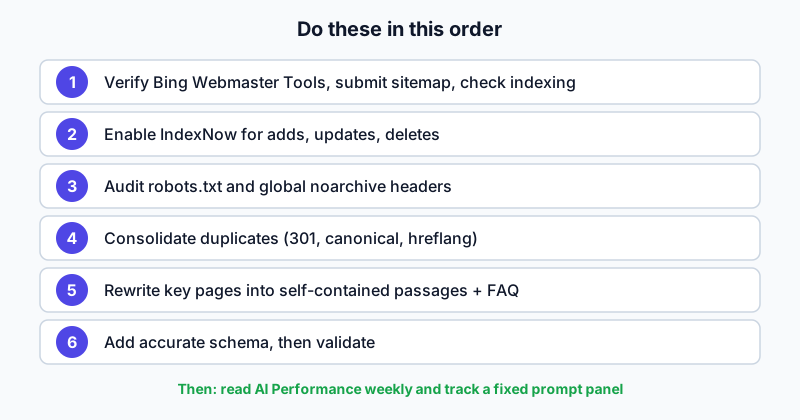
| # | Step | Why it comes here | Effort |
|---|---|---|---|
| 1 | Verify Bing Webmaster Tools, submit sitemap | No Bing index, no grounding | 30 minutes |
| 2 | Turn on IndexNow | Updates reach Bing faster | 1 to 2 hours |
| 3 | Check robots.txt and meta robots | Avoid blocking yourself | 1 hour |
| 4 | Remove duplicates and canonical conflicts | Clusters pick one page | 1 to 5 days |
| 5 | Align title, description and H1 | Purpose and scope signals | Per page |
| 6 | Rewrite into self-contained passages | Unit of selection | Per page |
| 7 | Add accurate schema | Machine-readable context | Per template |
| 8 | Build entity and trust signals | Authority evaluation | Ongoing |
| 9 | Measure in AI Performance and with a prompt panel | Closes the loop | Weekly |
Step 1: Verify Bing Webmaster Tools and submit your sitemap
Microsoft's December 2025 article states that many LLMs rely on data grounded in the Bing index or other search indexes. A page Bing never indexed cannot be a grounding source through that route. The CapstonAI vendor guide makes the same point more bluntly: most brands obsess over Google and ignore Bing.
Do this today:
- Create or open a Bing Webmaster Tools account and verify your domain.
- Submit your XML sitemap.
- Check which of your ten most important URLs are actually indexed.
- Open the Recommendations tab. Microsoft says it can surface issues such as too many pages with identical titles and lets you export affected URLs.
If a priority URL is missing, find out why before writing anything new. Noindex tags, redirect chains and blocked resources are the usual suspects.
Step 2: Turn on IndexNow
IndexNow tells participating search engines that a URL was added, updated or deleted. The Bing Webmaster Blog's AI Performance announcement (February 10, 2026) says IndexNow helps keep information fresh across search and AI experiences. The protocol documentation at indexnow.org says engines that adopt it share submissions with all other participating engines.
The mechanics are small:
- Generate a key of 8 to 128 characters (letters, numbers, dashes).
- Host a UTF-8 text file named
<key>.txtat your site root, containing the key. The documentation strongly recommends the root location. - Submit changed URLs.
A batch submission looks like this, using the documented JSON format (up to 10,000 URLs per post):
POST /indexnow HTTP/1.1
Content-Type: application/json; charset=utf-8
Host: api.indexnow.org

{
  "host": "www.example.com",
  "key": "a1b2c3d4e5f6a7b8",
  "keyLocation": "https://www.example.com/a1b2c3d4e5f6a7b8.txt",
  "urlList": [
    "https://www.example.com/guides/vendor-risk-checklist",
    "https://www.example.com/guides/soc-2-for-saas"
  ]
}
The api.indexnow.org host here is a placeholder for whichever participating engine endpoint you use; check the documentation for the current list. Read the response codes: 200 means received, 202 means key validation pending, 403 means key invalid, 422 means the URLs do not belong to the host, and 429 signals too many requests. A 200 only proves Bing received the notification, not that the page was indexed or cited.
CapstonAI claims IndexNow URLs appear in Copilot citations "4-7x faster" in its customer tests. That claim is unverified and should not be promised to a client. The documented benefit is faster discovery, nothing more.
Step 3: Check robots.txt and meta robots
It sounds obvious, yet this is where sites quietly exclude themselves. Bing states that it respects robots.txt and other supported controls. If you block Bingbot, you remove yourself from the evidence base.
A safe baseline for most publishers:
User-agent: bingbot
Allow: /

Sitemap: https://www.example.com/sitemap.xml
Then look at page-level directives. What nocache and noarchive do to Copilot answers is covered in the overview; here only the audit matters. A page that carries noarchive is left out of answers, so any page you want cited must not have it.
Audit in this order:
- Fetch five priority URLs with
curl -Iand read theX-Robots-Tagheader. Bing accepts the same values as a response header as in a meta tag. - View source and search for
noarchive,nocacheandnoindex. - Check your CDN, CMS and security plugins for a global
noarchiveheader. Paywalled publishers often set it for other reasons. - Remember that
name="bingbot"limits a tag to Bing, so a rule meant for another crawler may be hitting Bing by accident or missing it.
Microsoft's guidance for paywalled content is to add nocache alongside noarchive so Chat users can still find the articles. This guide assumes you want in, so remove both from pages you want cited.
Step 4: Remove duplicates and canonical conflicts
Microsoft's duplicate-content article is the most useful and least quoted source on this topic. Its key claims, in order of importance for AI visibility:
- Duplicate pages do not trigger a penalty on their own, but they dilute signals.
- LLMs group near-duplicate URLs into a cluster and then choose one page to represent it.
- If differences are minimal, the chosen version may be outdated or not the one you wanted.
- Crawlers that revisit duplicates slow down discovery of updated pages.
That changes what a site audit should look for. The risk is not Google-style cannibalisation. It is that your 2024 campaign page becomes the cluster's face while the 2026 page sits unused.
Fixes the article lists, in a sensible order of application:
- Use 301 redirects to consolidate URL variants (HTTP versus HTTPS, trailing slashes, uppercase, parameters).
- Add
rel="canonical"where several versions must stay live. - For syndicated articles, ask partners to canonicalise to your original, or syndicate excerpts with a link back.
- For localisation, change terminology, examples or regulations, and use hreflang.
- Keep staging and archive URLs out of the index.
After you consolidate, send the affected URLs through IndexNow so the change reaches Bing sooner.
Step 5: Align title, description and H1
Microsoft calls the title, description and H1 important signals for interpreting a page's purpose and scope. Alignment matters more than cleverness. Here is a before and after for a hypothetical vendor page:
| Element | Before | After |
|---|---|---|
| Title | "Solutions - Acme" | "SOC 2 Compliance Software for Small SaaS Teams - Acme" |
| H1 | "Welcome" | "SOC 2 compliance software for small SaaS teams" |
| Description | "We help businesses grow." | "Compare SOC 2 audit timelines, costs and evidence collection options for SaaS teams under 100 people." |
The description should explain value or outcome. Microsoft explicitly says to avoid keyword stuffing there. The sample from the Microsoft post (quiet dishwashers) shows slightly different wording between title and H1, so exact duplication is not required. Close alignment is.
The transcript from Beacon Sites adds that Bing puts weight on exact-match signals in titles and on meta descriptions. No Microsoft documentation reviewed ranks those signals. Treat it as a reasonable hypothesis: write the title and description so they would make sense as the answer to the query.
Step 6: Rewrite into self-contained passages
This is probably the step with the largest effect, and the one most teams skip. Microsoft says assistants parse content into small pieces and rank those pieces. So every paragraph should survive being pulled out of context.
Working rules, each grounded in Microsoft's post or the transcript:
- Lead each section with a one- or two-sentence direct answer. Microsoft lists concise answers as what makes content snippable.
- Keep paragraphs short. The Beacon Sites video recommends 30 to 60 words. That number is the agency's, not Microsoft's, but it is a sensible target.
- Replace vague adjectives with measurable facts. Microsoft's example is "42 dB dishwasher designed for open-concept kitchens" instead of "quiet dishwasher".
- Use lists for steps and tables for comparisons, but do not bullet every line. Microsoft's post also warns against walls of text and overloaded sentences.
- Put key answers in visible HTML. Tabs and expandable menus may not be rendered, according to Microsoft.
- Avoid decorative symbols, arrows, star characters and long punctuation strings. Be cautious with em dashes.
A worked example. A vendor page opens with: "We are a leading provider of innovative compliance solutions." Rewritten as an extractable passage:
How long does a SOC 2 Type II audit take? Most audits include an observation window chosen by the company and the auditor, then a reporting phase. Acme's evidence collection cuts manual screenshots by automating checks against 40 named integrations.
Check the second sentence: it is a placeholder claim you would replace with your own provable numbers. If you cannot prove it, delete it. Copilot is built to prefer verifiable material; Microsoft's grounding post describes AI agents as retrievers "drawn to structured, verifiable, and applicable content".
Q&A blocks deserve special mention. Microsoft says assistants can often lift question and answer pairs nearly word for word. A short FAQ section at the bottom of each key page is cheap and fits the format.
Step 7: Add accurate schema
Microsoft describes schema, usually JSON-LD, as turning plain text into structured data that machines can interpret with confidence. The CapstonAI guide says Bing is stricter about schema validity than Google and recommends validating. The "stricter" claim is not confirmed by any Microsoft source reviewed, but validating costs nothing.
A minimal FAQ block for a page that actually shows these questions to visitors:
{
  "@context": "https://schema.org",
  "@type": "FAQPage",
  "mainEntity": [{
    "@type": "Question",
    "name": "How long does a SOC 2 Type II audit take?",
    "acceptedAnswer": {
      "@type": "Answer",
      "text": "The duration depends on the observation window you agree with your auditor, followed by a reporting phase."
    }
  }]
}
Rules that keep you safe:
- Mark up only content visible on the page.
- Do not invent ratings or review counts.
- Add
Organizationdata once, on pages that describe the company, withsameAslinks to real profiles. - Re-validate after template changes.
Schema does not guarantee a citation. Microsoft says plainly that nothing guarantees selection.
Step 8: Build entity and trust signals
The transcript says Copilot cross-references claims against its knowledge graph and looks for consistency, framed through E-E-A-T. That framing comes from the video, not from Microsoft, so keep your expectations modest. The Microsoft Advertising post lists traditional SEO fundamentals, namely crawlability, metadata, internal linking and backlinks, as the baseline that still matters.
Practical items:
- A real author page with relevant credentials.
- Consistent company name and profile links across your site and public profiles.
- Citations to primary sources inside your own articles.
- Fresh dates and visible update notes. Microsoft's AI Performance article lists "keep content fresh and accurate" among the improvement levers.
- If you are a local business, register with Bing Places for Business. Microsoft names it as a way to keep address, hours and contact details current for AI answers.
The CapstonAI guide pushes LinkedIn Company Page activity, Microsoft Learn listings and B2B trade press as Copilot signals. These are plausible for enterprise topics given Microsoft's ownership of those properties, but no Microsoft statement reviewed confirms them as ranking factors. Treat them as optional experiments, not core steps.
Step 9: Measure with AI Performance and a prompt panel
Two instruments, used together.
Instrument one: Bing Webmaster Tools AI Performance. It reports total citations, average cited pages, grounding queries, page-level citation activity and a trend line across Copilot, AI summaries in Bing and select partners. The metrics, the March 2026 grounding-query mapping and the June 2026 additions (Intents, Topics, Citation Share, Compare) are described in the overview; all are preview and sample based, with no click-through numbers (per Search Engine Journal).
How to read it each week:
- Sort pages by citations. These are your proven passages.
- Open the grounding queries for your top pages. Note the phrasing; it shows how Bing's retrieval described the need.
- Look at Intents. If your commercial pages only appear under informational intents, your comparison content may be thin.
- Use Compare to overlay the prior 30 days after a content change. Microsoft cautions that changes cannot be attributed to a single cause.
Instrument two: a fixed prompt panel. Write 25 to 50 prompts that real buyers would ask. Run them in Copilot weekly. Record mention, citation and position within the answer. The CapstonAI guide recommends not editing the panel mid-measurement and repeating runs because answers are non-deterministic. Both rules are sound whatever one thinks of the vendor.
A tracking row might look like this:
| Prompt | Cited? | Which URL | Order in answer | Date |
|---|---|---|---|---|
| "best SOC 2 software for small SaaS" | Yes | /guides/soc-2-for-saas | 3rd source | 2026-10-26 |
| "SOC 2 audit cost" | No | n/a | n/a | 2026-10-26 |
A sensible 30-day plan
- Week 1: Bing Webmaster Tools, sitemap, IndexNow, robots audit.
- Week 2: duplicate audit and consolidation; resubmit changed URLs.
- Week 3: rewrite the ten pages that matter most; add FAQ blocks and valid schema.
- Week 4: start the prompt panel and read the first AI Performance data.
The Beacon Sites video says initial AI visibility usually takes 30 to 90 days, and separately claims a 16-hour result for one query. Both are unverified. Plan for the longer range.
Analysis of the reviewed walkthroughs
One video walkthrough transcript was reviewed for Copilot; the overview covers its claims in full. For action purposes it contributes three practical items: short, extractable paragraphs (step 6), titles and meta descriptions written to match the query (step 5), and a trust layer built on visible expertise (step 8). Its headline result, a number one citation for one Irish query within 16 hours, is a single self-reported case from an agency that sells the audit, so it is not used as a benchmark. Its ordering of Bing's signals is not backed by any Microsoft source. Use the video as a source of hypotheses, then test them with the prompt panel in step 9.
Common mistakes
- Optimising only for Google and never opening Bing Webmaster Tools.
- Shipping a site-wide
noarchiveheader and wondering why Copilot ignores you. - Hiding the answer inside an accordion.
- Publishing the same page with minor edits for every campaign or city.
- Judging success from a single Copilot run.
For how the engine behaves under the hood, return to the Microsoft Copilot search overview. If your audience also uses ChatGPT, compare with how to rank in ChatGPT. The methodology page explains how evidence is graded.
Frequently asked questions
Is ranking in Microsoft Copilot the same as ranking in Bing?
No, but they overlap. Copilot is grounded in Bing's index, so Bing indexing is required. After that, Copilot selects passages for an answer rather than ordering pages, so structure and clarity matter more than position.
Do I need IndexNow?
You do not need it to be indexed, since Bingbot can crawl normally. It is the documented way to tell Bing about additions, updates and deletions quickly, and Microsoft recommends it for keeping AI answers current. It costs little to set up.
Will schema markup get me cited?
Not by itself. Microsoft says schema helps machines understand content, and also says no practice guarantees selection. Use it where it accurately describes visible content.
Can I see which prompts led to a citation?
No. Bing Webmaster Tools shows grouped grounding queries, which are phrases the retrieval system generated. Microsoft says the report does not show individual answers or exact prompts.
Should I block Copilot from using my content?
That is a business decision. noarchive removes pages from Copilot answers and training use, while keeping them in Bing results, according to Microsoft's 2023 post. nocache limits answers to URL, title and snippet.
Does LinkedIn activity help me rank in Copilot?
A vendor guide claims so. The Microsoft sources reviewed do not list it as a factor. Test it only after the core steps are done.
How often should I check results?
Weekly is enough for the AI Performance report and a stable prompt panel. A single run says very little because answers vary between runs.
Limits of this guide
- Verified (Microsoft and IndexNow sources): Bing-grounded retrieval, content-structure advice, duplicate clustering,
nocache/noarchive, the AI Performance report and its limits, and the IndexNow protocol. - Reported: grounding-query-to-page mapping (Search Engine Journal, March 24, 2026).
- Unverified: CapstonAI's claims on LinkedIn, Microsoft Learn, press weighting, "stricter" schema parsing, IndexNow speed-ups and cohort percentages; the Beacon Sites "16 hours" result, "30 to 90 days" range and 30 to 60 word paragraph target.
- Missing: this guide ran no controlled experiments. The only hands-on material was one agency video transcript (Beacon Sites) with a single self-reported result. AI Performance features are in preview, the data is a sample, and nothing here guarantees a citation.
Sources
- Optimizing Your Content for Inclusion in AI Search Answers (Microsoft Advertising, Oct 8, 2025)
- Introducing AI Performance in Bing Webmaster Tools Public Preview (Bing Webmaster Blog, Feb 10, 2026)
- AI Performance, Bing Webmaster Tools help
- New AI Visibility Insights in Bing Webmaster Tools (Jun 16, 2026)
- Elevating the Role of Grounding on the AI Web (Feb 12, 2026)
- Does Duplicate Content Hurt SEO and AI Search Visibility? (Dec 19, 2025)
- Announcing new options for webmasters to control usage of their content in Bing Chat (Sep 22, 2023)
- Robots meta tags and attributes that Bing supports
- IndexNow documentation
- Bing AI Dashboard Maps Grounding Queries To Cited Pages (Search Engine Journal, Mar 24, 2026)
- How to Rank in Microsoft Copilot 2026: Bing AI Search Guide (CapstonAI, vendor page, last updated May 2026)
- Video walkthrough transcript, "How did an Irish company get the number one spot on Bing's AI Copilot" (Beacon Sites, third-party agency, reviewed 2026; original video URL not found)