Google AI Overviews are the AI-written summary boxes that sit above the classic results for some searches, and the pages linked inside them come straight out of Google's own index rather than a separate AI database.
What Google AI Overviews are, and what they are not
A Google AI Overview is a generated answer panel at the top of the results page: a short summary plus linked sources. French SEO consultant Hugo Domeur describes sources attached to paragraphs, plus a side column listing them with a date and an excerpt. Google changes the interface often.
Three things it is not:
- Not a chatbot. It lives inside Google Search. You do not visit a separate site or app.
- Not AI Mode. An overview is a quick, condensed, sourced panel. AI Mode is the conversational, multi-step experience, and Domeur notes that asking a follow-up under an overview hands you to it. The mechanics of that surface are in our guide to Google AI Mode.
- Not the Gemini app. The assistant is a different product with its own grounding behaviour, covered in our Google Gemini guide.
The feature grew out of an experiment called SGE (Search Generative Experience), according to a Digitaleo article. Availability keeps moving. A Webconversion article (modified 15 October 2026) reports a US launch in May 2024 and a French launch on 22 July 2026. This guide could not confirm those dates against a Google announcement, so they stay labelled "reported".
The pipeline: from query to cited summary
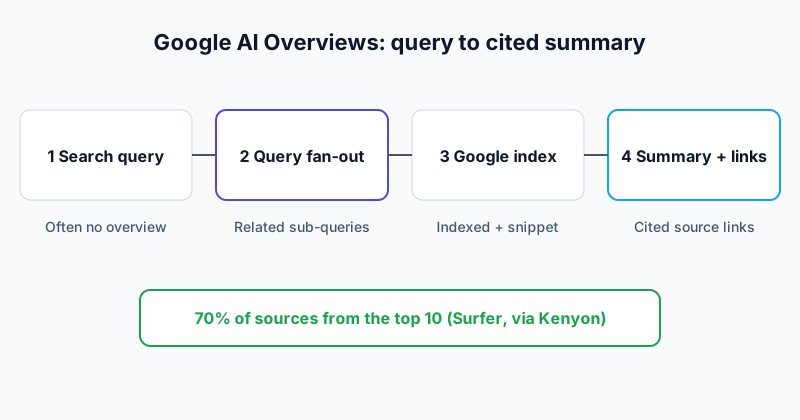
According to Google's AI features and your website page, AI Overviews may use "query fan-out": multiple related searches across subtopics and data sources. While the response is generated, Google's models identify more supporting pages than a classic search would show.
The sequence, as far as public evidence allows:
- The query arrives. Google decides whether an overview adds value. It says overviews "often don't trigger".
- Fan-out. Related searches run. Domeur reports 10.7 sub-queries on average, citing a third-party article that this guide could not verify.
- Retrieval. Pages come from the normal index and ranking systems. Domeur's summary: traditional Google algorithms, with an AI model summarising the relevant parts.
- Generation. A Gemini-family model writes the summary, per the Surfer-based video and the French articles. Domeur names Gemini 3, which is unconfirmed.
- Display. Links appear beside the text. They can differ from AI Mode, since Google says the two may use different models and techniques.
There is no separate "AI index" to submit to, so a page that Google cannot index or show with a snippet cannot be a supporting link.
How sources get picked: what the data says
The most useful numbers come from a video by Matt Kenyon (Kenyon Digital) on research by the SEO tool vendor Surfer. These are Surfer's figures as Kenyon describes them, not independently re-measured.
| Finding (Surfer, via Kenyon) | Figure |
|---|---|
| Average sources per AI Overview | About 8 |
| Responses with 7 or fewer sources | About half |
| Responses with more than 25 sources | 2.7% |
| Sources taken from Google's top 10 organic results | 70% |
| Share of sources that are "core" (repeat across similar queries) | About 9-12% |
If 70% of sources come from the top 10, then 30% do not. That is the opening for a page that ranks lower for the exact query but matches a fan-out sub-query. Domeur claims some cited sources are not even in the top 100 for the original search. That is unverified, yet it fits the mechanism Google describes.
Kenyon lists four traits of core sources:
- Consistent top-10 rankings across several related keywords.
- Titles, URLs and content tightly focused on specific topics.
- Comprehensive coverage of the questions around a topic.
- Fresh, maintained content with visible expertise.
None of this is exotic. The evidence suggests AI Overviews mostly reward pages that already rank and already cover a topic completely. Kenyon also warns that chasing one specific fan-out term is a poor bet because AI sources are volatile; covering the topic from every angle is the sturdier approach.
What Google officially requires
Google's documentation is direct: "there are no additional requirements to appear in AI Overviews or AI Mode, nor other special optimizations necessary." A supporting link must be indexed and eligible to be shown in Search with a snippet.
| Topic | What Google says |
|---|---|
| Technical requirements | None beyond normal Search requirements |
| Special markup or schema | No special schema.org markup; structured data must match visible text |
| New files (for example AI text files) | You do not need to create them |
| Crawling | Allow crawling in robots.txt and any CDN or hosting layer |
| Content format | Important content in text; images and videos can support it |
| Guarantees | Meeting every requirement does not guarantee crawling, indexing or serving |
A newer page, Optimizing your website for generative AI features on Google Search (last updated 10 July 2026), adds a myth-busting list. Google says you can ignore llms.txt files, which Google Search "ignores", that you need not "chunk" content, and that you need not rewrite pages just for AI. It calls inauthentic mentions "not as helpful as it might seem", and says making separate pages for fan-out queries to manipulate responses violates its scaled content abuse policy. It also states that a site must be included in Search generative AI features in Search Console to be eligible for display.
Google's May 2025 Search Central blog post adds that clicks from results with AI Overviews are higher quality. That is Google's claim, and Google has an interest in making it.
Some vendor advice goes beyond Google. Webconversion calls Schema Markup "essential" and recommends 40-50 word answers under each heading. Google requires neither; treat them as style choices, not rules.
Analysis of the reviewed walkthroughs
Four video transcripts were reviewed for this guide. Two are from Julian Goldie's channel (a digital avatar presenting for Goldie Agency), one is Kenyon's Surfer-based explainer, and one is a software founder reading through Google's generative AI guide. All come from firms selling SEO services or software, so they read as anecdotes, not experiments.
In the Goldie videos:
- Searching "best geo expert" produced an AI answer that named the presenter first and used several of his pages as sources.
- A page for "best AI SEO community" was reported to rank within three days.
- One site was said to grow from nothing to a large daily audience from AI answers. Presenters' visit and impression figures are self-reported and differ between the two videos, so none is repeated here.
- The explanation offered: the system reads pages that rank, then repeats the name most of them share.
Kenyon adds a distinction that is more useful. A runner searching for flat-foot tips may see a brand's article as a source and never click. Searching "best running shoe for flat feet" may show the brand's shoe named in the summary. His point: a mention inside the answer can be worth more than a small citation link. He also notes that the pages ranking for that product query were roundup lists, not the brand's site, and that informational, non-branded queries are where clicks are lost.
The fourth presenter says Google's guide confirms that classic SEO still applies and that "AEO" and "GEO" are SEO under other names. He argues AI-written content still works in some low-competition niches, which is opinion without data.
None of the transcripts shows a controlled test with a baseline, a sample size and a repeatable method.
Measurement and controls
On 3 June 2026 Google announced a Search Generative AI performance report in Search Console, and a note on the post says it reached all websites worldwide as of 31 August 2026. Per the Search Console Help page, it covers AI Overviews and AI Mode together, with impressions by page, country, device and date. The documentation describes impressions only, so analytics is still needed for conversions, and overviews cannot be split from AI Mode.
Traffic loss is harder to pin down. Webconversion says publishers report organic drops "up to 40%" on affected queries, naming no study. Digitaleo warns of lost visits and a weaker local pack for local businesses, with no figure. Google stresses higher-quality clicks instead. Fewer clicks and better clicks can both be true.
For control, Google frames AI as "built into Search". Robots.txt for Googlebot is the crawl control, and display is governed by snippet and indexing directives:
<!-- Limit how much of this page can be shown, including in AI features -->
<meta name="robots" content="max-snippet:50">

<!-- Hide one block from snippets -->
<p>Public text. <span data-nosnippet>Text that should not be quoted.</span></p>
Google states that more restrictive permissions limit how content is featured in AI experiences. noindex removes the page from Search entirely, so it is rarely what a publisher wants. Google-Extended is not the AI Overviews switch; where that token does apply is explained in the Google Gemini guide. If a preview control seems ignored, test with URL Inspection and wait for a recrawl, which can take days to months.
Where this leaves you
Treat AI Overviews as an extra surface on top of ranking, not a separate programme. The work that moves the needle is classic SEO done thoroughly, plus pages that answer the follow-up questions a fan-out would generate. The step-by-step plan is in how to rank in Google AI Overviews. The methodology page explains how sources are handled here.
For the action list, read how to rank in Google AI Overviews.
Frequently asked questions
Do I need special markup to appear in Google AI Overviews?
No, according to Google. It says no special schema.org markup or machine-readable file is required. Structured data is still worth adding where it fits, but it must match the visible text.
Can I turn AI Overviews off?
Searchers cannot, according to Hugo Domeur, who lists workarounds such as adding "-ai" to the query or "&udm=14" to the URL; these may change. For site owners, Google's Search Console help mentions a setting that includes or excludes a site from generative AI features, though its steps were not checked for this guide.
Do I have to rank in the top 10?
Not strictly. Surfer's data, as Kenyon describes it, says 70% of sources come from the top 10, which leaves a minority from lower positions. Ranking well raises your odds without guaranteeing anything.
Is being cited better than being mentioned?
Kenyon argues a brand mention inside the answer can be worth more than a source link, particularly on commercial queries. It is his opinion, backed by an example and no dataset. Ideally you earn both.
How do I see AI Overview traffic?
Use the generative AI performance report in Search Console, announced on 3 June 2026. It reports impressions for AI Overviews and AI Mode combined, not clicks.
Does Google-Extended block AI Overviews?
No. Google does not present Google-Extended as the Search control; Googlebot access and snippet controls are the levers here, and the Gemini guide covers the token itself.
Limits of this guide
Verified against pages that were opened: Google's AI features page, the 2026 generative AI guide, the 2025 Search Central blog post, the 3 June 2026 announcement and the Search Console Help page. Reported only: Surfer's source statistics (taken from Kenyon's video, not the original study), the French launch date, the 40% traffic-drop claim, the 10.7 sub-query average and the Gemini 3 model name, all from secondary articles named in the body. Missing: no official page explains the Search Console include/exclude setting, so no steps are given. This guide did not run a controlled test of AI Overviews. The four video transcripts are distinct files; their figures are self-reported and differ between videos, so none is quoted.
Sources
- AI features and your website, Google Search Central (last updated 10 December 2025)
- Top ways to ensure your content performs well in Google's AI experiences on Search, Google Search Central Blog (21 May 2025)
- Optimizing your website for generative AI features on Google Search, Google Search Central (last updated 10 July 2026)
- Introducing Search Generative AI performance reports in Search Console, Google Search Central Blog (3 June 2026)
- Generative AI performance report (Search), Search Console Help, Google
- Video walkthrough transcript, Surfer AI Overviews research explained, Matt Kenyon (Kenyon Digital), third-party creator, reviewed 2026 (original URL not located)
- Video walkthrough transcript, "How I get my websites ranked number one in Google AI overviews", Julian Goldie avatar (Goldie Agency), third-party creator, reviewed 2026 (original URL not located)
- Video walkthrough transcript, "geo examples how I rank number one inside a search engines", Julian Goldie avatar (Goldie Agency), third-party creator, reviewed 2026 (original URL not located)
- Video walkthrough transcript, software founder reading Google's official AI SEO guide, third-party creator, reviewed 2026 (original URL not located)
- Google AI overview : comment ça marche et s'y rendre visible ?, Webconversion (published 22 July 2026, modified 15 October 2026)
- Google AI Overview : Présentation et comment y apparaître, Hugo Domeur (10 August 2026)
- Google AI Overview : quel impact sur votre SEO local ?, Digitaleo blog (date not shown)