Microsoft Copilot search is a Bing-grounded answer engine: it turns a question into its own retrieval queries, pulls passages from the Bing index, and writes an answer with citations. If your pages are not in Bing's index, the rest of this article does not matter, so start there.
What Microsoft Copilot search actually is
"Copilot" is a family name. The consumer web assistant, the Bing AI summaries on the results page, Microsoft 365 Copilot and GitHub Copilot are different products. This guide covers the web-grounded one, the experience that answers open-web questions with linked sources. A CapstonAI vendor page says Bing Chat was renamed Copilot in late 2023; that was not confirmed on a Microsoft page, so read it as reported.
What matters for publishers is the source of the evidence. Microsoft has said publicly that its grounding layer is what links models to current information. In February 2026, Jordi Ribas, Corporate Vice President of Search & AI, wrote that Microsoft grounding "powers nearly every major AI assistant in the market" (Bing Search Blog, Feb 12, 2026). That is a company claim, not an audit, but it explains why Bing-side work can pay off outside Copilot too. If you also care about the other Bing-linked engine, see ChatGPT Search.
How the pipeline works
Microsoft does not publish a full architecture diagram, so what follows combines Microsoft's statements with careful inference. Each step notes which is which.
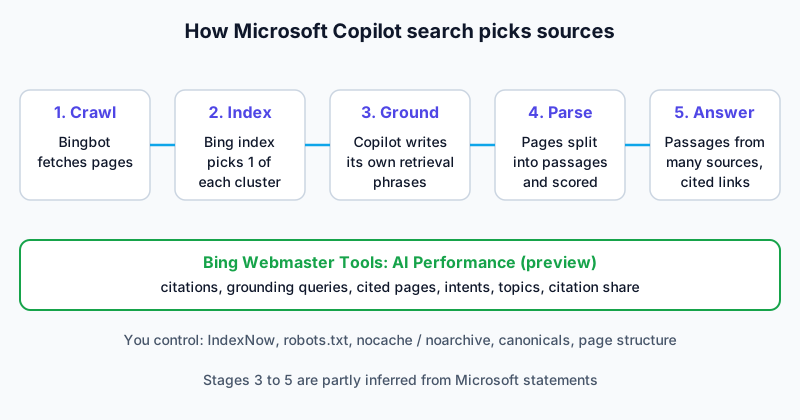
- Crawl. Bingbot fetches your pages. A CapstonAI guide states there is no separate Copilot crawler for web content. The Microsoft Bing documentation reviewed does not contradict this, but no Microsoft sentence confirming it was found either.
- Index. Pages enter the Bing index. Microsoft's duplicate-content article groups near-identical URLs and says the system picks one to represent the cluster.
- Grounding queries. For each user prompt, Copilot generates retrieval phrases. The Bing Webmaster Tools help page describes grounding queries as grouped phrases, not individual user questions.
- Parsing. According to Microsoft Advertising (October 8, 2025), assistants break content into smaller pieces and evaluate those pieces for authority and relevance.
- Assembly. Pieces from several sources are combined into one answer, with citations.
The reviewed walkthrough transcript calls the same flow "read, extract, assemble", which matches what Microsoft documents.
Where the evidence comes from: Bing, not Google
A page that ranks first on Google can be invisible to Copilot if Bing has not indexed it or has chosen a duplicate. Verify the site in Bing Webmaster Tools, submit the sitemap, and check index coverage before you touch content.
Two Bing-specific habits are worth building. First, IndexNow: you notify participating engines when URLs are added, updated or deleted. The Bing Webmaster Blog's AI Performance announcement (February 10, 2026) says IndexNow "helps keep information fresh across search and AI experiences". Second, canonical hygiene (see the December 2025 duplicate-content article in Sources). Microsoft states that duplicate pages "do not harm a site by themselves" but blur the signals used to pick a version.
The full tactical sequence is in how to rank in Microsoft Copilot. Here we stay on how the engine behaves.
Analysis of the reviewed walkthroughs
One video walkthrough transcript was reviewed for this guide. It comes from Beacon Sites, an Irish agency. It claims that a page published for the query "Irish AI visibility audit" was named the number one provider by Bing Copilot 16 hours after publication. The video also says initial AI visibility usually takes 30 to 90 days.
How much weight should that carry? Little. It is one query, self-reported, from a company that ends the video by selling that exact audit. The useful part is what the video says about the page itself: short paragraphs of 30 to 60 words, clear headings, schema markup, and visible expertise signals. Those line up with Microsoft's published advice, even if the speed claim cannot be generalised. The video also says Bing weights exact-match signals in titles, freshness and meta descriptions. No Microsoft source ranks those signals, so planning around that ordering is not supported.
What Microsoft says gets content selected
Microsoft Advertising's October 2025 post is the most direct first-party guidance. The author, Krishna Madhavan, calls out the following, and also says there is "no secret strategy".
| Element | Microsoft's advice | Practical reading |
|---|---|---|
| Title, description, H1 | Signals for purpose and scope; keep them aligned | One topic per page, same promise in all three |
| H2 and H3 | Act like chapter titles that define content slices | Write headings as questions or clear statements |
| Q&A blocks | Can often be lifted almost word for word | Put the answer in the first one or two sentences |
| Lists and tables | Break details into reusable segments | Use them for steps and comparisons, not every line |
| Schema (JSON-LD) | Turns plain text into data machines can interpret | Mark up what is truly on the page |
| Hidden content | Tabs and expandable menus may not be rendered | Keep key answers in visible HTML |
| PDFs and images | Weaker structure; image text adds complexity | Put core facts in HTML with alt text |
The same post warns against overloaded sentences and decorative symbols. The practical message is that the sentence, not the page, is what gets chosen.
Measuring citations in Bing Webmaster Tools
This is the part that sets Copilot apart from most engines: a first-party report exists. AI Performance was announced in public preview on February 10, 2026 and covers Microsoft Copilot, AI-generated summaries in Bing, and select partner integrations.
| Metric | What it shows | Caveat from Microsoft |
|---|---|---|
| Total citations | Times your content was shown as a source | Does not indicate placement in an answer |
| Average cited pages | Unique cited pages per day, averaged | Not a ranking or authority score |
| Grounding queries | Phrases the AI used to retrieve cited content | A sample of citation activity |
| Page-level activity | Citation counts per URL | Not page importance |
| Trend timeline | Changes across 7 days, 30 days, 3 months or custom | Cannot be tied to one cause |
In March 2026 Microsoft linked grounding queries to pages, so you can click a query and see which URLs were cited for it. Search Engine Journal noted at the time that the data is a sample and that there is still no click-through data. On June 16, 2026 Microsoft added Intents (such as Informational, Commercial, Local), Topics, Citation Share and Compare, all in preview. Citation Share is the percentage of citations for a grounding query that go to your site, and Microsoft says it does not expose competitor domains.
The honest limit: this report tells you that you were cited, not why. Per the Bing help page, it shows grouped grounding phrases rather than exact user prompts, and gives no reason a page was referenced.
Controlling how Copilot uses your content
You do not need to do anything to be eligible. Microsoft's September 2023 post says content without nocache or noarchive may be included in Bing Chat answers. The two values change that:
nocache: the page may appear in answers, with only URL, title and snippet shown.noarchive: the page is not included or linked in Bing Chat answers, and is not used to train Microsoft's generative AI foundation models.- Both present: Bing treats the page as
nocache.
These pages still appear in ordinary Bing results, according to the same post. A minimal example:
<meta name="robots" content="noarchive">
<meta name="bingbot" content="nocache">
Bing's current help page adds that the same values can be sent as an X-Robots-Tag header and that name="bingbot" limits a tag to Bing. Blocking Bingbot in robots.txt is a blunter tool: it removes you from the evidence base entirely.
How Copilot differs from its neighbours
| Engine | Main evidence source | First-party citation report |
|---|---|---|
| Microsoft Copilot | Bing index and grounding | Yes, AI Performance in Bing Webmaster Tools |
| ChatGPT Search | Reported to rely partly on Bing, not confirmed here | No equivalent verified |
| Google AI surfaces | Google index | See the Google AI Overviews guide |
| Brave Search AI | Brave's own index | Not verified |
The ChatGPT row is deliberate hedging; our ChatGPT Search guide covers what is and is not confirmed. For an independent-index comparison, see Brave Search AI. For the Google side of reporting, see the Google AI Overviews guide.
Claims to treat with caution
A CapstonAI page (May 2026) reports 89 million weekly active Copilot users in March 2026, a +234% citation rate for its own customer cohort, and IndexNow URLs being cited "4-7x faster". None of these could be traced to a primary document. The user figure is attributed by CapstonAI to Microsoft earnings, which were not checked. The cohort numbers come from a vendor that sells tracking software. Quote them as "reported by CapstonAI", never as fact.
Recommended order of work
The recommended order, based on the sources above: confirm Bing indexing, turn on IndexNow, fix duplicates, restructure your ten most important pages into self-contained answers, then read the AI Performance report weekly. The step-by-step version, with a robots snippet and a page template, is in how to rank in Microsoft Copilot. Our testing approach is described on the methodology page.
Frequently asked questions
Does Microsoft Copilot search use Google?
No evidence found says so. Microsoft's own material describes grounding on the Bing index, and the duplicate-content article states that many LLMs rely on data grounded in the Bing index or other search indexes. Plan around Bing.
Is there a separate Copilot crawler?
A vendor guide says Bingbot is the only crawler for web content. No Microsoft page reviewed contradicts this, but none states it plainly either. Check your server logs and Bing Webmaster Tools rather than assuming.
How do I see whether Copilot cites my site?
Use the AI Performance report in Bing Webmaster Tools. It shows total citations, cited pages, grounding queries and, since June 2026, intents, topics, citation share and compare views. All of it is in preview and sample based.
Can I opt out of Copilot answers without leaving Bing results?
Yes, per Microsoft's 2023 announcement. noarchive keeps a page out of Chat and Copilot answers while it still appears in search results. nocache limits the answer to URL, title and snippet.
Does schema markup guarantee a citation?
No. Microsoft says schema helps machines interpret content, and also says nothing guarantees selection. Use it for accuracy, not as a lever.
How long until a new page gets cited?
Unknown. The Beacon Sites video claims 16 hours for one query and says 30 to 90 days is typical. Neither figure is independently verified, so measure your own pages.
Limits of this guide
- Verified (Microsoft sources): Bing-grounded retrieval, the AI Performance report and its metrics,
nocacheandnoarchivebehaviour, IndexNow, and the duplicate-content clustering described by Microsoft. - Reported: the Search Engine Journal account of grounding-query mapping (March 2026); Microsoft's claim that its grounding powers nearly every major assistant (a company statement, not an audit).
- Unverified: the CapstonAI figures (user count, +234% cohort lift, IndexNow "4-7x faster") and its claim that Copilot has no dedicated crawler; the Beacon Sites "16 hours" result and "30 to 90 days" range.
- Missing: this guide ran no controlled Copilot tests, and how ChatGPT or other engines use Bing was not verified. Microsoft's AI Performance features are labelled preview and may change.
Sources
- Introducing AI Performance in Bing Webmaster Tools Public Preview (Bing Webmaster Blog, Feb 10, 2026; also source of the IndexNow quote)
- AI Performance, Bing Webmaster Tools help
- New AI Visibility Insights in Bing Webmaster Tools (Bing Search Blog, Jun 16, 2026)
- Elevating the Role of Grounding on the AI Web (Bing Search Blog, Feb 12, 2026)
- Optimizing Your Content for Inclusion in AI Search Answers (Microsoft Advertising, Oct 8, 2025)
- Does Duplicate Content Hurt SEO and AI Search Visibility? (Bing Webmaster Blog, Dec 19, 2025)
- Announcing new options for webmasters to control usage of their content in Bing Chat (Sep 22, 2023)
- Robots meta tags and attributes that Bing supports
- Bing AI Dashboard Maps Grounding Queries To Cited Pages (Search Engine Journal, Mar 24, 2026)
- How to Rank in Microsoft Copilot 2026: Bing AI Search Guide (CapstonAI, vendor page, last updated May 2026)
- Video walkthrough transcript, "How did an Irish company get the number one spot on Bing's AI Copilot" (Beacon Sites, third-party agency, reviewed 2026; original video URL not found)