Kimi search is the web retrieval layer inside Moonshot AI's Kimi assistant, and it works differently from a classic search engine because the model itself decides when to search, what to fetch and which sources to trust.
What Kimi search actually is
Kimi is the consumer assistant built by Moonshot AI, the company behind the open-weight Kimi K2 model family. Its web search is described by the company as Agentic Search. The help centre says it is built on end-to-end agentic reinforcement learning, and that it lets the model "autonomously decide when to search, which tools to invoke, and how to adjust strategy" (Kimi Help Center).
That matters for publishers. In a classic engine, a query always triggers retrieval. Here, a toggle called Web search (Auto or Off) sits under the chat box. With Auto, the model judges whether a question needs fresh data. A question about a stable concept may be answered from training memory, and your page never gets a chance.
The same page dates the first generation, Explorer Search, to October 2024. Agentic Search is the newer layer, and it also covers financial data, academic literature and image search.
If you want the practical playbook rather than the anatomy, jump to how to rank in Kimi.
Three crawlers, three different jobs
Moonshot publishes a crawler policy page. It is clearer than many competitors' documentation (Kimi Crawlers).
| Crawler | Documented purpose | Effect of blocking |
|---|---|---|
| KimiBot | Crawls content potentially used to train Kimi's foundation models | Signals your content should not be used for training |
| Kimi-SearchBot | Analyses pages for relevance and builds the search index | Site will not appear in Kimi search results |
| Kimi-User | Handles user-initiated actions, such as summarising a given article | May reduce visibility in user-directed searches; robots.txt "may not directly apply" |
Two details deserve attention. First, the policy says each subdomain is treated as a separate origin, so blog.example.com needs its own robots.txt. Second, Moonshot recommends managing access through robots.txt rather than IP rules, because its addresses are dynamic and blocking them "may prevent us from reading your latest robots.txt".
A third-party check dated 18 May 2026 found the three published IP lists identical, with four IPv4 addresses in Alibaba Cloud space (Coaley Peak). That means an IP match tells you traffic is Kimi's, and the user-agent token tells you which job it is doing. Moonshot's own page says only that a crawler inside its ranges "is coming from Kimi".
One conflict is worth flagging. Moonshot says KimiBot follows standard robots.txt directives, while a bot directory summarised by Promptwatch reports that Cloudflare's listing marks it as not following them (Promptwatch). Neither side can be confirmed from outside. Check your logs after publishing a rule.
The pipeline from page to answer
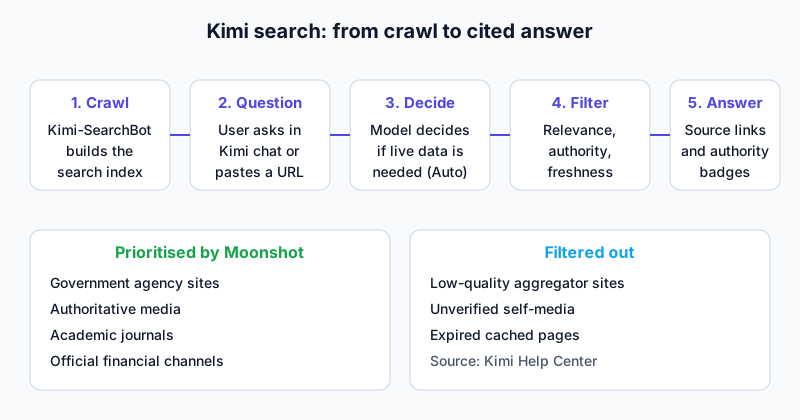
The documented path has five steps. Kimi-SearchBot crawls and builds the index. A user asks a question. The model decides whether to search. Retrieved sources are filtered on relevance, authority and freshness. The answer is written with reference links.
What the documentation does not say is how many results are retrieved per query, how the index is ranked, or whether the index is the only source. A Moonshot staff reply on the developer forum, dated 21 August 2026, says the web search service behind the API is "the same search that powers Kimi Chat" (Kimi Forum). That is useful, because the API is documented in more detail than the app.
How Kimi filters sources
The help centre lists the screening rules directly.
- Filtered out: low-quality aggregator sites, unverified self-media, expired cached pages.
- Prioritised: government agency websites, authoritative media, academic journals, official financial reporting channels.
- Dimensions: relevance, authority and freshness.
- Scale of coverage: "100+ verified, trustworthy sources" across news, government, finance and academic databases.
Sources that pass receive authority badges in the response, such as official website, academic or media certification icons (Kimi Help Center).
A small independent publisher is not excluded by these rules, but it is competing against sources Kimi explicitly favours. That is an editorial reading, not a Moonshot statement. For a niche query where no government or academic page exists, a clear, well-attributed specialist page is a plausible candidate. For a medical or financial query, expect the favoured categories to dominate.
The API gives a hint of what sits underneath. The Search API returns, for each result, a title, snippet, site name, URL, date and an authority field described only as the "authority level of the source" (Kimi API Platform). The scale is not documented. The API docs also name current models (kimi-k3.1-pro and kimi-k2.6) and say the legacy $web_search built-in tool retires on 20 October 2026, a date that has now passed (Kimi API Platform). Product names and endpoints therefore change quickly.
Search modes compared
| Mode | Where | Depth | Documented behaviour |
|---|---|---|---|
| Web search (Auto) | Kimi chat | Short, model decides | Source links on all search-based answers |
| Direct URL access | Kimi chat | One page | Fetches a pasted URL; initial HTML only on dynamic pages |
| Deep Research | Kimi-Researcher | Long, asynchronous | Citations embedded in the report body |
| Search API | Developers | Programmatic | Basic and Pro endpoints, optional full-page text |
Deep Research: a different audience
Deep Research is powered by Kimi-Researcher, trained with end-to-end agentic reinforcement learning. Moonshot gives averages per task: 23 reasoning steps, 74 planned keywords, 206 URLs found, and the top 3.2% of content kept after removing redundant and low-quality material. Reports exceed 10,000 Chinese characters on average and cite about 26 sources, each clickable with the original text highlighted (Kimi Help Center).
Read those numbers as vendor averages, not guarantees. They still tell you something. Deep Research casts a wide net and discards most of it. Being one of 206 candidates is easy. Being in the 3.2% requires information quality that survives comparison with the other 205.
The model underneath is also built for long browsing chains. Moonshot reports that Kimi K2 Thinking scored 60.2% on the BrowseComp benchmark against a human baseline of 29.2%, and can run 200 to 300 sequential tool calls (Kimi K2 Thinking). A model that persistent will often follow a second link from your page, so internal linking carries more weight than it does for single-shot engines.
What Kimi can and cannot read
Kimi supports direct URL access: paste a link and it fetches and analyses the page. The help page adds three cautions: prefer publicly accessible links, some password-protected or crawl-restricted pages may fail, and "for dynamically loaded pages, Kimi may only retrieve the initial HTML content" (Kimi Help Center).
If your prices, specs or key claims appear only after JavaScript runs, assume Kimi may not see them. The statement concerns the URL-fetch feature specifically. Whether Kimi-SearchBot renders JavaScript when indexing is not documented, so the safe course is server-rendered content for everything you want cited.
A minimal robots.txt that keeps search access while declining training looks like this, based on the directive format on Moonshot's policy page:
User-agent: KimiBot
Disallow: /

User-agent: Kimi-SearchBot
Allow: /
Crawl-delay: 1
Whether declining training is wise is a business call. It does not change search visibility according to the documentation, and it is separate from the search-access decision. How claims in this guide were weighed is explained in the methodology.
Language and region
Kimi can "proactively search non-English sources (e.g., Japanese technical documentation, French news)" and synthesise them, per the help centre. The product has a Chinese-language origin, and Moonshot runs a separate China service. A third-party analysis notes that the China service is filed with the Cyberspace Administration of China, while the same filing is not documented for the international kimi.ai site (Coaley Peak).
For publishers, the practical reading is cautious: multilingual pages are not penalised in principle, but no evidence was found on how Kimi balances Chinese-language and English-language sources for the same query. Treat that as unknown.
How Kimi sits among its neighbours
Kimi belongs to the group of Chinese open-model assistants with their own search behaviour, alongside DeepSeek search and Qwen search. The difference worth noting is documentation: Moonshot separates training, search and user-triggered crawling into distinct tokens with distinct consequences. If your priority is simply the largest Western audience, ChatGPT Search is the more common first target, and many of the same page-quality habits transfer.
Where to go next
The anatomy above converts into a short list of actions: allow Kimi-SearchBot, serve facts in initial HTML, cite primary sources, and write pages that survive a skim by a model looking for an answer. The step-by-step version is in how to rank in Kimi.
Frequently asked questions
Is Kimi search a separate search engine?
Moonshot documents its own crawler, Kimi-SearchBot, which it says builds the search index. It does not state whether other providers also feed results. Treat the index as Kimi's own, with the caveat that the full retrieval stack is not public.
Does blocking KimiBot remove my site from Kimi answers?
According to Moonshot, no. KimiBot concerns possible training use. Kimi-SearchBot controls inclusion in search results. Blocking one does not automatically block the others, so write a separate rule for each token.
Will Kimi always cite my page if it uses it?
Moonshot says all search-based answers include reference source links. It does not say every consulted page is shown, and no independent measurement of citation completeness was found.
Can I tell Kimi visits apart in my logs?
Yes, by user-agent token (KimiBot, Kimi-SearchBot, Kimi-User) and by the published IP lists. Moonshot warns the ranges are dynamic, so use them to verify traffic rather than to block it.
Does Kimi read JavaScript-rendered pages?
For URL fetches, the help page says dynamic pages may yield only the initial HTML. Indexing behaviour is not documented. Server-rendered content avoids the question.
Is there a way to pay for placement?
Kimi's documentation describes no advertising or sponsored-source programme. The API offers paid search calls to developers, which is a different thing.
Limits of this guide
- Verified (Moonshot pages read 29 October 2026): the three crawlers, the filtering rules, source links on search answers, the Deep Research averages and the URL-fetch limits.
- Reported, not confirmed: the Cloudflare robots.txt conflict (second-hand via Promptwatch), the identical IP lists and CAC filing note (Coaley Peak), and Moonshot's own benchmark and Deep Research averages.
- Missing: no video walkthrough of Kimi was available (the transcript folder for Kimi is empty), and Moonshot does not publish ranking weights, index size, the authority scale or citation statistics. No independent citation study was found. Editorial-judgment statements are labelled as such.
Sources
- Agentic Search for Guides and Answers, Kimi Help Center
- Kimi Crawlers, Moonshot AI
- What Is Kimi Deep Research?, Kimi Help Center
- Kimi K2 Thinking, Moonshot AI
- Web Search Basic, Kimi API Platform
- Use Web Search with the $web_search Built-in Tool, Kimi API Platform
- Kimi Forum: web-search recommendation thread
- Kimi: how Moonshot AI's assistant builds its own index, Coaley Peak (third-party analysis; IP-list check dated 18 May 2026)
- KimiBot, Promptwatch bot directory (third-party directory)