To rank in Grok you have to be findable in two places at once, the open web and X, because xAI's assistant searches both before it writes an answer. There is no ranking list to climb and no console to submit to. What you can control is whether your pages are easy to read, easy to quote and current, and whether real people mention you in public on X. This guide gives an order of work, with the reasoning and the evidence behind each step, and it is honest about where that evidence stops.

Start with how Grok finds sources
Grok searches the web and X through two documented tools; the mechanics, DeepSearch and the citation rules are covered in the overview, Grok search explained. Two consequences drive the plan below.
- Retrieval is not citation. A page can be read and still left out of the named sources, so the work aims at being both retrieved and quotable.
- The model searches again each time. A page published yesterday can be eligible today, which makes freshness practical.
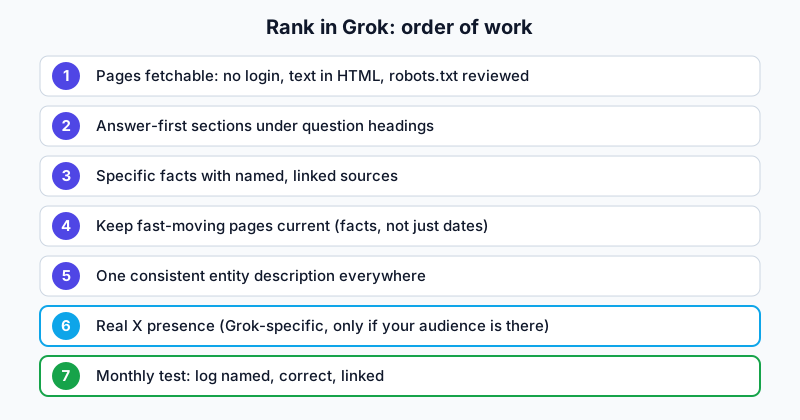
The priority order at a glance
| Priority | Action | Effort | Applies to other engines? |
|---|---|---|---|
| 1 | Check that nothing blocks fetching your pages | Low | Yes |
| 2 | Rewrite key sections answer-first | Medium | Yes |
| 3 | Add specific, sourced facts | Medium | Yes |
| 4 | Keep dates and facts current | Low, recurring | Yes |
| 5 | Make your entity consistent everywhere | Medium | Yes |
| 6 | Build a real presence on X | High, ongoing | Mostly Grok |
| 7 | Test monthly and log results | Low, recurring | Yes |
Access comes first because everything else is wasted if the page cannot be fetched. X comes sixth because it only pays when your audience is there.
Step 1: Make sure Grok can fetch your pages
Open your site as an ordinary visitor and check three things: pages load without a login, the main text is in the HTML (not injected late by scripts), and nothing in your server rules returns errors to unknown crawlers.
Then read your robots.txt. What is known about xAI's crawler is thin. The Tow Center reported in March 2025 that the crawlers of Grok 2 and Grok 3 were "not publicly known". A third-party tracker, crawlreadiness.com, lists the token GrokBot as community-listed and states that xAI publishes no crawler documentation, user agent or IP ranges. Its own count, as of 12 October 2026, was 53 of 569 top-1,000 sites with a robots file blocking it. None of this is confirmed by xAI, and whether any given crawler honours robots.txt is undocumented.
So treat this as a precaution, not a guarantee:
# Allow the community-listed xAI token (unverified, may not match what xAI uses)
User-agent: GrokBot
Allow: /

# Keep your existing rules for everything else
User-agent: *
Disallow: /admin/
If you previously blocked AI crawlers in bulk, review that list. A blanket rule can quietly remove you from answers. Whether that is right for your business is your call; training and answer use are different decisions, and publishers have real reasons to restrict training.
Also note what robots.txt cannot do. Grok can read X posts about your page without touching your server. Blocking a crawler does not remove public discussion of you.
Step 2: Rewrite key sections answer-first
AI engines quote passages, not pages. The most reliable structural habit is to open each section with the direct answer in one or two sentences, then support it. Question-style headings help, since each section can be extracted on its own.
The agency Customer Impact, writing about Grok for B2B brands, recommends exactly this: short complete answer first, question headings, fresh facts, one consistently described entity. That is an agency's opinion, not a measurement, but it matches common sense about extraction.
Here is a before and after for a hypothetical accounting-software page.
Before
Welcome to our pricing page. We have been building tools for small firms for many years and believe that every business deserves clarity. Our plans are designed with flexibility in mind, and there are several options to look through below.
After
How much does Ledgerline cost for a five-person firm?
Ledgerline costs 29 EUR per user per month on the annual plan, so a five-person firm pays 145 EUR a month. The monthly plan is 35 EUR per user. Prices exclude VAT and were last checked on 29 October 2026.
The "after" version states a price, a unit, a date and a boundary. Ledgerline is invented for illustration. Use your own verified numbers, and never copy a figure you cannot back up.
Use a repeatable section pattern
- Heading phrased as the user's question.
- First sentence: the answer, with the key term.
- Second to fourth sentences: the condition, the number, the exception.
- A visible date for anything time-sensitive.
- One link to a source or deeper page.
Keep paragraphs short. Use a table when you compare three or more things across the same attributes, because a table is easy for a model to lift cleanly.
Step 3: Add specific, sourced facts, but do not over-read the studies
You will see the claim that statistics and quotations boost AI visibility. The source is real: the GEO paper by Aggarwal et al. (arXiv 2311.09735, 2024) reports visibility improvements of up to 40% in the paper's benchmark, and says efficacy varies across domains. The SEO Handbook adds that a later test, C-SEO Bench (arXiv 2506.11097), found the same edits did not move where a source was cited on a simulated engine, and that adding statistics often lowered it.
The two studies measure different things on different setups, and neither was run on Grok. The recommended approach is to add specifics because they make the page more useful to a human reader and easier to verify, not because a lift is guaranteed. Write for accuracy first and treat any citation lift as a bonus.
Practical rules:
- Cite your source inline by name, and link to it.
- Prefer a number you can defend over a round, vague one.
- State the date of the data.
- Do not invent studies or attribute quotes you cannot trace. If a model reads a fabricated claim on your page, you carry the cost.
Step 4: Keep pages current
Freshness is the Grok-specific lever on the web side, with a caveat. The SEO Handbook says recency plausibly counts for more in Grok than elsewhere, and states plainly that xAI publishes no ranking specification, so this is inference. The reasoning is simple. A system with a live query tool into a real-time platform is marketed on current awareness, and a stale page on a fast-moving topic is a weaker candidate.
A low-effort routine:
- List your pages on fast-moving topics (launches, pricing, regulations, comparisons).
- Review each on a schedule that matches how quickly the topic changes.
- Update facts, not just the date. A changed date with unchanged content is a trust problem.
- Show an honest "last updated" line.
For evergreen pages, a yearly review is plenty.
Step 5: Make your entity consistent
If Grok reads three different descriptions of your company, it may merge them wrongly or skip you. Pick one short description of who you are and what you do, and reuse it on your site, your X profile, your LinkedIn page and any directory listing. Match the name, the spelling, the location and the main product term.
The SEO Handbook, citing a Peec AI analysis of 30 million US sources published in March 2026, reports that Reddit was the most-cited domain, followed by YouTube, LinkedIn, Wikipedia and Forbes. Two cautions from that same source: Grok was not among the platforms measured, and the findings are not Grok-specific. Still, genuine participation in the communities that discuss your field helps across engines. Participate honestly. Do not astroturf.
Step 6: Build a real X presence, if your audience is there
This is the only step that is mostly specific to Grok. Because the X tool can search posts by keyword or meaning, find users and read full threads, what is said publicly on X about your topic and your brand can enter an answer. xAI's documentation shows citations can point to X posts as well as pages.
What a useful presence looks like:
- A complete profile that uses the same entity description as your site.
- Substantive posts in the discussions that matter in your field, not promotion.
- Replies that add facts, with a link when it genuinely helps.
- Public mentions from customers and partners who have real reasons to name you.
Decide how much to invest
Customer Impact makes a sensible point: for many B2B firms X is not the biggest channel, so the weight should be proportional. The table below adapts that framing:
| Your situation | Weight on the web work | Weight on X |
|---|---|---|
| Buyers barely use X | High | Low: claim the profile, post occasionally |
| Buyers follow your field on X | High | Medium: join real discussions |
| Your sector debates live on X | High | High: be part of those threads |
| You publish breaking or topical content | High | High: post when news breaks |
Before you spend hours, search your own field on X. If your buyers are not in those threads, put the hours into the web pages instead.
Analysis of the reviewed walkthroughs
In the one video walkthrough reviewed for this guide (a third-party creator's transcript), the presenter describes Grok as having become a real search engine that answers with sources, and shows a trend-hunting method. The logic: Grok is connected to X, so it sees topics as they surface, while Google Trends and keyword tools are slower. The example keyword was "Grok bot versus Hermes agent", described as only days old.
According to the presenter, content built around that keyword ranked on Google page one within 24 hours across several results (a Reddit post, the presenter's website and another owned site), and when the same query was put to Grok, those sites appeared among its sources.
How should you read this? With caution. It is one self-reported keyword. The transcript stops mid-example, so the announced four steps and the indexing trick are not available. A brand-new keyword has little competition, so speed says more about the keyword than about Grok. Still, the idea behind it is reasonable and testable: watch what is trending on X in your field, publish a clear, accurate page early, and check later whether it is retrieved. The methodology page explains how this kind of evidence is weighed.
Step 7: Test and log, monthly
No first-party analytics for Grok were found, so sampling is the method.
- Write ten questions a real prospect would ask, in your language and in English. Ask for a need ("which maintenance software suits a mid-sized factory?") rather than your brand name.
- Run each question in the regular mode and in DeepSearch, which behave differently.
- For each answer, record three things: named (does it mention you), correct (does it describe you accurately), linked (does it link to your page or a post about you).
- Repeat monthly, with the same questions, so you compare like with like.
- Act on the pattern over several weeks, not on a single answer. One answer is one sample.
A sample log that works in a spreadsheet:
| Date | Question | Mode | Named | Correct | Linked | Notes |
|---|---|---|---|---|---|---|
| 2026-10-29 | Best X for Y? | Regular | Yes | Yes | No | Cited a forum thread |
| 2026-10-29 | Best X for Y? | DeepSearch | Yes | Partly | Yes | Old pricing quoted |
| 2026-11-29 | Best X for Y? | Regular | Yes | Yes | Yes | Page now linked |
A correct description without a link still has value. A link next to a wrong description is a problem to fix first, usually by correcting the page that Grok read.
Analytics help a little. The SEO Handbook reports that Google Analytics 4 added an "AI Assistants" default channel group in May 2026 whose documentation names Grok, so referral clicks can be grouped where they occur. Expect small numbers and treat them as an early signal.
Check citations before you celebrate
A mention is not a win until the link works. The Tow Center test (details in the overview) found 154 of 200 Grok 3 citations led to error pages, and Grok 2 often linked to a publisher's homepage. The models were older, but the lesson is to click every link Grok gives for your brand.
If Grok cites a broken or wrong URL for you:
- Confirm your real URL resolves with a clean 200 and a stable address.
- Keep one canonical URL per page, and avoid moving pages without redirects.
- Make your canonical page the clearest statement of the fact.
- Do not rely on correcting the model. You cannot, so fix what you control.
Common mistakes
- Chasing a ranking number. There isn't one. Answers vary between runs.
- Posting on X only to please Grok. Posts that nobody engages with add little beyond noise.
- Fresh dates, stale facts. It reads as manipulation and hurts trust.
- Blocking everything, then wondering why you are absent. Decide deliberately.
- Copying statistics. If you cannot trace it, do not print it.
- Treating one engine as the whole picture. Compare with how to rank in Meta AI for the other social-platform assistant, or how to rank in Perplexity for an engine that leans harder on the open web.
A realistic four-week plan
| Week | Focus | Output |
|---|---|---|
| 1 | Access and baseline | robots.txt reviewed, ten-question log started |
| 2 | Top five pages | Answer-first rewrites, dated facts, sources named |
| 3 | Entity and X | One consistent description, profile completed, first useful posts |
| 4 | Retest | Second log, compare named, correct, linked |
Small, honest, repeatable. That is the whole method.
Frequently asked questions
Can I submit my site to Grok?
No submission tool or webmaster console was found. xAI documents that Grok searches and browses the live web and X, so your job is to be fetchable, clear and current.
Do I need to post on X to rank in Grok?
No. The web tool works on its own, and the shared fundamentals apply. A presence on X is a bonus that matters mainly for topical or X-heavy audiences, and the evidence for its effect is inference, not xAI documentation.
How fast can a new page appear in Grok?
In the one video walkthrough reviewed here, the presenter reports sources appearing within 24 hours for a trending keyword. That is one self-reported case, so do not plan around it.
Does adding statistics make Grok cite me?
Not reliably. The GEO paper reports visibility improvements of up to 40% in the paper's benchmark, while C-SEO Bench, as summarised by the SEO Handbook, found no such effect on a simulated engine. Neither was run on Grok.
Should I block xAI's crawler?
That is a business decision. xAI publishes no crawler documentation, so token names come from community lists and are unverified. Weigh your training concerns against your wish to be cited.
Which Grok model should I test against?
Use whatever the consumer app currently offers. Sources reviewed name Grok 4.6 (SEO Handbook, 12 August 2026) and grok-4.7 (xAI code samples, October 2026) within weeks of each other, so version names go stale fast. Record the date of each test.
Limits of this guide
- Verified against the source: xAI tool and citation documentation, the Tow Center figures, the GEO paper's "up to 40%" claim.
- Reported, not verified: the
GrokBottoken and blocking count (crawlreadiness.com), C-SEO Bench, the Peec AI analysis and the GA4 channel group (all as summarised by the SEO Handbook), and the agency advice (Customer Impact). - Missing: no controlled test on Grok was run for this guide. Hands-on evidence is one third-party video transcript that ends before its main steps, with self-reported results. xAI publishes no ranking specification, so recency and X weighting are inference. The API documentation describes developer tools, which the consumer app may not mirror. The Ledgerline example is invented for illustration.
Sources
- Web Search tool, xAI developer documentation
- X Search tool, xAI developer documentation
- Citations, xAI developer documentation
- Grok 3 Beta: The Age of Reasoning Agents, xAI, 19 February 2025
- AI Search Has a Citation Problem, Tow Center, Columbia Journalism Review, 6 March 2025
- GEO: Generative Engine Optimization, Aggarwal et al., arXiv 2311.09735
- GrokBot crawler entry, crawlreadiness.com
- C-SEO Bench: Does Conversational SEO Work? Puerto, Gubri, Green, Oh and Yun, arXiv 2506.11097
- Grok (xAI) Search Optimisation, The SEO Handbook, updated 2 September 2026
- How to Rank in Grok, Customer Impact, updated 20 October 2026
- Video walkthrough transcript on ranking in and with Grok 4.6, third-party creator, reviewed 2026 (1 transcript; original URL not available)
For the mechanics behind this plan, read Grok search explained.