YandexGPT search is the set of generative answers that Yandex shows on top of, or next to, its classic results, and it is built on the ordinary Yandex index rather than on a separate crawl of the web.

What "YandexGPT search" really covers
The phrase is used loosely, so a definition helps. YandexGPT is the language model family. Neuro and Alice AI are the products that put it in front of searchers. There is no single "YandexGPT crawler" and no separate index you can submit to.
Three surfaces matter to a publisher:
- Quick answers (быстрые ответы): short answers above or beside results. Yandex's help says some of them are generated with YandexGPT, which finds several best sources in real time, summarises each, and picks the most helpful result.
- Neuro: launched on 16 April 2024 as a chat-like product that combines Yandex search with the company's own LLM, YandexGPT 3 at launch, and cites its sources.
- Alice AI answers in Search: since 22 May 2025, Yandex says, technologies from its assistant Alice power structured answers, a reasoning mode and content generation inside Search.
Yandex's Webmaster blog described the 2025 change as Alice inheriting and extending Neuro. For your SEO plan, treat the three as one family that draws on the same ranked pool of pages.
How the answer is assembled
The English Webmaster page for Yandex AI describes three steps: scan the internet for relevant information, analyse those sources in real time with a generative neural network, and merge the findings into one answer with references. The Alice AI help page adds detail. The system analyses the query and may split it into sub-questions. It then queries Search with the refined questions and uses the results. Finally it writes the answer and divides it into semantic blocks.
Yandex's own example is a telegraphic hockey query that becomes two sub-questions, one about the name of the penalty and one about which violations earn it. A second example, why sea water is salty, produces a short one-or-two-sentence answer followed by paragraphs on where the salt comes from, how it accumulates and how it is distributed.
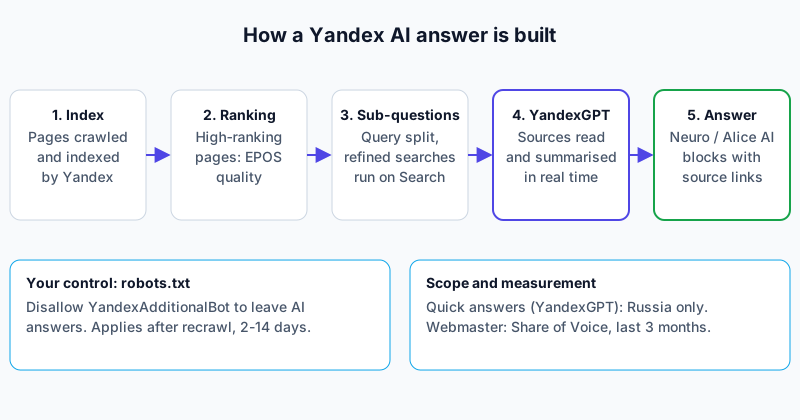
Two details deserve attention.
First, Neuro is described as pulling facts from live sources, not from the model's memory. The Yandex launch post says it relies on real-time search results rather than a fixed dataset. The exception is the math-solving mode, which the Neuro help page says describes steps from memory and shows no source links.
Second, Yandex says Alice AI does not reproduce page content word for word, except when it quotes direct speech. You are cited and summarised, not copied. That affects how you write: a clear, self-contained passage survives summarisation better than a clever one.
Which pages become sources
Yandex gives a short list of selection criteria on its Alice AI help page: expertise, usefulness, originality and substance. In Russian the four words form the acronym ЭПОС (EPOS). A separate Webmaster page expands each one.
| Aspect | What Yandex says | Practical reading |
|---|---|---|
| Expertise | Reputation, proven experience and author specialisation matter most where mistakes are costly, such as medicine, law and finance | Show real authors, credentials and company details |
| Usefulness | The page should help the user solve a task | Remove friction, keep it usable on every device |
| Originality | Unique wording alone is not enough; rewriting or AI-generating from existing content adds no value | Add your own data, experience and commentary |
| Substance | High density of meaning and full coverage of the task | Cut filler, answer the real decision criteria |
| Relevance | Fit to the user's actual task, not just formal match | An out-of-stock page loses to an in-stock one with delivery |
There is also the ranking link. The Alice AI help page says answers rely on sources that rank high in search. The 2024 Neuro announcement for webmasters said the same in other words: to appear more often among the sources, sites should rank high in Search and carry content that helps answer user questions. If you want the practical steps, they are laid out in how to rank in YandexGPT.
The bot, the opt-out, and where it applies
Yandex's help states that answers are generated from pages indexed by Yandex, and that your page is more likely to be used if the information is well structured, informative and grammatically correct. The control you have is the robots.txt directive. Yandex documents YandexAdditional and YandexAdditionalBot. The Yandex Cloud bot list describes YandexAdditionalBot as the bot that generates quick responses with YandexGPT, and its documented user agent string is Mozilla/5.0 (compatible; YandexAdditionalBot/1.0; +http://yandex.com/bots).
# Keep the whole site out of Yandex AI answers
User-agent: YandexAdditionalBot
Disallow: /

# Or only one section
User-agent: YandexAdditionalBot
Disallow: /internal-drafts/
The Webmaster blog warns that the older YandexAdditional directive removes the site both from Neuro and from quick answers under the search bar. Yandex says the change applies after the robots recrawl the page, typically within 2 to 14 days.
One technical trap: Yandex's robots.txt documentation says a robot looks for records containing Yandex or *, and if a User-agent: Yandex record exists, the * record is ignored. If you have a broad Yandex block, check that it does not swallow the intent of your AI-specific rules.
Region and language limits
This is the part most Western guides skip. Yandex's English help for quick answers says that answers generated with YandexGPT are produced only for the Russian region. At launch in April 2024, Neuro was available in Yandex Browser and the Yandex app to users who had Russia set as their location. In the comments on the blog post, a Yandex representative said it worked from any country if the app's region was set to Russia.
So the audience is mainly Russian-speaking users in Russia and neighbouring countries that use Yandex. If your readers are elsewhere, YandexGPT search will not move your numbers much. No conclusion about sanctions, availability abroad or business risk should be drawn from this article. That is outside what the documentation reviewed says.
Behaviour you should expect
Yandex describes Alice AI links in unusual terms, and they change how you should interpret "ranking":
- The links are not ranked. They are placed according to the logic of the answer.
- The number of links can exceed the default number of links on a classic results page.
- One answer can link to several pages of the same site.
- The same page can appear several times if it supports several paragraphs.
- An answer may have no links at all, for example an arithmetic solution.
- The answer to the same query can differ between days or even hours, and personalisation may affect it.
Yandex adds that errors are not fixed by hand; dislike feedback is used for training. Plan for volatility. A citation you saw yesterday is a snapshot, not a position.
Measuring visibility in Yandex Webmaster
Yandex gives site owners a first-party tool. The "Site visibility in Alice AI" report in Yandex Webmaster shows how often your site is among the sources in Alice AI answers.
| Report element | What it tells you |
|---|---|
| Mention-range notice | A band such as top-3, top-10 or top-20 by share of mentions, if you are cited often enough |
| Share of Voice (SoV) | Queries with a mention of your site divided by all queries where Alice AI answered, shown as a percentage |
| Query examples | Sample queries and the pages mentioned, with your site listed first where it appears |
| Competitor examples | Sites in your topic that are often cited in generative results |
The limits are just as informative. Data covers the last 3 months and refreshes weekly. Statistics are collected only for queries where the site already ranks fairly high. There are no clicks or impressions in the report, and Yandex says the tool cannot be used to manage inclusion. A "not enough data" message can mean few queries, low positions, little text for the algorithms to rely on, or rare Alice AI answers for your queries.
If SoV drops, Yandex suggests checking whether all pages are in Search, whether content is outdated, and whether better competitors appeared. That is a fair diagnostic order. You can only measure what the engine reports, so for broader checks read the methodology.
What the third-party commentary adds, and what stays unconfirmed
This guide also reviewed a June 2026 article from a mobile proxy vendor, MobileProxy.Space, about YandexGPT results. It claims that AI blocks are personalised by geography and device, that candidate extraction, re-ranking, context assembly, generation and verification form the pipeline, and that regional landing pages and FAQ blocks raise inclusion odds. The article is commercial: it promotes proxies and a promo code.
Its pipeline description is unconfirmed, because Yandex's documentation gives a shorter three-step description and says nothing about a verification stage. Personalisation is partly supported, since Yandex says personalisation may influence Alice AI answers. Regional page advice is plausible for local queries, but no Yandex statement reviewed names regional landing pages as a ranking input for AI answers.
How YandexGPT compares with neighbouring engines
Two contrasts matter. Yandex runs its own index and publishes webmaster documentation for the AI layer, including a visibility report, which few Western engines do. Compare that with Brave Search AI, which sits on a different independent index, or Perplexity AI search, which publishes crawler guidance but no equivalent share-of-voice report in the sources reviewed for this guide.
On the Western side, ChatGPT Search and Google AI Overviews tie answers to their own search stacks in a similar way. The shared lesson is the same everywhere: the answer layer sits on top of retrieval, so a page that is not retrievable cannot be cited. The Yandex-specific lessons are the Russian region limit, the EPOS wording and the YandexAdditionalBot rule. To act on them, follow the YandexGPT ranking guide.
Frequently asked questions
Is YandexGPT search a separate search engine?
No. Yandex describes AI answers as generated from pages indexed by Yandex, with a language model analysing and merging the sources. It is a layer on top of the normal Yandex search, not a second index.
What is the difference between Neuro and Alice AI answers?
Neuro launched in April 2024 as a combined search and LLM product. In May 2025 Yandex said Alice technologies were coming to Search and would inherit and extend Neuro. Both cite sources and both draw on search results.
Can I block my site from Yandex AI answers?
Yes. Yandex documents a robots.txt disallow for YandexAdditional or YandexAdditionalBot. It applies after a recrawl, typically 2 to 14 days. The older YandexAdditional rule also removes the site from quick answers.
Does being cited mean a click?
Not necessarily. Yandex says links appear in answers and can lead users to your site, but its Webmaster visibility report shows no clicks or impressions. Yandex also cites a Microsoft Clarity 2025 study saying AI-answer visitors convert three times more often than organic visitors on news and info sites.
Does it work outside Russia?
Yandex's English help says quick answers with YandexGPT are generated only for the Russian region. At the 2024 launch, a Yandex representative said Neuro worked from any country if the app's region was set to Russia.
Limits of this guide
- Verified: the generation steps, EPOS criteria, opt-out rule, region statements, link behaviour and the Webmaster visibility report, as stated on the Yandex pages listed below.
- Reported, not verified: the Microsoft Clarity 2025 conversion figure (quoted by Yandex, study not reviewed) and every claim from the MobileProxy.Space vendor article.
- Missing: Yandex publishes no ranking weights for AI citations. No hands-on video transcript exists for this engine, so there is no walkthrough analysis, and no Yandex queries were run for this guide. Russian help pages may be updated before the English ones, so dates should be checked. Nothing here is legal or sanctions advice.
Sources
- Search with Yandex AI, Yandex Webmaster help (English)
- Quick answer, Yandex Webmaster help (English)
- Yandex launches Neuro, Yandex company news, 16 April 2024
- Yandex launched Neuro: how it works, Yandex Webmaster blog (Russian), 16 April 2024
- Yandex Search learned to reason and generate content with Alice technologies, Yandex Webmaster blog (Russian), 22 May 2025
- How Alice AI answers are formed, Yandex Webmaster help (Russian)
- Which aspects influence ranking and inclusion in Alice AI answers (EPOS), Yandex Webmaster help (Russian)
- Site visibility in Alice AI, Yandex Webmaster help (Russian)
- Search with Neuro, Yandex Search help (Russian)
- How to check that a robot belongs to Yandex, Yandex Webmaster help
- The User-agent directive, Yandex Webmaster help
- Managing bot traffic, Yandex Cloud documentation
- YandexGPT in Search 2026: New AI Results, Ranking Factors, and How to Adapt Your SEO Now, MobileProxy.Space, 5 June 2026 (commercial; claims unconfirmed)