To rank in Kimi you first have to be reachable by its search crawler, then be readable in plain HTML, then look like the kind of source its filters are built to keep.

What it takes to rank in Kimi
There is no results page with ten blue links. When a user turns on Web search, Kimi's help centre says the model can "autonomously decide when to search" and so judges whether the question needs live data, then retrieves sources and writes an answer with reference links (Kimi Help Center). To rank in Kimi means one thing: your URL appears among those reference links, ideally early and with a badge.
Three consequences follow.
- If the model decides not to search, you have no chance, whatever you do. You cannot control that decision. You can only own the queries where searching is likely: recent facts, comparisons, prices, documents, anything with a date.
- Inclusion is a pipeline with gates: crawl access, index entry, retrieval, source filtering, then citation. A failure at an early gate cannot be fixed later.
- Deep Research is a separate behaviour with a much longer funnel.
For the anatomy behind these gates, read the Kimi search overview first. This page is the action list.
Step 1: Let the right crawler in
This is the cheapest step and the one most sites get wrong by accident, usually through a blanket AI-bot block copied from a blog post.
Moonshot documents three user-agent tokens (KimiBot, Kimi-SearchBot, Kimi-User) on its crawler policy page; the overview tabulates what each does. In short, Kimi-SearchBot builds the index, Kimi-User fetches on request, and KimiBot concerns training.
If you want to be cited, the minimum is that Kimi-SearchBot is not disallowed. Here is a sample that allows search, allows user fetches and opts out of training:
User-agent: KimiBot
Disallow: /

User-agent: Kimi-SearchBot
Allow: /

User-agent: Kimi-User
Allow: /
Whether to opt out of training is a business decision. Moonshot describes KimiBot only as crawling "content potentially used to train Kimi's foundation models", and says the three crawlers are configured independently. Nothing in the documentation says that allowing training improves citations, and nothing says it hurts. That question is best decided on your content-licensing position, not on SEO.
Subdomains, firewalls and IPs
Moonshot says robots.txt applies per subdomain, so docs.example.com needs its own file. It also warns that its IPs are dynamic and that blocking them "may prevent us from reading your latest robots.txt". Many sites block by IP or by bot-score in a CDN without knowing. If you use Cloudflare, a managed AI-crawler rule can deny Kimi-SearchBot even though your robots.txt allows it.
Check this way:
- Search your server logs for
Kimi-SearchBot, for examplegrep -c "Kimi-SearchBot" access.log, then repeat with the status code column to see 200s versus 403s. If you have never seen it, either it has not visited or something is blocking it. - Compare the source address with the JSON lists linked on Moonshot's policy page. A third-party check on 18 May 2026 found four IPv4 addresses in Alibaba Cloud space, identical across the three lists (Coaley Peak). Lists can change, so fetch the current files yourself.
- If you are filtering, allow-list by user-agent plus IP match, and keep the rule written down.
A caveat: Cloudflare's bot directory reportedly marks KimiBot as not following robots.txt, while Moonshot says it does (Promptwatch). That conflict concerns the training crawler. Watch your logs rather than trusting either claim.
Step 2: Put the facts in the initial HTML
Kimi's own help page says that for dynamically loaded pages it "may only retrieve the initial HTML content". The sentence appears in the section about pasting a URL into chat, so it describes fetching, not necessarily indexing. Still, the cost of assuming the worst is small and the cost of assuming the best can be total.
Test your page:
- View source (not Inspect). Is your key fact there?
- Disable JavaScript in the browser and reload. Is the price, spec, date or answer still visible?
- Use
curl -A "Kimi-User" https://example.com/page | head -200and read what comes back.
If the answer is no, you have three options in order of preference: server-side rendering, static generation, or a pre-rendered snapshot for bots. Tabs, accordions and "read more" widgets are fine as long as the text is in the HTML. Content loaded from an API after page load is not.
Worked example: a product comparison page
Before, a client-rendered page returns this to a fetcher:
<div id="app"></div>
<script src="/bundle.js"></script>
After, the same URL returns the answer first (illustrative markup, invented product names):
<h1>Standing desk A vs desk B: 2026 comparison</h1>
<p>Desk B lifts 125 kg and costs less; desk A is quieter. Tested 12 Oct 2026.</p>
<table>...</table>
The second version gives a model a quotable sentence, a date and a table without running any script.
Step 3: Look like a source Kimi keeps
Moonshot is unusually explicit about the filter, and the overview lists its rules. The ones that matter here, per the Kimi Help Center: "low-quality aggregator sites, unverified self-media, expired cached pages" are filtered out, and passing sources can receive authority badges.
No application route for a badge is documented. What you can do is remove the signals that resemble the filtered categories.
| Filtered category | What it looks like | Fix |
|---|---|---|
| Low-quality aggregator | Scraped or rewritten snippets, no original data | Add original numbers, photos, test notes |
| Unverified self-media | No author identity, no credentials, no contact | Named author page, role, organisation, contact route |
| Expired cached pages | Old date, stale prices, dead links | Visible "last updated", real refreshes, redirect old URLs |
| Duplicate syndication | Same text on many domains | Canonical tag, publish first, syndicate with a link back |
These fixes are editorial judgment drawn from Moonshot's stated filters, not a documented scoring formula. They are also good practice for other engines.
Show your authority openly
If you are an official source, say so in plain text near the top: the organisation name, the regulator, the standard, the dataset owner. If you are not, cite the ones who are. A page that says "according to the Eurostat table linked here, unemployment in X was Y in month Z" gives a retrieval model something verifiable. A page that says "experts agree" gives it nothing.
Use named, dated, linkable sources and keep quotes short. Avoid claims you cannot support. The help page says Kimi filters out "duplicate syndication, low-quality web content, and hallucinated information", and a page full of invented figures is a poor candidate for any answer engine.
Step 4: Write pages shaped like answers
Agentic search decomposes a question into sub-queries. That means pages that answer one specific sub-question cleanly tend to be easier to use than sprawling guides. This is an inference from how Moonshot describes the system, not a measured result.
A recommended structure:
- Answer sentence in the first 40 to 60 words, naming the entity and the fact.
- Scope line: who, where, which period.
- Evidence block: table or list with the numbers and their sources.
- Method note: how you know. Even two sentences help.
- Related questions as H2s phrased as users would ask them.
- Update line: date and what changed.
Before and after
Before:
Our team has put together a comprehensive overview of the topic for you to explore, covering many aspects in depth.
After:
[Entity] charges [figure] for [service] in [country], according to [named official source] (checked [date]).
The second sentence names an entity, a figure, a source and a date. Fill the brackets only with figures you have verified yourself.
Prompts to build your headings from
Kimi accepts natural-language questions in several languages. Pull real phrasings from your search console, support tickets and sales calls. Typical shapes:
- "Is X better than Y for Z in 2026?"
- "What does regulation N say about threshold T?"
- "Summarise the price changes of product P this year."
Step 5: Structured data, freshness and signals
No Moonshot statement says Kimi reads schema.org markup. Adding it is still advisable, for three reasons: it costs little, other engines use it, and it forces you to state author, date and organisation consistently.
ArticleorNewsArticlewithauthor,datePublished,dateModified.OrganizationwithsameAslinks to official profiles.FAQPageonly where you really have visible questions and answers.- A clear
<title>, meta description and one H1.
Freshness is a documented dimension. Real updates matter more than a changed date. Update numbers, add what changed, and keep the old URL. A date that moves without content changing is the kind of signal a freshness filter is designed to distrust, though no Kimi source documents that detail.
Also check that your sitemap lists the canonical URLs and that pages return a plain 200. Redirect chains and soft errors waste crawl budget on any engine. Moonshot supports Crawl-delay for its bots; set it only if the crawler actually strains your server, since a high value slows discovery.
Step 6: Prepare for Deep Research
Deep Research behaves differently, and the overview covers its averages (206 URLs found, top 3.2% kept, about 26 cited sources; Kimi Help Center). The underlying K2 Thinking model reportedly handles 200 to 300 sequential tool calls (Kimi K2 Thinking).
What that implies, as judgment:
- Depth wins. A thin page can be found but is unlikely to be kept.
- Internal links matter. A persistent agent follows links, so your best page should link to your methodology, data downloads and related reports.
- Give the agent something to extract: CSV downloads, clean tables, labelled charts with text equivalents, PDF reports with real text layers (not scans).
- Publish a stable anchor for each key claim (an
idon the heading or table) so a cited passage can be re-found after a redesign. - Make the original text easy to highlight. The Deep Research report links to a source and highlights the passage, so short self-contained paragraphs near each claim help.
Step 7: Multilingual and regional
Kimi says it can search non-English sources such as Japanese technical documentation and French news, and synthesise them. If your audience is outside English, publish proper native pages, not machine-translated copies, and use hreflang consistently. No data was found on whether Kimi favours Chinese-language pages for English queries, so no strategy should rest on that assumption. Neighbouring Chinese-model assistants such as DeepSeek and Qwen have their own documented behaviour, and the checklist does not transfer one to one.
Step 8: Test whether Kimi cites you
You cannot buy a ranking report for Kimi. Measure it yourself.
- Build a list of 20 to 40 prompts covering your topics. Mix brand, category and question prompts.
- Run each with Web search on Auto in a fresh chat, and note the date, model name shown, and every cited URL.
- Repeat the same prompts a few days later. Answer engines vary run to run, so one pass proves little.
- Paste your URL and ask for a summary. This tests the fetch path and tells you what Kimi sees in the HTML.
- Check your logs for Kimi-SearchBot and Kimi-User hits in the hours around each test.
Record results in a table like this:
| Prompt | Date | Cited? | Position | Competing sources |
|---|---|---|---|---|
| "best X for Y 2026" | 2026-11-02 | Yes | 3 | Government page, two media |
| "X regulation threshold" | 2026-11-02 | No | n/a | Official site, academic PDF |
| "X vs Z price" | 2026-11-02 | Yes | 1 | Two retailers |
The examples are placeholders for your own data. Do not read much into a single run. Trends over a month tell you more.
Step 9: Common mistakes
- Blocking all "AI bots" with one rule. It can remove you from Kimi search.
- Blocking Moonshot's IP ranges. The vendor says this can stop it reading your robots.txt.
- Hiding facts behind JavaScript. See Step 2.
- Anonymous authorship. Unverified self-media is on the filtered list.
- Aggregating other people's snippets. Aggregator sites are filtered out.
- Expecting a badge. No application route is documented.
- Chasing a score. There is no published ranking formula, so be wary of anyone claiming one. The methodology page explains how this site labels what is documented versus inferred.
A priority list you can use today
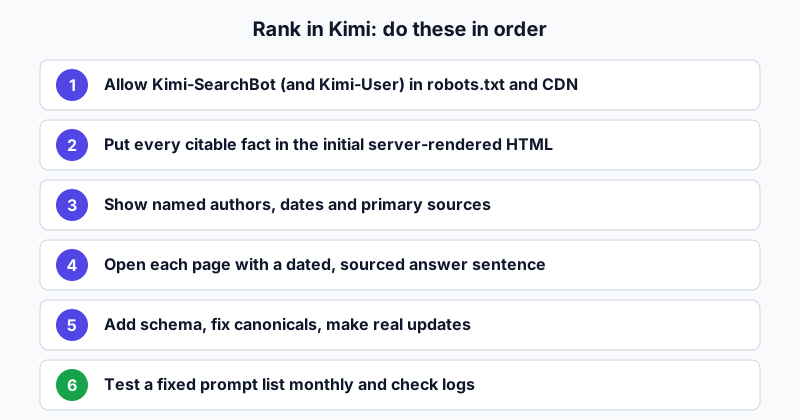
- Check robots.txt and CDN rules for Kimi-SearchBot and Kimi-User.
- Confirm in logs that Kimi-SearchBot has visited.
- Make your 10 most important pages render their answer in plain HTML.
- Add named authors, dates, sources and an organisation page.
- Rewrite openings into answer-first form.
- Add schema, fix canonicals, update stale numbers.
- Run your prompt list, record, and repeat monthly.
If you operate in the Google ecosystem as well, similar groundwork applies for Google AI Mode, though its index and crawler differ. And for the explanatory background, return to the Kimi search overview.
Frequently asked questions
How long until Kimi cites a new page?
No timing is published. The crawler must visit, the page must enter the index, and the model must choose to search and select it. Check logs for Kimi-SearchBot to confirm the first step, then test with prompts.
Do I need to submit my site to Kimi?
No submission tool or webmaster console for Kimi was found. Moonshot's documented route is robots.txt access and the crawlers discovering your pages, so a clean sitemap and good internal links are the practical levers.
Should I allow KimiBot?
It is your call. Moonshot says KimiBot concerns possible training use and that disallowing it signals you do not want that. The documentation does not link it to search citations.
Does Kimi prefer government and academic sources?
Moonshot's help page says it prioritises them, along with authoritative media and official financial channels. It does not say that other sources cannot be cited. A strong specialist page can still qualify, particularly where no official source covers the topic.
Can I get an authority badge?
No application process is documented. Badges are described as marking sources that pass Kimi's screening, such as official, academic or media certification.
Will schema markup help?
Not documented. It is still recommended because it clarifies authorship and dates and helps other engines, but treat any Kimi-specific benefit as unproven.
How do I know if a visit is real Kimi traffic?
Match the user-agent token and compare the source address with Moonshot's published IP lists. Spoofed user agents exist, so use both checks.
Limits of this guide
- Verified (Moonshot pages read 29 October 2026): the crawler tokens, the filtering rules, authority badges, the Deep Research averages and the 200 to 300 tool-call figure for K2 Thinking (both Moonshot's own). The JavaScript warning comes from the URL-fetch section of the help page.
- Reported, not confirmed: the Cloudflare robots.txt claim (second-hand via Promptwatch) and the identical IP lists (Coaley Peak, 18 May 2026).
- Missing: no video walkthrough of Kimi was available (the transcript folder for Kimi is empty), Moonshot publishes no ranking weights, authority scale, index size or citation statistics, and no independent study measures which on-page changes raise Kimi citations. Whether Kimi-SearchBot renders JavaScript is unconfirmed. Steps beyond the documented rules (answer-first writing, schema, internal linking, freshness practice) are editorial judgment. Recheck the crawler policy page before acting.
Sources
- Agentic Search for Guides and Answers, Kimi Help Center
- Kimi Crawlers, Moonshot AI
- What Is Kimi Deep Research?, Kimi Help Center
- Kimi K2 Thinking, Moonshot AI
- Kimi: how Moonshot AI's assistant builds its own index, Coaley Peak (third-party analysis; IP-list check dated 18 May 2026)
- KimiBot, Promptwatch bot directory (third-party directory)