Qwen search is harder to pin down than any other major AI search feature, because Alibaba has told publishers almost nothing about where its answers come from. That gap matters. Before you spend a month "optimizing for Qwen", you should know which parts of the system are documented, which parts are guesses, and which parts are sold to you by agencies as facts.

What "Qwen search" actually refers to
The naming is a mess, so start there. Alibaba Cloud unveiled Tongyi Qianwen (通义千问) in April 2023. The English brand shortened to Qwen. In November 2025 Alibaba launched the 千问 consumer app, which Reuters described as a rebrand of the earlier Tongyi app (Reuters, 18 Nov 2025).
Then there is the model line. The model you may have read about in August 2026, Qwen 3.8 Max, is a large language model. The table below separates the surfaces that can search from the model that powers some of them.
| Name | What it is | Where it runs | Search behaviour |
|---|---|---|---|
| 千问 (Qwen app) | Consumer assistant, China | China, Chinese mobile number needed | Searches when it detects intent; shows reference sources |
| Qwen Chat / Qwen Studio | International chat | chat.qwen.ai, run from Singapore | Same wording in its terms; provider not named |
| Quark | Alibaba's search and assistant app | China | Qwen reasoning models integrated since March 2025 |
| Model Studio API | Developer service | Alibaba Cloud | enable_search or web_search tool, documented |
| Qwen 3.8 Max | Model, announced 3 Aug 2026 | API, Qwen Chat | A model, not a search engine |
If someone sells you "Qwen optimization", ask which row they mean.
The scale argument, with care
Qwen is not a niche product. Alibaba said the Qwen app passed 100 million monthly active users within two months of its 17 November 2025 beta launch (Alibaba Cloud blog, 15 Jan 2026). Later it claimed more than 300 million monthly users across all platforms in February 2026, as reported by Presenc AI. QuestMobile, a panel estimator, counted 167.18 million for the China mobile app in June 2026, behind Doubao's 382.3 million, with DeepSeek third at 129.82 million, as summarised by Presenc AI.
Those numbers measure different things: every surface versus one app in one country. Neither tells you how many users trigger a web search or click a cited link.
One vendor page goes further. AIPOGEO's Qwen page says Qwen has "over 500 million users" (AIPOGEO). That figure appears in no Alibaba disclosure reviewed for this guide, and it contradicts the 300 million number, so it should not be repeated.
Other counts disagree too. For the shopping-first experience, Coaley Peak reports an Alibaba claim of 250 million users, while The Expert Ranking puts it at about 140 million by the end of February 2026. Because the two sources conflict, this guide uses neither number. The same sources disagree on the default model behind the international chat: Expert Ranking saw Qwen3.7-Plus in September 2026, and Coaley Peak (7 October 2026) saw Qwen3.7-Plus, Qwen3.8-Max and Qwen3.8-Omni-Flash offered. Alibaba does not say which model powers the China app.
What the consumer app says about its sources
The honest answer is short. According to Coaley Peak's review of the China and international terms (checked 7 October 2026), both services search "publicly available third-party sources" automatically when they detect search intent or when the user switches search on. Both display reference sources and warn that answers may still be wrong (Coaley Peak). Neither names a search provider.
That is the whole documented picture: no index size, freshness policy or ranking factors.
The China app adds a second layer that Western engines mostly lack. Since 15 January 2026 it connects to Taobao, Taobao Instant Commerce, Alipay, Fliggy and Amap and can complete tasks such as ordering food or booking travel inside the chat (Alibaba Cloud blog, above). For a retailer, that means an answer can end in a purchase on an Alibaba property rather than a click to your site.
The developer API: the part that is documented
Alibaba's developer documentation is where Qwen search becomes concrete. It shows what Alibaba considers a search-enabled answer to be, even if the consumer app may differ.
Search is switched on with enable_search: true on the chat endpoints or by attaching a web_search tool in the Responses API (Alibaba Cloud Model Studio). The QwenCloud documentation lists these strategies:
turbo(default): balances speed and quality.max: a more comprehensive strategy that may call multiple search engines.agent: several rounds of search and model calls; recommended for English scenarios. Coaley Peak reports that Alibaba's Chinese documentation warns English queries may not trigger search; this was reported second-hand and not re-checked.agent_max: adds full-page reading, available only on qwen3.7-max in thinking mode.
For the Qwen 3.8 family the agent strategy is not available on the Chat Completions API. Developers are told to use the Responses API, where the model decides on its own how many times to call web_search and, optionally, web_extractor (QwenCloud).
Two details matter for publishers. First, with enable_source: true the DashScope response returns search_results containing an index, a title and a URL, and the answer carries markers such as [1]. Citations are a first-class feature, not an afterthought. Second, search results are added to the prompt, so a page is only useful if its text can be pulled out and summarised cleanly.
The separate Qwen Web Search Agent product goes further. Its documentation describes query rewriting, a limit of up to 100 preferred domains, deeper page reading and automatic or forced search modes (Alibaba Cloud Help Center). That is an enterprise configuration, not proof of what the public chat does.
The API documentation tells you how Qwen can search; it does not tell you how the public apps do.
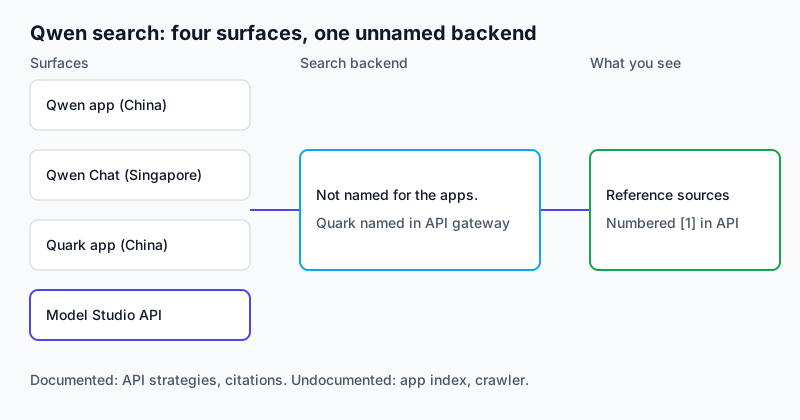
Is Quark the engine behind it?
Possibly, but nobody has confirmed it for the consumer apps. Alibaba's AI Gateway documentation says its web search policy uses the Quark search engine (Alibaba Cloud Information Query Service), with a maximum of 10 results per call, a default timeout of 3,000 ms, and optional filters for finance, law, medical and news (Alibaba Cloud API Gateway docs).
In March 2025 Alibaba said the revamped Quark integrated Qwen-based reasoning models and drew on multiple online sources with reference links in responses (Alibaba Group). In May 2025 it added "deep search" (South China Morning Post).
Put those together and Quark is a reasonable hypothesis. But an API gateway policy and a consumer chat are different deployments. "Qwen uses Quark" is plausible and unconfirmed.
Crawlers: what exists and what is only listed
| Token | Listed purpose | Who documents it | What can be verified |
|---|---|---|---|
| QwenBot | Training data collection | Third-party directories | Known Agents: "Not directly" affects AI chat visibility; compliance measured at 78.5% |
| TongyiBot | Fetch for Qwen answers on user request | Third-party directories | Known Agents lists it as visibility-relevant, with too little traffic to measure compliance |
| Yisouspider | Shenma search engine crawler | Shenma | Nothing links it to Qwen answers |
| Qwen-specific search crawler | Unknown | Nobody | Alibaba has not published one |
Known Agents gives the example user agent Mozilla/5.0 (compatible; Qwenbot/1.0; +https://qwen.alibaba.com/), notes that 7% of top sites block QwenBot and 8% block TongyiBot, and observes that QwenBot traffic often comes from Singapore (data as of 28 October 2026, QwenBot, TongyiBot). It also states that neither bot publishes a verification method, so any client can claim the name.
Another directory, xSeek, lists a different QwenBot user-agent URL, pointing at tongyi.aliyun.com (xSeek). When two directories disagree on the string, the string is not a reliable identifier.
Coaley Peak adds that the pages these directories cite no longer resolve, and that Alibaba publishes no IP ranges. So a robots.txt rule for either token is cheap but may have no effect. If you want to try it anyway, this is the syntax Known Agents shows:
User-agent: QwenBot
Disallow: /

User-agent: TongyiBot
Disallow: /
Blocking TongyiBot is the riskier choice. Known Agents says it can keep your pages out of AI answers and eliminate citation traffic, although it also notes that a separate crawler may control automatic indexing. For deeper steps, see how to rank in Qwen.
What the agency pages claim, and what they leave out
Two vendors dominate English-language results for "Qwen optimization". Both are selling something, so their claims are treated here as hypotheses.
AIPOGEO offers a five-phase service (audit, Chinese content restructuring, credible source deployment, scenario coverage, monthly monitoring). Its page cites "3x" average citation increase, "30 days" to results and an "85%" client recommendation rate, none with a method or sample size. The hero graphic is a mock Qwen answer recommending AIPOGEO itself (AIPOGEO).
Presenc AI says Qwen weights multilingual authority, Alibaba ecosystem presence and technical documentation depth, and that agency recommendations concentrate about 60% in the top ten names (Presenc AI). No sample or method is shown. Worse, two of its pages disagree: one says the public chat relies mainly on built-in knowledge with limited live retrieval, another says Qwen uses Alibaba Cloud crawlers for live retrieval (guide).
Neither claim can be reproduced from public evidence. The generic advice in both (clear content, accurate profiles, test your own prompts) is sound but not Qwen-specific.
How Qwen compares with its neighbours
Qwen sits in a group of Chinese assistants that publishers often lump together. DeepSeek launched its own Search API on 17 October 2026 with per-result authority and rerank scores (DeepSeek API docs). Kimi has its own guide here. Qwen's difference is the split: rich developer documentation, thin publisher documentation.
Qwen is well documented for developers and poorly documented for publishers. For how this review was built, read the methodology.
What this means for a publisher
Four conclusions survive the uncertainty.
- Qwen is two audiences. Decide whether you care about Chinese users, international users or both before touching anything.
- Public, crawlable, plainly written pages are the only lever Alibaba has not contradicted.
- Marketplace presence matters for commerce queries in the China app.
- Measurement is manual: run the same prompts on each surface, search on and off, and record the sources.
For the action plan, continue to how to rank in Qwen.
Frequently asked questions
Does Qwen search the web?
Yes, according to the terms summarised by Coaley Peak: it searches publicly available third-party sources when it detects search intent or when search is switched on, and shows reference sources. The provider is not named.
Which search engine does Qwen use?
Alibaba has not said for the consumer apps. Its API gateway documentation names Quark for the gateway's web search policy, which makes Quark a plausible but unconfirmed backend.
Does Qwen have an official crawler?
Alibaba has published no crawler documentation for Qwen. QwenBot and TongyiBot appear in third-party directories only, and neither can be verified by IP or reverse DNS.
Is Qwen 3.8 Max a search product?
No. The August 2026 launch coverage from Marketing4eCommerce describes a 2.4 trillion parameter model with 95 billion active parameters, strong coding and vision results on launch day, and Alibaba's own benchmarks. Search is a separate feature that models can use.
Can I stop Qwen from using my content?
No publisher opt-out for training is documented. A robots.txt rule for QwenBot or TongyiBot is possible, but its effect is unverified.
Are the agency numbers about Qwen citations reliable?
Not as presented. The figures lack a method, sample size or independent replication.
Limits of this guide
- Verified (documentation read 29 October 2026): the Model Studio and QwenCloud search parameters, the API gateway's use of Quark, and the 15 January 2026 app integrations.
- Reported, not confirmed: the consumer apps' search provider, the QwenBot and TongyiBot details (third-party directories), the English-query warning in Alibaba's Chinese documentation, user counts (which differ by definition), and Alibaba's own benchmark results.
- Missing: no video walkthrough of Qwen was available (the reviewed sources are articles and vendor pages), Alibaba documents no crawler or ranking factor for the consumer apps, and the agency figures have no method.
Sources
- Search, DeepSeek API Docs
- A deep dive into Qwen 3.8 Max and QwenWork, Marketing4eCommerce, 3 Aug 2026
- Qwen (千问): how Alibaba's assistant searches, cites and sells, Coaley Peak, checked 7 Oct 2026
- Web search with large models, Alibaba Cloud Model Studio
- Web search, QwenCloud documentation
- Qwen Web Search Agent overview, Alibaba Cloud Help Center
- Web search policy, Alibaba Cloud API Gateway
- Alibaba Unveils Flagship AI Super Assistant Application Quark, Alibaba Group
- Alibaba's Quark launches deep search, South China Morning Post
- Alibaba unveils major consumer AI upgrade, Reuters
- Qwen App advances agentic AI strategy, Alibaba Cloud Community
- Chinese AI assistant MAU rankings 2026, Presenc AI
- QwenBot, Known Agents
- TongyiBot, Known Agents
- Qwen Chat provider profile, The Expert Ranking
- Qwen user agents, xSeek Docs
- Qwen GEO Service Company, AIPOGEO (vendor page)
- Qwen Visibility Tracker and optimization guide, Presenc AI (vendor pages)