To rank in Qwen, you first have to accept that nobody outside Alibaba can show you a ranking formula, and anyone who claims otherwise is guessing or selling. What you can do is test what Qwen says about you, remove the obstacles that stop pages being read, and publish material that is easy to quote. This guide gives that plan in priority order.

Before you start: what "rank in Qwen" can and cannot mean
Qwen does not publish a list of ten blue links. When it searches, it writes an answer and shows reference sources. So "ranking" here means three separate outcomes: being named in the answer, being listed among the reference sources, or being the brand the model recalls from training.
Those outcomes have different causes. A page can be cited because it was retrieved today. A brand can be named because it appeared in training data months ago. If you mix them up, you will fix the wrong thing.
Also decide which product you care about. Alibaba runs 千问 in China, which needs a Chinese mobile number, and an international Qwen at chat.qwen.ai run from Singapore, according to Coaley Peak. The same source says Alibaba documents no crawler and names no search provider for either. You can read the background in the Qwen search overview.
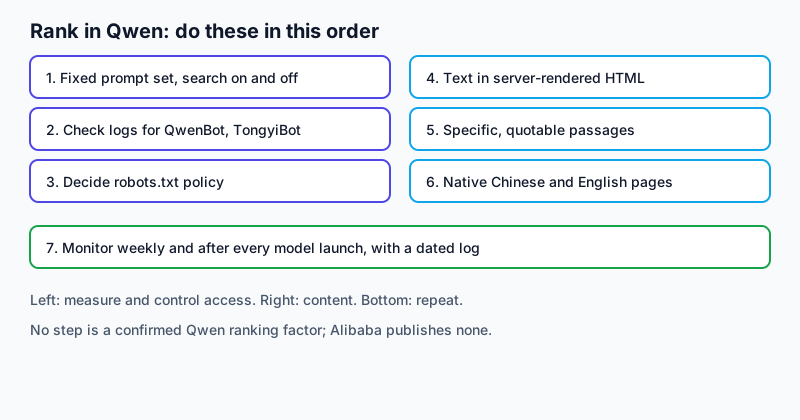
Step 1: Build a fixed prompt set and a baseline
This is the only mandatory step, because it turns opinions into data.
Write 15 to 25 prompts that a real customer would type. Include a mix: category questions ("best X for Y"), comparison questions ("A versus B"), a brand question, and two or three questions your content answers directly. Presenc AI, a vendor, suggests 10 to 20 queries and recording which competitors appear (Presenc AI); the exact number matters less than keeping it fixed.
Run each prompt in a table like this:
| Field | Example value | Why it matters |
|---|---|---|
| Date | 2026-10-29 | Answers drift over time |
| Surface | Qwen Chat (international) | The China app may differ |
| Language | English | English may behave differently from Chinese |
| Search | On / Off | Separates memory from retrieval |
| Brand named? | Yes / No | Outcome 1 |
| Your URL cited? | Yes / No | Outcome 2 |
| Competitors named | List | Shows who wins the slot |
Presenc's guide also advises logging responses with and without the search toggle, since the two states show whether a gap sits in training data or in retrieval. The reasoning is sound, though it comes from a vendor guide and its claimed results could not be verified.
How to read the baseline
If your brand is missing with search on and off, retrieval is not your first problem; the model does not know you. If you appear with search off but not on, retrieval is skipping you. If you appear with search on only, you depend on live sources, which is more fragile.
Step 2: Check who is actually visiting your site
Look at your server logs for requests containing "QwenBot" or "TongyiBot". The overview explains how the directories (QwenBot, TongyiBot, xSeek) describe them and why their user-agent strings are unreliable. The practical version: neither bot publishes a verification method, so any client can claim the name.
A one-line log check is enough to start:
grep -iE "qwenbot|tongyibot" access.log | awk '{print $1, $9}' | sort | uniq -c | sort -rn | head
So a log entry proves little. If you see none, that proves little too. Qwen may fetch pages through infrastructure under other names, and Alibaba publishes no IP ranges, according to Coaley Peak. Judge by behaviour: single-page requests after a user prompt look like a fetcher, broad sweeps look like a training crawl.
| Observation in logs | Likely meaning | Action |
|---|---|---|
| Broad, deep sweeps with "QwenBot" | Training-style collection (unconfirmed) | Decide on robots.txt policy |
| Single-page hits with "TongyiBot" | On-demand fetch for a user (unconfirmed) | Keep allowed; check pages render |
| Traffic claiming Qwen names, wrong behaviour | Possibly spoofed | Rate-limit like any unknown bot |
| No Qwen-named traffic | Unknown | Do not conclude you are invisible |
Step 3: Decide your robots.txt policy deliberately
Here you have a real choice, and the trade-off is honest. Known Agents reports (as of 28 October 2026) that 7% of the top websites it tracks block QwenBot and 8% block TongyiBot. Its own advice is that blocking QwenBot gives control over training use, while blocking TongyiBot is usually a mistake if you want citations.
If you want to be visible, allow both, or simply add nothing. If you want to limit training use and accept the uncertainty, this is the rule Known Agents shows:
# Optional: limit possible training collection (effect unverified)
User-agent: QwenBot
Disallow: /
Do not add a blanket rule for TongyiBot if citations are the goal. And remember Coaley Peak's warning: Alibaba documents no Qwen robots.txt token, so these rules may have no effect at all. A robots.txt line for an undocumented bot is a statement of intent, not a guarantee.
Step 4: Make sure the page can be read and summarised
This step is inference, but it rests on a documented fact. In Alibaba's API, search results are added to the prompt, and developers can request full-page reading through a web extractor tool (QwenCloud). If a model must summarise your page from extracted text, anything that hides text hurts you.
Check these basics:
- The main content is in the HTML the server returns, not injected later by JavaScript.
- The page loads without a login, cookie wall or interstitial.
- The title and first paragraph state the topic in plain words.
- The page is not blocked by a firewall rule that treats unknown bots as hostile.
- Mobile and desktop versions show the same text.
A quick test: fetch the page with a plain HTTP client and read the result. If your answer is not in it, a retrieval tool probably will not see it either.
Mind the firewall
Many hosts silently block data-center traffic. Known Agents notes that QwenBot traffic often comes from Singapore. If your CDN blocks that region or treats it as bot traffic, you may be turning away the very fetcher you want. Check your firewall logs for blocked requests that match.
Step 5: Write passages that are easy to quote
Qwen's API documentation shows that answers can carry numbered citations such as [1], tied to a title and URL. That favours pages with discrete, quotable statements. Here is a before and after for a short passage.
Before (vague): "Our platform helps teams work better with many features that customers love."
After (specific and quotable): "Acme Planner is a project-management tool for teams of 5 to 50 people. It includes shared timelines, task dependencies and a weekly summary email. Pricing starts at a flat monthly fee listed on the pricing page."
The second version names the product, the audience, the features and where the pricing is. A model can lift it without inventing anything. Only state facts you can support; do not copy numbers from this example.
Practical rules:
- Put the direct answer in the first one or two sentences under each heading.
- Use headings that match real questions.
- Add a short comparison table when you compare options.
- Date time-sensitive claims.
- Link to primary sources.
For a related view on how engines treat structured answers, compare the approach in how to rank in DeepSeek, which has a documented search API with authority scoring.
Step 6: Cover Chinese and English deliberately
Qwen3 was trained on 36 trillion tokens in 119 languages and dialects, per Coaley Peak. That does not tell you how languages are weighted in search. Still, two things follow.
First, if your market includes Chinese-speaking users, a native Chinese page beats a machine translation. AIPOGEO recommends "Chinese content structuring" and Presenc recommends localized, not merely translated, content; both are vendors, so treat this as a hypothesis worth testing with your prompt set.
Second, Alibaba's API documentation recommends the agent strategy for English scenarios, and Coaley Peak reports that Alibaba's Chinese documentation warns English queries may not trigger search. That second claim could not be re-verified. It does suggest you should test English and Chinese prompts separately, as Step 1 does.
Declare language clearly in your markup:
<html lang="zh-CN">
<link rel="alternate" hreflang="en" href="https://example.com/en/page/">
<link rel="alternate" hreflang="zh-CN" href="https://example.com/zh/page/">
Whether Qwen reads hreflang is unconfirmed. It is good practice for search engines generally, and costs little.
Step 7: Strengthen third-party and marketplace signals
Both Qwen-focused vendors push the same idea: be present on sources the model trusts. AIPOGEO calls it a "credible source network" and Presenc points to Alibaba properties such as Tmall Global and Alibaba Cloud partner directories, plus regional publishers. Neither shows evidence that these specific sources feed Qwen's answers, so use them as tests, not promises.
What is documented is the commerce angle. Since 15 January 2026, the Qwen app has been connected to Taobao, Taobao Instant Commerce, Alipay, Fliggy and Amap, and can complete tasks such as ordering or booking inside the chat (Alibaba Cloud blog). For a seller, that means the answer may end inside an Alibaba marketplace.
Use this priority list:
- Keep your own site's product facts accurate and consistent.
- If you sell in China, keep marketplace listings complete and matching your site.
- Maintain accurate profiles on review or directory sites relevant to your industry.
- Seek coverage from reputable publications, not link schemes.
Consistency across your own site and third-party listings is the one signal every vendor and every engine agrees on.
Entity markup
A small structured-data block helps any engine connect your pages to one organisation. This is general practice, not a Qwen-confirmed factor:
{
  "@context": "https://schema.org",
  "@type": "Organization",
  "name": "Example Brand",
  "url": "https://example.com/",
  "sameAs": [
    "https://www.linkedin.com/company/example-brand"
  ]
}
Keep the name identical everywhere. If you use a Chinese brand name, use one form consistently across your site and listings.
Step 8: Monitor on a schedule
Re-run your prompt set on a fixed cadence, and log the same fields. Alibaba's own search documentation lists strategies and models that change over time: the Qwen 3.8 family does not support the agent strategy on Chat Completions, for example, and agent-style retrieval moved to the Responses API (QwenCloud). Behaviour shifts, so only a log can show your own trend.
| Cadence | What to do | What to record |
|---|---|---|
| Weekly | Re-run 5 core prompts | Brand named, URL cited |
| Monthly | Run the full prompt set in both surfaces | Changes vs baseline |
| After a site change | Re-run affected prompts | Before/after |
| After a model launch | Re-run everything once | Note model name shown |
Model launches matter. Qwen 3.8 Max, announced 3 August 2026, has 2.4 trillion parameters with 95 billion active, and Alibaba's own benchmarks are not independently validated, according to Marketing4eCommerce. That coverage says nothing about how it picks sources, so a new model is a reason to re-measure, not a reason to change tactics.
Common mistakes
Most of these come from over-trusting confident vendor pages.
- Treating a Qwen user-agent in logs as proof of Alibaba traffic.
- Blocking TongyiBot, then wondering why citations stop.
- Paying for "citation lift" without a baseline you control.
- Translating pages by machine and calling it localization.
- Optimizing only the website when the China app transacts on marketplaces.
- Quoting audience size from a vendor page. AIPOGEO says "over 500 million users"; Alibaba itself reports 300 million across platforms, and QuestMobile counted 167.18 million for the China app in June 2026 (Presenc AI).
What to do this week
If you have limited time, do these four things in order:
- Write the prompt set and record the baseline in both surfaces.
- Search your logs and firewall for Qwen-named traffic.
- Fetch your top five pages with a plain client and confirm the answer text is present.
- Rewrite one vague page into specific, quotable passages and re-test it in two weeks.
For the background on what is documented, return to the Qwen search overview. For how this guide was built, see the methodology. If your audience also uses Moonshot's assistant, see how to rank in Kimi.
Frequently asked questions
Can I pay to rank in Qwen?
There is no advertising or sponsored placement documented for Qwen answers in the sources reviewed for this guide. AIPOGEO itself says GEO is not buying ad placements. Agency services exist, but none publishes a method you can verify.
Should I block QwenBot?
Only if you want to limit possible training use and accept that the effect is unverified. Known Agents says blocking QwenBot does not directly affect AI chat visibility. Blocking TongyiBot is different: it can keep your pages out of answers.
Does Qwen cite sources?
Yes. Both consumer terms say reference sources are shown with search answers, according to Coaley Peak, and the API returns numbered citations when you enable source output.
Do I need Chinese content?
It depends on your audience. If Chinese-speaking users matter, native-quality Chinese pages are a sensible hypothesis, but no source proves they raise citation rates. Test with separate Chinese and English prompts.
How long until I see results?
Nobody can say. AIPOGEO claims measurable change within 30 days, with no method published. Presenc's tracker page says gains depend on Alibaba's training cycle for model knowledge, which can take weeks to months. Track your own log.
Does Qwen use Google or Bing results?
Alibaba has not said which search provider the consumer apps use. Its API gateway documentation names the Quark search engine for that gateway's web search policy, which is not proof about the apps.
Limits of this guide
- Verified (documentation read 29 October 2026): the API search strategies and citation output (QwenCloud, Model Studio) and the January 2026 app integrations (Alibaba Cloud blog).
- Reported, not confirmed: bot behaviour (Known Agents, xSeek, Coaley Peak), the English-query warning in Alibaba's Chinese documentation, user counts, and the Qwen 3.8 Max benchmarks (Alibaba's own).
- Missing: no video walkthrough of Qwen was available (the reviewed sources are articles and vendor pages), no controlled citation tests were run, the vendor guides (AIPOGEO, Presenc AI) show no reproducible method, and nothing confirms the search provider, any ranking factor, or whether hreflang or schema influence Qwen.
Bot behaviour and model availability change quickly, so verify against your own logs.
Sources
- Qwen (千问): how Alibaba's assistant searches, cites and sells, Coaley Peak (terms checked 7 Oct 2026)
- QwenBot, Known Agents
- TongyiBot, Known Agents
- Qwen user agents, xSeek Docs
- Qwen Visibility for Marketing Agencies / Qwen Visibility Tracker, Presenc AI (vendor page, 23 Apr 2026)
- Web search, QwenCloud documentation
- Web search with large models, Alibaba Cloud Model Studio
- Qwen App advances agentic AI strategy, Alibaba Cloud Community
- A deep dive into Qwen 3.8 Max and QwenWork, Marketing4eCommerce, 3 Aug 2026
- Chinese AI assistant MAU rankings 2026, Presenc AI
- How to optimize for Qwen, Presenc AI (vendor guide)
- Qwen GEO Service Company, AIPOGEO (vendor page)