To rank in Claude you need two things before any copywriting trick matters: a page that Claude's search backend can find, and a passage on that page worth quoting.

What "ranking" means in Claude
Claude does not show ten blue links. It searches, reads, and answers with a handful of citations. So "rank in Claude" really means three outcomes, in rising order of value: your page is retrieved, your page is cited, and your brand or product is named in the answer text.
Before spending time, read our Claude web search overview. It explains the pipeline this checklist is built on. The short version: Anthropic's crawlers gather content, a search backend (reported to be Brave Search, with other subprocessors listed by a third-party tracker) supplies results, and Claude writes an answer that cites sources.
One caution up front. Anthropic has not published ranking factors. Everything below falls into one of three groups: documented by Anthropic, reported by independent testers, or recommended by marketers. Each step is labelled so the difference stays visible.
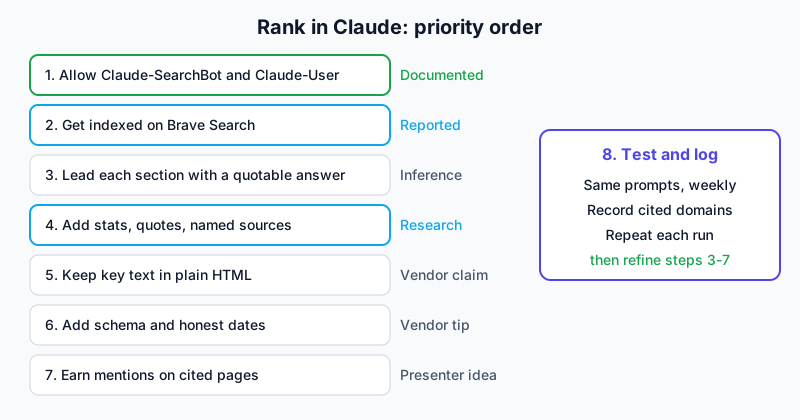
How to rank in Claude: the 8 steps
| Step | Action | Evidence level |
|---|---|---|
| 1 | Allow Claude-SearchBot and Claude-User in robots.txt | Documented by Anthropic |
| 2 | Make sure Brave can index your pages | Reported by testers |
| 3 | Put a direct answer at the top of each page | Inference from citation format |
| 4 | Add statistics, quotes and named sources | Research (GEO paper, not Claude-specific) |
| 5 | Serve content in plain HTML | Vendor claim (Omnius) |
| 6 | Add schema markup and honest dates | Vendor recommendation |
| 7 | Earn mentions on pages Claude already cites | Presenter suggestion |
| 8 | Test, log and repeat | Practical method |
Step 1: Let the right Anthropic bots in
This is the only step Anthropic itself documents, so do it first. The three robots (ClaudeBot for training, Claude-User for user-triggered fetches, Claude-SearchBot for search quality) and the effect of blocking each are explained in the Claude web search overview. The short version for action: block ClaudeBot if you object to training, and leave the other two open if you want to be cited.
That gives you three sensible policies. Pick the one that matches your business.
| Policy | ClaudeBot | Claude-SearchBot | Claude-User | When it fits |
|---|---|---|---|---|
| Open | Allow | Allow | Allow | You want training and citations |
| Cited, not trained | Block | Allow | Allow | You want citations but no training use |
| Closed | Block | Block | Block | You accept zero visibility in Claude |
Here is a robots.txt for the middle policy:
User-agent: ClaudeBot
Disallow: /

User-agent: Claude-SearchBot
Allow: /

User-agent: Claude-User
Allow: /
Three traps to avoid:
- A generic
Disallowfor all unknown bots also blocks the two search bots. - Blocking by IP address is not a reliable opt-out. Anthropic says it stops the bots reading your robots.txt, and it publishes its ranges at claude.com/crawling/bots.json so you can verify genuine visits.
- Rules apply per host. Repeat them on each subdomain.
Then check your server logs for the user agents. A quick filter on a standard access log (adjust the path to your server):
grep -E "ClaudeBot|Claude-User|Claude-SearchBot" /var/log/nginx/access.log | awk '{print $1, $7}' | sort | uniq -c | sort -rn | head
Compare any suspicious source IP with the published ranges before trusting the user agent string. If you never see Claude-SearchBot, that is a clue, not a verdict: Scrunch observed that Claude did not seem to fetch a page live at citation time, so absence in your logs does not mean you are uncited.
Step 2: Get indexed where Claude looks
Claude's web search was widely reported in March 2025 to run on Brave Search (evidence summarised in the overview). A later third-party listing also shows other web-search subprocessors, which is not confirmed on Anthropic's own page. So treat Brave as the most important gate, not the only one.
What to do, in order:
- Search for your own brand and a few key pages on Brave Search. If they do not appear, you have an indexing problem before you have a Claude problem.
- Do not block Googlebot or add
noindexto pages you want cited. Scrunch notes that Brave has no robots.txt token for its indexer and follows your Googlebot rules and page-level noindex. - Ask for indexing if you can. A video presenter in the reviewed walkthroughs says that submitting your URL on Brave's search site makes you eligible but does not guarantee a citation. This guide could not verify the exact submission form, so look for it on Brave's own pages.
The same presenter points out that Brave's index is much smaller than Google's, and frames that as less competition. Maybe. But a small index also means fewer second chances: if your page is missing, there is no fallback. For more on that engine see Brave Search AI and the matching guide to ranking in Brave Search.
Step 3: Lead with a quotable answer
Anthropic's documentation says each web citation includes a URL, a title and a cited_text field of up to 150 characters. Claude is not pasting your page. It is lifting a short snippet. That is the single most useful mechanical fact for writers.
Write the first sentence under every heading so that it could stand alone as the answer. Then add context below it.
Before and after, using an invented example:
| Opening of the section | |
|---|---|
| Before | "Many businesses wonder about pricing, and there are lots of factors to think about when choosing a plan." |
| After | "The Team plan costs a flat monthly fee per seat and includes unlimited projects; the Free plan is limited to three projects." |
The "after" version contains a fact a model can quote, a comparison a buyer cares about, and no throat-clearing. (The prices are placeholders in this example; use your real ones.)
Practical rules that follow from this:
- One question per heading, phrased the way a buyer would ask it.
- A direct answer in one or two sentences, then the detail.
- No answer hidden inside a tab, a carousel or a PDF.
- Keep key claims in the body text, not only in images.
The transcript presenter says the same thing in his own words: a "liftable answer" near the top of the page, plus one clear signal and trusted mentions. That is opinion, but it fits the documented citation format.
Step 4: Back claims with numbers, quotes and sources
The best-known research on this is Aggarwal et al., "GEO: Generative Engine Optimization" (2024). It reports visibility improvements of up to 40% in the paper's benchmark, with results that vary by domain and method. Omnius summarises the paper as favouring statistics, expert quotations and source citations. The study tested generative engines in general, not Claude specifically, so use it as a direction, not a promise.
What this looks like on a page:
- Replace "sales grew a lot" with a number and its source, named inline.
- Quote an expert in under 25 words and name them.
- Link to the primary source, not to another blog that mentions it.
- Date anything time-sensitive.
One sentence of warning, because this is where most guides lie. Never invent a statistic to make a page look authoritative. A fabricated figure is easy for a human reviewer to catch and bad for trust, which is the thing you are trying to build.
Step 5: Make the content easy to read without scripts
Omnius claims AI search engines struggle with JavaScript-heavy pages, and that pages relying heavily on scripts may be invisible to AI crawlers. Anthropic has not said this about its bots, and no test reviewed here shows how Claude-SearchBot renders scripts. Still, the cost of being safe is low.
A quick check:
- Open the page, view the source (not the inspector), and search for your main paragraph.
- If it is missing from the raw HTML, a bot that does not run scripts will not see it.
- If it is missing, render the content on the server or pre-render it.
Scrunch's launch-day note suggests Claude may work from stored page content. If a cached copy is what gets read, then what is in your HTML at crawl time is what Claude has. That is an inference, but it is a reason to keep the important text in plain markup.
Step 6: Add schema and honest dates
Marketing guides for Claude recommend Article, FAQ and Product schema. Infrasity's post, for one, lists them as a minimum. This is best treated as a sensible hygiene step rather than a proven ranking factor, since Anthropic documents no use of structured data in retrieval.
A minimal Article snippet:
{
  "@context": "https://schema.org",
  "@type": "Article",
  "headline": "How to rank in Claude",
  "author": { "@type": "Person", "name": "Mohamed CISSE" },
  "datePublished": "2026-10-29",
  "dateModified": "2026-10-29"
}
Two rules for the dates. Update dateModified only when you changed something real. Omnius makes the same point: the date should reflect a genuine refresh, not a cosmetic bump. Also remember that the API reports a page_age for each result, described as when the site was last updated, so freshness is at least visible to the system. Whether it weighs it is unknown.
Review your most important pages every three to six months, which is Omnius's suggested cycle. Check each statistic, link and example. Fast-moving topics deserve a shorter cycle.
Step 7: Earn mentions on pages Claude already trusts
The advanced move in the transcript is simple to describe. Ask Claude the buyer questions in your niche, write down which pages it cites, and work to be listed or mentioned on those pages. The presenter compares it to backlinks. A more precise label is citation gap analysis.
A workable routine:
- Write 10 to 20 buyer questions, from "what is" through "best for" and "alternatives to".
- Ask Claude each one with web search enabled.
- Save every cited URL in a sheet with the question next to it.
- Sort by how often each domain appears.
- For the top domains, look for honest ways in: a contributed explanation, a correction, a data point, a listing.
This is slow and manual by design. It also tells you something for free: whether Claude cites forums, vendor docs, news or review sites for your topic. That shapes where you should publish.
The Omnius post gives a flavour of how citation habits differ between engines: it cites a study reporting Perplexity averaging 6.61 citations per response, Gemini 6.1 and ChatGPT 2.62, and does not list Claude. So do not assume the source mix you see in other engines applies here. Compare with our guides on ranking in Perplexity and ranking in ChatGPT if you publish for several engines.
Step 8: Test, log and repeat
Claude does not expose rankings, so you build your own measurement. Infrasity suggests tracking presence, position within the answer, citations and sentiment, and picking five to ten real competitors to compare against. The basic manual loop it describes is: run prompts, capture responses, log them in a spreadsheet, repeat on a schedule.
Make the log useful:
| Column | What to record |
|---|---|
| Date | When you ran the prompt |
| Prompt | The exact wording |
| Searched? | Whether Claude ran a web search at all |
| Queries | The search terms Claude used |
| Cited domains | Every URL cited |
| Your page | Cited, read but not cited, or absent |
| Notes | Any wrong claim about your brand |
Two details matter. First, per Anthropic's documentation, Claude searches when information is current or changing and answers from memory for stable knowledge. A prompt that never triggers a search can never cite you, so write prompts that need fresh facts. Second, run each prompt more than once. Answers vary, and one run is an anecdote.
If you want a faster way to find pages to improve, the other reviewed walkthrough uses Google Search Console data: it looks for queries where a page sits around position 14 with decent impressions but few clicks, and treats those as refresh candidates. The presenter claims large gains from this approach. Those results are self-reported in a sales video and are not repeated here; the method (find near-miss pages) is the useful part.
Analysis of the reviewed walkthroughs
Two video walkthrough transcripts were reviewed; the overview summarises what each says. For action purposes, only one points at citation mechanics: it recommends submitting to Brave for eligibility, then supplying a liftable answer, a clear signal and trusted mentions (steps 2, 3 and 7). Its overlap figures are second-hand and unverified.
The other describes using Claude with Search Console data to plan content. It supports step 8 (finding refresh candidates) but offers no evidence about how Claude chooses sources. Presenter performance figures are self-reported and differ between videos, so none are repeated. Neither transcript shows a controlled test with before-and-after citation counts.
A short worked plan for one page
Say you run a small accounting-software site and want your pricing page cited. A sensible sequence:
- Confirm robots.txt allows Claude-SearchBot and Claude-User.
- Search Brave for "your brand pricing". If the page is missing, fix indexing first.
- Rewrite the top of the page so the first sentences state the plans, prices and limits.
- Add one sourced statistic about the problem you solve, named inline.
- Add Article or Product schema and a real modified date.
- Ask Claude five pricing questions in your category, log the citations, and note who gets cited instead of you.
- Repeat in two weeks and again in a month.
That plan takes an afternoon to set up. The loop afterwards is what produces learning.
Frequently asked questions
Can I pay to rank in Claude?
No source reviewed for this guide describes a paid placement for web search citations. The API charges developers for searches, but that is a usage fee for the person building the app, not an advertising product for publishers.
How long until Claude cites a new page?
No reliable figure was found. Infrasity claims well-structured content can gain visibility "in hours instead of days or weeks," which is a vendor claim and unverified. Plan to test over weeks, not days.
Do I need to block ClaudeBot to be cited?
No. Anthropic describes ClaudeBot as a training crawler and Claude-SearchBot and Claude-User as the search-related bots. Block or allow each according to your policy, as in step 1.
Does Google ranking help me in Claude?
Possibly through indirect routes, but the evidence points to Brave rather than Google. The video presenter says overlap with Google is low for some queries, and Scrunch found close alignment with Brave. Do not assume a Google top three carries over.
Is schema markup required?
No source shows that it is. Marketing guides recommend it for clarity. It is best treated as low-cost hygiene, not a lever.
Should I write in a neutral tone?
Agencies say Claude deprioritises promotional copy. Anthropic has not published that. Neutral, specific writing is good practice for readers anyway, so you lose little by trying it.
Can I track Claude citations with software?
Several vendors sell AI visibility trackers, and Infrasity names Profound and Peec AI as examples. None was tested for this guide, so check their methods before relying on their numbers.
Limits of this guide
- Verified: the Anthropic crawlers and their documented effects, the citation fields, and when Claude searches (Anthropic Help Center and developer documentation).
- Reported: the Brave link (Anthropic's March 2025 subprocessor entry plus independent tests by Simon Willison, TechCrunch and Scrunch); later subprocessors (third-party tracker, not cross-checked); schema, neutral tone, tracking and visibility-speed advice (Infrasity), JavaScript, refresh-cycle and citation-count claims (Omnius), all vendor opinion; the GEO paper's up-to-40% figure (Aggarwal et al., not tested on Claude).
- Unverified: the 87% Brave overlap quoted in one video and any presenter-reported performance figures.
- Missing: how Claude ranks or selects sources, so steps 3 to 7 are reasoned from the citation format and third-party advice. No controlled citation experiments were run.
The methodology page explains how evidence is graded.
If you want the background on crawlers, backends and citations first, the Claude web search overview covers it in full.
Sources
- Does Anthropic crawl data from the web, and how can site owners block the crawler? (Claude Help Center, April 7, 2026)
- Web search tool (Anthropic developer documentation)
- Anthropic Trust Center: Brave Search added as a subprocessor (Simon Willison's Weblog, March 21, 2025)
- Anthropic appears to be using Brave to power web search for its Claude chatbot (TechCrunch, March 21, 2025)
- Anthropic has released web search for Claude (Scrunch, March 21, 2025)
- Anthropic subprocessor listing (thirdpartyindex.com, third-party compilation, entries dated September and October 2026)
- GEO: Generative Engine Optimization (Aggarwal et al., arXiv, 2024)
- How to Rank in Claude: Best Practices & Tips (2026) (Infrasity, February 8, 2026)
- 6 Best GEO Practices For Ranking in AI Search Engines (Omnius, updated August 2026; page blocks automated fetching, so the URL could not be re-verified)
- Video walkthrough transcript, "Claude AI SEO, zero to 200 clicks a day" (third-party creator, reviewed 2026; original URL not found)
- Video walkthrough transcript, Claude uses Brave as its search engine (third-party creator, referencing a Chris Long LinkedIn post, reviewed 2026; original URL not found)