To rank in Perplexity you do not climb a list; you earn a numbered link inside a written answer, and that starts with letting Perplexity's crawler reach your page. This guide gives you seven steps in priority order, with a robots.txt snippet, a before/after rewrite, and a JSON-LD example you can copy.
What "ranking" means here
There is no position 1 to 10. Search Atlas, an SEO software vendor, states that Perplexity "does not rank pages in static positions" and that tracking should focus on citations and mentions instead (Search Atlas). The logic holds: the goal is to be one of the sources linked beside an answer.
If you want the background first, read Perplexity AI search explained. It separates what Perplexity documents (two crawlers) from what vendors only claim. This how-to is the action list.
The checklist below is ordered by what blocks you first. A perfect page behind a blocked crawler earns nothing.
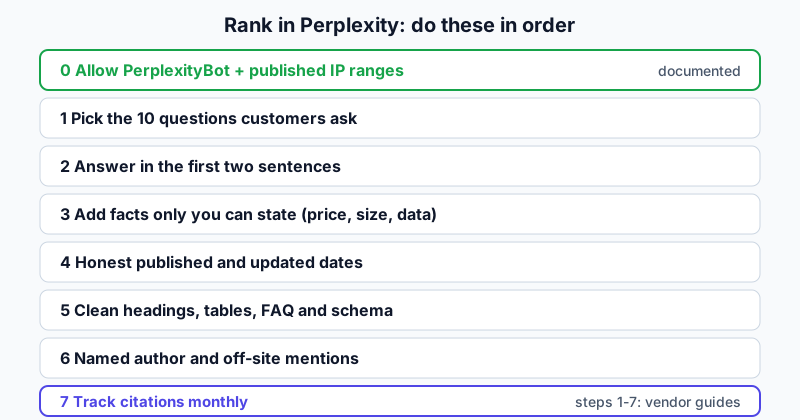
| Step | Action | Evidence level |
|---|---|---|
| 0 | Allow PerplexityBot and its IP ranges | Documented by Perplexity |
| 1 | Pick the questions you want to own | Common advice, video transcript |
| 2 | Write answer-first, self-contained passages | Transcript plus vendor guides |
| 3 | Add facts only you can state | Transcript, GEO paper (arXiv) |
| 4 | Show honest dates and refresh | Vendor guides; API date fields |
| 5 | Structure the page and add schema | Vendor and agency guides |
| 6 | Build author and off-site trust | Agency and vendor guides |
| 7 | Track citations manually, then with tools | Common practice |
How to rank in Perplexity: the seven steps
Step 0: let Perplexity in
Everything starts here. The two agents, PerplexityBot and Perplexity-User, and what each does are described in Perplexity's crawler documentation and summarised in the overview of Perplexity AI search. This section only covers the actions.
The docs recommend allowing PerplexityBot in robots.txt "and permitting requests from our published IP ranges". Here is a permissive file:
User-agent: PerplexityBot
Allow: /

User-agent: Perplexity-User
Allow: /

Sitemap: https://www.example.com/sitemap.xml
Replace the sitemap URL with yours. Then check the three places that silently block it:
- robots.txt. Search for a blanket
Disallow: /underUser-agent: *and for any AI-bot blocklists copied from a plugin. - Firewall or CDN. Perplexity's docs give a Cloudflare recipe: a custom rule where the user agent contains
PerplexityBotorPerplexity-Userand the source IP is in the published ranges, with the action set to Allow. For AWS WAF, create IP sets and string-match rules, then give them higher priority than blocking rules. - Rendering. If your text only appears after JavaScript runs, a fetcher may see an empty shell. Test with
curland read what comes back: if the answer to your main question is missing from the raw response, a fetcher that does not run scripts will not see it either.
Allow the bot, and allow the IP ranges, because a user-agent rule alone is not what Perplexity recommends. The IP lists live at perplexity.com/perplexitybot.json and perplexity.com/perplexity-user.json, and the docs say to treat them as the source of truth. Automate the refresh if you can, since the lists are updated regularly.
Robots.txt changes may take up to 24 hours to be reflected, per Perplexity. Because Perplexity-User "generally ignores robots.txt rules", restrict it with the firewall if you must.
A quick raw-HTML check you can run on any page you want cited:
curl -s -A "Mozilla/5.0 (compatible; PerplexityBot/1.0; +https://perplexity.ai/perplexitybot)" \
  https://www.example.com/your-page/ | grep -i -c "your key phrase"
A count of zero means the phrase is not in the server-rendered HTML. Note that this only simulates the user agent string from the same docs. A real request would come from the published IP ranges, so a WAF may still treat your test differently.
Step 1: choose the questions to own
Write down the ten questions your customers genuinely ask. GEO-Score, a vendor, suggests typing each one into Perplexity yourself, noting which sites get cited and what those pages do that yours does not (GEO-Score). That is free and it works for any engine.
Do it in this order:
- List the question as a customer would phrase it, in full sentences.
- Run it in Perplexity and copy the cited domains into a sheet.
- Open the top cited pages and note what they contain: a price, a table, a date, a named author.
- Decide whether you have a page that could be cited for that question. If not, that is your backlog.
One page per question is a sound rule. Mixing five questions on one page produces a muddy passage for retrieval. The video transcript makes a related point: the query people type, such as "pottery classes in Vienna", should be the headline, not a poetic line. It also suggests that about 40% of H2 headings be phrased as questions people would ask an AI.
Step 2: write answer-first, self-contained passages
The video test walkthrough describes retrieval in three moves: the question becomes a meaning vector, passages with similar meaning are pulled into a pool of roughly 40 to 50, and a second model reranks them on relevance, specificity and factual detail. This was explained for AI search in general, not for Perplexity alone, but it matches how the vendor guides describe Perplexity.
The practical output is the answer unit, a term used in the transcript. It has four parts:
- Claim: the main point, in the first sentence.
- Context: who it is for, under what conditions.
- Proof: specific numbers or facts.
- Takeaway: what to do next.
GEO-Score's version is shorter: answer the question in the first two sentences. Same idea.
Now a worked example. The numbers below are illustrative, not real data, but the structure is the point.
Before (vague, un-citable):
At Soma Ceramics we offer a calm introduction to working with clay. Our supportive, no-pressure environment is perfect for everyone.
After (answer unit):
A beginner pottery class at Soma Ceramics in Vienna costs 69 euros for three hours. It suits first-timers who have never used a wheel. The price includes materials, 1 kg of clay and firing, and groups are limited to six people. Book a place from the classes page.
What changed? The business is named, the city is named, there is a price, a duration, a group size and a next step. If an AI pulls only that paragraph, it still makes sense. The transcript calls this the "liftability test": strip the surrounding page and see whether the paragraph still tells you who, where and how much.
Four habits follow from it, all taken from the walkthrough:
- Name the business in every paragraph instead of writing "the studio" or "we".
- Use one term for one thing. Do not alternate between "class", "session" and "workshop".
- Never write "as mentioned above" or "see below". The transcript notes AI does not understand page position.
- Make each H2 cover one attribute, with the H1 naming the entity.
Step 3: add facts only you can state
Generic statements are interchangeable. A fact that exists nowhere else gives a reason to cite you. The video lists four kinds:
| Kind of detail | Example (illustrative) |
|---|---|
| Proprietary data | Your prices, schedule, class sizes, waiting-list times |
| Fresh information | A new 2026 timetable or a seasonal workshop |
| A distinct viewpoint | Why you only offer three-hour sessions |
| A named method | Your own approach to teaching beginners |
There is outside support for the principle. The paper GEO: Generative Engine Optimization (Aggarwal et al., 2024), which GEO-Score also cites, reports visibility improvements of up to 40% in the paper's benchmark when content adds statistics, quotes and citations. Treat that as directional: it studies generative engines in general, not Perplexity. Oscar Référencement, a French agency, quotes its own uplift percentages without showing a method, so they are not repeated here.
What should you add on a typical page? A practical shortlist:
- At least three specific facts that competitors lack, as the transcript advises.
- A named source for every external figure, linked.
- One short expert quote, with the person's name and role.
- A table when you compare options.
And never invent a number. If you cannot support it, leave it out, because a cited page with a false figure is worse than an uncited one.
Step 4: show honest dates and refresh on a schedule
Freshness is the point on which most guides agree, though they disagree on windows. GEO-Score says one 2026 analysis found 82% of citations on time-sensitive questions went to pages published in the previous 30 days; it does not name the analysis. Search Atlas claims decay begins within two to three days of publication, which no other source reviewed corroborates.
Here is something firmer. Perplexity's own Search API returns, for each result, a date and a last_updated field (Perplexity Search API quickstart). That API is a developer product, not the consumer app, but it shows Perplexity treats dates as structured data.
So the practical rules are modest:
- Put a real published date and a real updated date on the page, in the HTML and in your structured data.
- Update the date only when you change something substantive. A cosmetic date bump is a trick and should not be relied on.
- Review time-sensitive pages (prices, schedules, versions) more often than evergreen ones. A quarterly cycle for important pages is the rule GEO-Score suggests.
- Keep a changelog line at the top: "Updated October 2026: new prices".
Freshness only helps if the change is real, so log what you changed.
Step 5: structure the page and add schema
Short paragraphs, descriptive headings, lists and tables appear in every guide reviewed, including the French agency one. They help for a boring reason: a retrieval system cuts pages into chunks, and clean headings make clean chunks.
A sensible template:
- H1 with the entity and the main query.
- A two-sentence answer directly under it.
- H2 sections, each answering one question.
- A comparison table where it fits.
- A short FAQ with real questions.
- Author box and update date.
On schema, vendors say FAQ and Article markup help. Search Atlas states schema contributes about 10% of ranking weight and GEO-Score claims a 36% uplift, but neither figure comes from Perplexity, so neither is a target. Schema is still worth adding because it is cheap and it clarifies entities. Only mark up what is visible on the page. Here is a minimal FAQ example:
{
  "@context": "https://schema.org",
  "@type": "FAQPage",
  "mainEntity": [{
    "@type": "Question",
    "name": "How much does a beginner pottery class in Vienna cost?",
    "acceptedAnswer": {
      "@type": "Answer",
      "text": "A beginner class at Soma Ceramics costs 69 euros for three hours, including materials and firing."
    }
  }]
}
The text must match the visible FAQ. Mismatches are an easy way to lose trust.
Technical basics round it out: crawlable URLs, a submitted XML sitemap, fast loading and a responsive design. Oscar Référencement lists these; they are ordinary hygiene even though Perplexity does not document them as factors.
Step 6: build trust the model can see
The transcript is blunt: a page with no author and no proof of expertise is a weaker signal than one with a real person attached. Its fix was an instructor profile on the About page, with photo, name, title and a bio listing training and experience.
Do the same, with real details:
- A named author with credentials and a link to a profile elsewhere.
- An About page that states who runs the business, where, and since when.
- Consistent naming of your brand everywhere it appears.
Outside your site, the agency and vendor guides agree that mentions help. Oscar Référencement recommends presence in specialised media, sector lists and reference databases, plus verified reviews on platforms such as Trustpilot. Search Atlas stresses brand mentions and the sentiment of discussions. Neither can show Perplexity's actual weighting. Still, earning a mention from a trade publication is useful for many reasons beyond Perplexity.
For local businesses, the French guide also names Google Business Profile listings and recent reviews as inputs for "near me" queries. That is an agency claim, so test it for your own market instead of assuming it.
Step 7: track citations
Before paying for a tool, do this by hand once a month:
- Run your ten questions in Perplexity.
- Record whether your domain appears among the numbered sources.
- Record which competitors appear and what their cited passage looks like.
- Compare with last month and note what you changed in between.
Search Atlas lists paid trackers (its own LLM Visibility tool, xSeek, Otterly.AI, SE Ranking, Peec AI and Rankshift AI). None was tested for this guide, and Search Atlas sells one of them, so weigh its ranking of the field accordingly. Useful metrics, according to that vendor, are citation count, mentions with or without a link, share of prompts that cite you, and your position in the answer.
Also check your server logs. Look for PerplexityBot and Perplexity-User in the user agent, and verify the IP against the published lists before trusting it, since user-agent strings can be faked.
What to skip
Some advice in circulation is risky or unproven:
| Claim | Why to skip it |
|---|---|
| "Hit 1,000 impressions in 30 minutes" | Only Search Atlas says it; no Perplexity statement found |
| "Content decays in 2-3 days" | Single vendor claim |
| "3x multiplier for AI and tech topics" | Single vendor claim, unverifiable |
| "Quality score of 0.75" | A vendor construct, not a Perplexity metric |
| Daily cosmetic date changes | Looks manipulative and adds no information |
| Stuffing the question into every heading | Hurts readability, and nothing documents a benefit |
If you want to compare engines, our guides cover how to rank in ChatGPT, how to rank in Brave Search and how to rank in Mistral Le Chat. The overlap is large: access, answer-first writing, and real facts. The methodology page explains how evidence is graded. For the explanatory companion to this guide, return to Perplexity AI search.
A 30-day plan
If you only have a month, this is a workable order:
- Week 1: fix access (Step 0), verify with a log check, pick ten questions.
- Week 2: rewrite the top three pages with answer units and real facts.
- Week 3: add dates, an author box, FAQ and schema to those pages.
- Week 4: run the manual citation check and write down the baseline.
Then repeat on the next three pages. Small, measured batches beat a site-wide rewrite you cannot evaluate. Revisit the whole list, including how to rank in Perplexity itself, every quarter, because the vendor claims will change faster than Perplexity's documentation does.
Frequently asked questions
Do I need to allow PerplexityBot to be cited?
Perplexity recommends it. PerplexityBot is the agent that surfaces and links sites in search results, so blocking it would be expected to reduce visibility. Also allow its published IP ranges in any firewall.
Does robots.txt stop Perplexity-User?
Not reliably. Perplexity's docs say it generally ignores robots.txt because a user requested the fetch. Use firewall rules if you need to control it.
How long until my page is cited?
Unknown. One agency (geoseoservices.ai) promises results in two to four months, which is a sales estimate. Test with your own questions and track monthly.
Is schema markup required?
No source reviewed shows it is required. Vendors say it helps. It is cheap, so add FAQ and Article markup that matches visible content.
Should I change my dates often?
Only when the content changes. Honest dates and a changelog are reasonable; cosmetic updates are not.
Is the same advice valid for ChatGPT or Google?
Largely. Answer-first writing, concrete facts and clean structure are common to most guides, but each engine has its own crawler and index, so check each separately.
Limits of this guide
- Verified: crawler behaviour, IP lists, the 24-hour robots.txt delay and the Search API date fields, read in Perplexity's documentation on 29 October 2026.
- Reported, not verified: the 82% freshness figure, the weight table, schema uplift and decay claims, and agency timelines. Each is named in the body with its source.
- Missing: Perplexity publishes no ranking rules. Steps 1 to 7 rest on vendor and agency guides plus one video transcript about AI search in general. No before/after citation experiments were run, and the example prices are illustrative.
Sources
- Perplexity Crawlers documentation, Perplexity, read 29 October 2026
- Perplexity Search API quickstart, Perplexity, read 29 October 2026
- Ranking in Perplexity AI: Strategies for Citation and Visibility, Search Atlas
- Perplexity SEO: How to Rank in Perplexity AI Search (2026 Guide), GEO-Score
- Perplexity AI: Le Guide pour Dominer le GEO et le SEO, Oscar Référencement (French agency), 2025
- SEO for Perplexity AI Services: Rank in Answer Search, geoseoservices.ai
- GEO: Generative Engine Optimization, Aggarwal et al., arXiv, 2024
- Video walkthrough transcript, ceramic studio in Vienna example of AI search retrieval, third-party creator, reviewed 2026 (original URL not available)