DeepSeek search is the web retrieval layer behind the DeepSeek app and API, and since October 2026 DeepSeek says it runs on an index the company built itself.
What DeepSeek search is in late 2026
DeepSeek is a Hangzhou lab known for open-weight models, so people assume its search is a thin wrapper. That was true for a while. It is no longer the safe assumption.
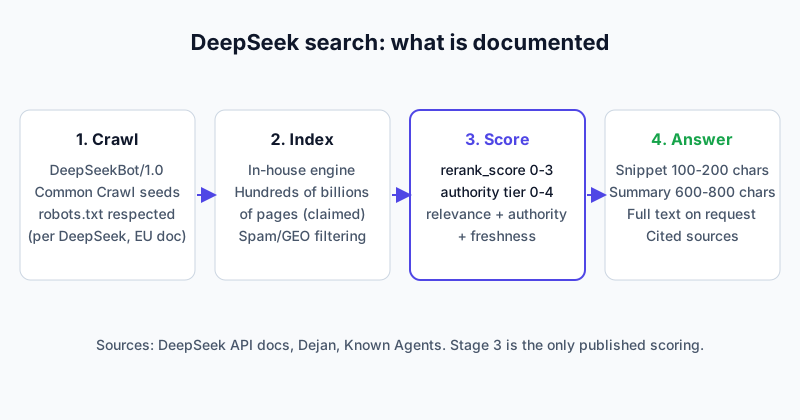
On the DeepSeek API documentation, the Search API "finds web pages for a query and returns structured results" and "is powered by DeepSeek's in-house search engine". A companion Fetch API takes one URL and returns its content as Markdown. Both sit under api.deepseek.com, and the docs add that fetching is "subject to the target site's availability and access policies".
Dan Petrovic of Dejan, author of the most detailed outside analysis reviewed, reports that DeepSeek describes the index as holding hundreds of billions of pages and handling hundreds of millions of search requests a day, and that the same engine serves the consumer app. Treat those size figures as DeepSeek's own claims. Nobody outside the company has measured them, as Dejan itself notes.
The practical meaning for a publisher: when someone toggles search in DeepSeek, the answer is built from pages that this engine retrieved. Your job is to be in that retrieval set, and then to be the page the model quotes.
From Bocha to its own index: a short timeline
The story matters because most "how to rank in DeepSeek" advice was written for an older architecture.
| Period | What was reported | Where it comes from |
|---|---|---|
| 2025 | The DeepSeek app's web search ran on Bocha, a Chinese search API provider | Dejan, citing a National Business Daily interview with Bocha's CTO |
| Dec 2025 | Search agents in the V3.2 paper were evaluated with "a standard commercial search API" | DeepSeek-V3.2 technical report, as cited by Dejan |
| Feb 2026 | English privacy policy says DeepSeek integrates third-party APIs for search | DeepSeek privacy policy, as cited by Dejan |
| Sep 2026 | The V4.1-Flash report mentions "our crawling system", rebuilt from Common Crawl | DeepSeek technical report, as cited by Dejan |
| 17 Oct 2026 | Search and Fetch APIs launched on the in-house engine | DeepSeek API docs and launch notes |
Two caveats. First, no source says when the Bocha arrangement ended, so a blend of providers in some surfaces is possible. Second, the privacy policy predates the launch by eight months and does not say whether any search traffic still goes to an outside vendor. The New Stack (19 October 2026) likewise reports it is not clear whether DeepSeek has entirely replaced its external search suppliers, so a clean cutover should not be assumed.
What the Search API returns
The response schema is the best window available into how DeepSeek thinks about a page. Here it is, condensed from the official docs.
| Field | What it holds | Why a publisher cares |
|---|---|---|
rerank_score |
0 to 3, combining relevance, authority and freshness; 1.5 or above counts as high quality | The only documented blended quality score |
authority |
Tier 0 to 4, where 3 or above means highly authoritative and -1 means unknown | Explains why obscure domains lose to established ones |
snippet |
Typically 100 to 200 characters, meant for display | Your opening text and meta description feed this |
summary |
Typically 600 to 800 characters, meant to be read by a model | A tight, factual first section survives summarisation |
date |
Publication time in UTC, or null when unknown | Missing dates cost you on freshness |
content |
Full page text, returned only on request | The model can read the whole page, not just the snippet |
Notice what is missing. There is no field for review count, star rating, schema type or city. The weights you will read about elsewhere do not map onto this schema at all.
The query syntax is also telling. Requests accept site:, -site:, quoted phrases, lang:, after: and before:. That is a conventional search engine toolkit, and it means an agent can ask for fresh pages from one domain in one language. If your site ships without dates, it cannot win an after:2026 query.
DeepSeekBot, robots.txt and the crawler puzzle
DeepSeek's crawler identifies itself with this string:
Mozilla/5.0 (compatible; DeepSeekBot/1.0; +https://www.deepseek.com/)
Known Agents classes DeepSeekBot as an AI data scraper used for model training, reports that 11% of the top 1,000 websites block it, and marks its effect on AI chat and search visibility as "Not directly". Dejan reports that DeepSeek's EU training-data summary says the crawler respects robots.txt.
Here the sources split. Menra states that DeepSeek publishes no official crawler documentation, verified user-agent list or IP ranges. xSeek goes further and says DeepSeek publishes no crawler user agent at all. That conflicts with Known Agents and Dejan, who both give the string above. The most consistent reading: the string exists and appears in logs, but DeepSeek has not documented it in a way third parties can verify, and nobody has published the Fetch endpoint's identity.
The consequence is uncomfortable. If you block DeepSeekBot in robots.txt, you may stop training use without touching search retrieval, or you may block more than you intended. Nobody can currently prove which. Until DeepSeek names a search crawler, do not block DeepSeekBot unless you have decided you do not want DeepSeek visibility.
If you do want to be reachable, a plain allow rule is enough:
User-agent: DeepSeekBot
Allow: /
The "ranking weights" you keep reading about
A widely shared guide from Search Atlas (founder Manick Bhan, updated 2 March 2026) says DeepSeek scores content on relevance (30%), reviews (25%), authority (20%), recency (15%) and local presence (10%). It adds a review sub-formula, bonus points for schema markup, and a minimum of five reviews and a "verified Toronto address" for local queries. It says DeepSeek pulls 100 organic and 50 local results from Google Custom Search, Bing Web Search, Google Maps Places API and Yelp Fusion.
Those numbers do not appear in DeepSeek documentation, in the papers Dejan lists, or in the API reference. The Toronto and Yelp details read like the result of a local-business test on one query set, presented as a rule. The article also predates the October 2026 engine launch, so its description of Google and Bing as the retrieval backbone may be out of date even if it was once accurate for some surface.
So how should you use it? As a hypothesis list, not a spec. The themes (relevance, authority, freshness) do line up with the three things DeepSeek says rerank_score combines. The percentages and the local-business mechanics do not have support.
Analysis of the reviewed walkthroughs
Three third-party video walkthrough transcripts were reviewed for this guide. They are not about being cited by DeepSeek. All three are about using DeepSeek to produce SEO content, and that distinction matters. Traffic and click figures quoted by the presenters are self-reported and differ between the videos, so none are repeated here.
- Transcript 1 (an SEO educator demonstrating DeepSeek V4): the presenter compares "expert" mode with DeepThink and search enabled against faster "instant" mode, says no usage limits have been seen on the free chat site, and says Claude writes better for him. He recommends a human quality-control checklist covering E-E-A-T and search intent before publishing.
- Transcript 2 (DeepSeek Harness walkthrough): describes an MIT-licensed, plugin-based agent harness, a "trajectory view" for auditing which files an agent read, and a split where V4 Pro handles strategy and V4 Flash handles volume work. The GitHub repository confirms the MIT licence and the "everything is a plugin" design.
- Transcript 3 (R1 blog workflow): the presenter says DeepSeek's own search crashed repeatedly over two days because of demand, so he fed research from Perplexity into the model instead.
The one finding relevant to this page is indirect: the R1 video shows DeepSeek's search feature failing under demand at that time, which is consistent with Dejan's report that search then ran on an outside provider. Nothing in the transcripts tests citation behaviour.
How DeepSeek differs from its neighbours
DeepSeek sits with Qwen and Kimi among the Chinese open-model engines, yet its retrieval story is different from theirs. See the guides on Qwen search and Kimi search for how those assistants retrieve and cite. Against the independent-index crowd, Brave Search AI and Perplexity AI search have longer public track records for their indexes, whereas DeepSeek's is brand new and only partly documented.
One structural point stands out. DeepSeek exposes the engine as a paid API for other agents. DeepSeek Harness, Claude Code and Codex can call it, and calls from those tools are free until 00:00 Beijing time on 1 November 2026, after which each endpoint costs $0.75 per 1,000 successful requests, per the API docs. That means your pages may be retrieved by third-party agents that are not the DeepSeek chat app. Visibility here is broader than one product.
What to do with this
Start with access and clarity. Make sure DeepSeekBot is not blocked, serve content in the initial HTML, add visible publication dates, and open each page with a direct answer. Then measure by asking DeepSeek your target questions with search on, and log which domains appear. The full playbook, including a robots.txt checklist and a prompt-testing routine, is in how to rank in DeepSeek. The approach to testing is described on the methodology page.
Frequently asked questions
Does DeepSeek have its own search engine?
DeepSeek's API docs say its Search API is powered by an in-house engine, launched on 17 October 2026. Earlier in 2025 the app reportedly used Bocha. Whether any third-party provider remains in some surfaces is not stated.
What is the DeepSeek crawler called?
The string seen in logs is DeepSeekBot/1.0. Known Agents lists it as a training-data crawler. DeepSeek has not named a separate bot for its search index, and some directories say it publishes no user agent at all.
Can I block DeepSeek from training on my site without leaving search?
Not reliably today. A robots.txt rule for DeepSeekBot may affect only training or more than that, and no one has published evidence either way. Blocking CCBot affects Common Crawl, which DeepSeek has said it used as a crawl seed.
Are the 30/25/20/15/10 ranking weights real?
No DeepSeek source for them was found. They come from a vendor guide and conflict with DeepSeek's documented fields, which are rerank_score and authority.
Which signals does DeepSeek document?
Only that rerank_score combines relevance, authority and freshness, and that authority runs from 0 to 4. Everything finer than that is inference.
Does DeepSeek show citations?
The third-party site chinaai.chat describes visible web results and sources when search is on, but the interface changes often and this guide did not verify the current layout. Check the current app before relying on a specific layout.
Limits of this guide
- Verified against the source: the Search and Fetch API fields, operators, pricing and rate limits (DeepSeek API docs), and the
DeepSeekBot/1.0string (Known Agents). - Reported, not verified: index size, query volume and spam filtering (DeepSeek statements relayed by Dejan); the Bocha history and the V3.2 and V4.1-Flash report quotes (Dejan); the Search Atlas weights (vendor claim, unsupported by DeepSeek documents); crawler publication status (Menra and xSeek, which conflict with Known Agents). Rate limits conflict too: the docs list 100 queries per second for Search and 25 for Fetch, while Dejan reports 5, and the docs are followed here.
- Missing: no controlled citation test was run for this guide, and the three video transcripts cover content production, not retrieval. DeepSeek's interface, pricing and promotions change quickly, so recheck dates before acting. The ordered checklist is in how to rank in DeepSeek.
Sources
- Search & Fetch, DeepSeek API Docs
- Search API reference, DeepSeek API Docs
- DeepSeek made its name with cheap AI models. Now it's undercutting search API rivals, too, The New Stack, 19 October 2026
- DeepSeek Search Engine, Dejan (Dan Petrovic, 18 Oct 2026)
- What is DeepSeekBot?, Known Agents
- DeepSeek Crawlers Explained, Menra
- DeepSeek Search: Web Results, Sources & API Limits, chinaai.chat
- DeepSeek user agents, xSeek Docs
- DeepSeek Harness repository, GitHub
- How To Rank In DeepSeek AI?: Importance, Strategies, and Tools, Search Atlas (Manick Bhan), updated 2 March 2026
- Video walkthrough transcripts (3), third-party creators: DeepSeek V4 SEO workflow, DeepSeek Harness, and DeepSeek R1 blog workflow, reviewed 2026 (original URLs not available)