Google Gemini does not keep a web index of its own: when it needs fresh facts, it asks Google Search and builds the answer from what comes back. That one design choice explains most of what publishers need to know about being cited by it. If your page is not crawled, indexed and retrievable in Google Search, Gemini has nothing to quote.
What Google Gemini is, and which part is searchable
"Gemini" names a family of models and also the consumer assistant that runs on them. For publishers the useful distinction is between three surfaces that share the same models but behave differently. The Gemini app is a chat assistant that can pull in live web results. Grounding with Google Search is the developer feature that gives any application built on the Gemini API the same ability. And the Google Search AI features (AI Overviews, AI Mode) are a separate product. They are covered on the pages for Google AI Overviews and Google AI Mode, and this guide keeps them apart on purpose.
Why bother separating them? Because the controls differ. A rule that removes you from Gemini answers will not necessarily touch AI Overviews, and the reverse is also true. Mixing the surfaces is the most common mistake in articles on this topic.
How grounding with Google Search works
Google's developer documentation describes the loop in plain steps. The app sends a prompt with the google_search tool enabled. The model analyzes the prompt and determines whether a Google Search can improve the answer. If so, it generates one or several search queries and runs them. It then processes the results, synthesizes them, and returns a response with citations. According to Google AI for Developers, this works with all available languages.
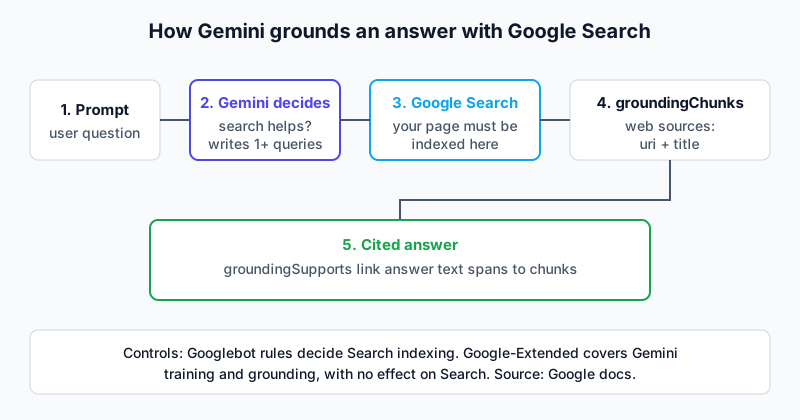
Two things matter here. First, the model chooses whether to search at all, so some questions get no web lookup and no citation. Second, the queries are written by the model, not typed by the user, so a page that matches the sub-question can win without matching the user's exact wording.
What the response exposes
When grounding succeeds, the API response contains a groundingMetadata object. Google's reference lists the pieces that matter to a publisher:
webSearchQueries: the queries the model actually ran.groundingChunks: the web sources retrieved, each with a URI and a title.groundingSupports: links from segments of the answer text (start and end index) to one or more chunks. This is what lets an interface show an inline citation next to a specific sentence.
This is useful beyond curiosity. If you build or test with the API, webSearchQueries shows you the real sub-questions your content needs to answer. It is the closest thing to a public keyword report that Gemini offers.
Where Gemini gets its sources
The answer to "what index does it use?" is Google's. Google's crawler documentation states that Google-Extended manages whether content crawled from your site may be used for training future Gemini models and for grounding, defined as "providing content from the Google Search index to the model at prompt time to improve factuality and relevancy". The grounding clause names Gemini Apps and Grounding with Google Search on Vertex AI.
A secondary source, the Menra crawler guide (July 2026), summarizes it as Gemini having no crawler of its own. That is a fair shorthand, but it is a third-party interpretation of Google's documents rather than something Google says in those words.
| Component | What it is | Visible in your logs? | Effect of blocking it |
|---|---|---|---|
| Googlebot | Crawler that builds the Google Search index | Yes | Affects Google Search and its features |
| Google-Extended | robots.txt product token, no separate user agent | No | Stops training and grounding use for Gemini; Search unaffected |
| GoogleOther | Generic crawler for R&D and one-off fetches | Yes | No specific product affected, per Google |
| Google-InspectionTool | Search Console testing fetcher | Yes | Affects testing tools only |
Table built from Google's "common crawlers" documentation, last updated 15 October 2026.
The Google-Extended switch
Google states plainly that Google-Extended "does not impact a site's inclusion in Google Search nor is it used as a ranking signal". It is also not a user agent you will see in logs, because crawling is done with existing Google user agents and the token only acts as a control. A publisher who wants out of Gemini training and grounding writes:
User-agent: Google-Extended
Disallow: /
Marie Haynes, writing in April 2025, interprets the effect this way: if you block the token, you will not appear as links recommended within the Gemini app. That is her reading, and Google's own text only says the token covers grounding in Gemini Apps. Either way, think twice before copying a blanket AI-bot block from a template. If your goal is to be cited, this line removes a surface you could otherwise appear on.
What Gemini does with a page it retrieves
Google does not publish a ranking formula for Gemini citations, and anyone quoting weights is guessing. What can be described comes from the documented loop plus careful reading of third-party material.
The retrieval step is Search, so the usual prerequisites apply: the page is crawlable, indexable, and relevant to the model's generated query. After that, the model synthesizes and attributes. A citation is therefore a pointer, not a guarantee that the page supports the sentence it is attached to. The practical steps that follow from this are in how to rank in Gemini.
Passages, not pages
Several agency articles argue that generative systems retrieve passages and reward self-contained answers. Mintec Blog (July 2026) puts it as a test: could a section be quoted in isolation and still make sense? Google's grounding output is consistent with that idea, since groundingSupports links individual text segments to sources. Still, the documentation does not state that passage extraction is how selection works, so it is best treated as a sensible editorial hypothesis.
The cheapest improvement you can make is to write sections that answer one specific question in the first one or two sentences. It costs nothing, it helps human readers, and it does not depend on any unverified claim about the model.
Signals people claim, and how much to trust them
The archived articles and the three video transcripts reviewed repeat a handful of ideas. Here is how much weight each deserves.
| Claim | Who says it | Confidence |
|---|---|---|
| Structured data (FAQ, Article, Organization) helps AI understand a page | Gravitate (May 2025), Mintec Blog (July 2026), video presenter | Low to medium: Google says no special optimization is required for its AI features |
| FAQ schema pages are cited "roughly 2-3x more" | Mintec Blog internal A/B tests | Low: single agency, method not published |
| Pages older than 90 days lose about 40% of citation rate | Mintec Blog, 40+ pages over three months | Low: small sample, AI Overviews context |
| Third-person writing and listicles help | Video presenter | Low: anecdotal, self-reported |
| Entities and topical authority beat keyword repetition | Gravitate, Mintec Blog | Medium: consistent with how Search works, no controlled test |
None of these claims is crazy. Most are good writing practice. What they lack is evidence tied to Gemini specifically, and the single official statement located points the other way for Search AI features: Google says there are no additional requirements to appear in AI Overviews or AI Mode. That page is about Search, not the Gemini app, but it is the closest official guidance.
Analysis of the reviewed walkthroughs
Three video walkthrough transcripts were reviewed for Gemini, and their material is uneven. Two come from the same channel, run by an SEO agency owner. In one, the presenter says Gemini 3.0 powers Google's AI Mode and recommends schema markup, FAQ sections and organized headings, plus a five-prompt workflow: an outline, the article, JSON-LD, video and image prompts, and four related articles with an internal linking plan. No measurement is shown for that workflow.
In the other, the presenter shows his own sites appearing in AI Mode for "best AI community" with three source links, two of them videos. He recommends several formats per keyword, listicles, third-person writing, and several sites targeting similar keywords. He also reports traffic growth. Traffic figures from presenters are self-reported and differ between videos, so none are quoted here. He names a model that could not be matched to any verifiable model name, so it is not repeated.
The third transcript is a case study about a ranking contest for new local-business microsites on Google. It is not about Gemini. Its relevance is indirect: after six days, the presenter reports (Rank Expander Academy) that heavier queries were won by established profile platforms rather than new sites, which is a useful reminder that Gemini grounding inherits the competitive reality of Google results.
What publishers can and cannot control
| Lever | Controls Gemini? | Notes |
|---|---|---|
| Googlebot rules / noindex | Yes, indirectly | Removing from Search removes the retrieval pool |
| Google-Extended | Yes (training and grounding) | No effect on Search, per Google |
| nosnippet, data-nosnippet, max-snippet | Limits displayed text | Google lists these for Search AI features |
| Submitting content to the model | No | Gravitate states you cannot submit directly |
| Schema markup | Unproven | Helps general understanding in Search |
Consider a hypothetical. A retailer publishes "Best cordless drills for tiling". Asked "what drill for ceramic tile?", Gemini might write sub-queries about bit speed or hammer mode. A page with labelled sections on those has a chance; a generic buyer's guide probably does not. This illustrates query rewriting, not a measured result.
Where to go next
What counts as evidence on this site is explained in the methodology. For the order of operations, from indexing to measurement, read how to rank in Gemini. Neighbouring Google surfaces are covered in Google AI Mode.
Frequently asked questions
Does Gemini have its own crawler?
Google documents Googlebot for Search and Google-Extended as a control token without its own user agent. Gemini grounding draws on the Google Search index, so a third-party guide describes Gemini as having no crawler of its own. That summary matches Google's wording about grounding, but it is an interpretation.
Does blocking Google-Extended hurt my Google rankings?
Google says it does not. The token does not affect inclusion in Google Search and is not a ranking signal. It does cover Gemini training and grounding, so blocking it can take you out of those uses.
Will Google-Extended remove me from AI Overviews?
No, based on Google's pages. Google says robots.txt rules for Googlebot are the control for Search AI features, and snippet controls limit what is shown. Google-Extended is described for Gemini Apps and Vertex AI.
Is a Gemini citation the same as an AI Overview citation?
No. They are different products with different controls, even though both lean on Google Search. A page may appear in one and not the other, and no data comparing them was found.
Do I need schema markup to be cited?
Google says there are no extra requirements for its Search AI features. Schema helps machines read the page and can earn rich results, but no controlled evidence was found that it changes Gemini citations.
Limits of this guide
- Verified: the grounding loop, the
groundingMetadatafields, the Google-Extended definition and its no-effect-on-Search statement, and the "no additional requirements" line for Search AI features (Google documentation, read October 2026). - Reported: the 2-3x FAQ effect and the 90-day citation decay (Mintec Blog, an agency; both concern AI Overviews), the Menra and Marie Haynes interpretations, and every claim made by video presenters, which are self-reported.
- Missing: Google publishes no ranking formula for Gemini citations, and no controlled Gemini tests were available to this publication. One model name in a transcript could not be confirmed and is omitted.
Sources
- Grounding with Google Search, Gemini API, Google AI for Developers (read October 2026)
- Grounding with Google Search overview, Google AI for Developers (read October 2026)
- GroundingMetadata reference, Google Cloud, Vertex AI documentation (read October 2026)
- Google's common crawlers, Google for Developers, last updated 15 October 2026
- AI features and your website, Google Search Central, last updated 10 December 2025
- Gemini Crawlers Explained, Menra, July 2026
- Should you use Google-Extended in robots.txt?, Marie Haynes Consulting, April 2025
- AI Search SEO: How to Rank on ChatGPT, Perplexity, & Gemini, Chad Stoecker, Gravitate, 19 May 2025
- How to Rank in Google AI Overviews: The GEO Framework for AI Citation, Mintec Blog, 25 July 2026
- Video walkthrough transcript, "This Gemini 3.0 SEO trick is insane" (AI Mode and schema workflow), Julian Goldie / Goldie Agency (third-party creator), reviewed 2026; no public URL confirmed
- Video walkthrough transcript, "how to rank number one inside Google Gemini" (AI Mode example queries), Julian Goldie / Goldie Agency, reviewed 2026; no public URL confirmed
- Video walkthrough transcript, microsite SEO contest case study (local-business sites on Google), Rank Expander Academy (third-party creator), reviewed 2026; no public URL confirmed