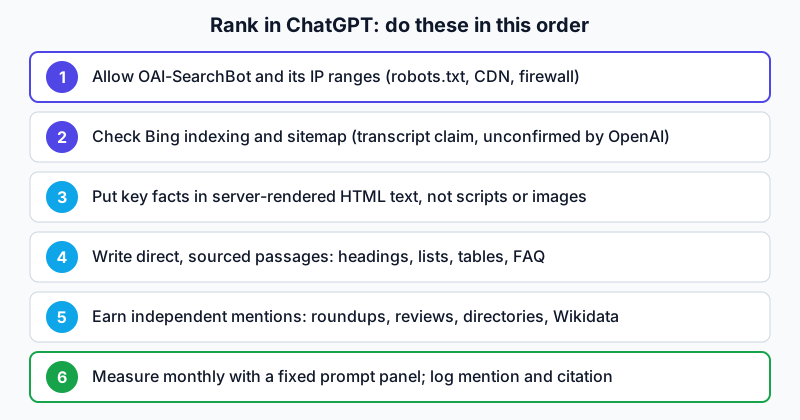
To rank in ChatGPT you first have to be allowed in, and for most sites that is a robots.txt and firewall question, not a content question. The word "rank" is shorthand here. OpenAI says ChatGPT "ranks search results using multiple factors" and that placement is not guaranteed, so what follows is a plan to become eligible, readable and credible, not a recipe for a fixed position. Each step is tagged by how well it is backed: documented by OpenAI, claimed by third parties, or editorial judgment.

How each step is graded
Before the steps, a quick note on evidence, because this topic is full of confident numbers. Every recommendation carries one of four labels, the same scheme described on the methodology page.
| Label | Meaning | Example in this guide |
|---|---|---|
| Documented | Stated by OpenAI in its own pages | Allow OAI-SearchBot to be eligible |
| Reported | Claimed by a third party, not verified | "Meaningful movement takes 6 to 12 months" (Smart Money Media) |
| Observed | Seen in the video walkthrough reviewed | Raw HTML is what AI systems mostly read |
| Judgment | Editorial opinion, with reasoning | Refresh a page only when its facts change |
If you want the background on how the engine works before you start, read the ChatGPT Search overview. This guide is the action list.
Step 1: Get access right for OAI-SearchBot
This is the only step with a hard rule behind it. OpenAI's help center says that to make a website eligible for inclusion you should "allow OAI-Searchbot to crawl the site and confirm that the website host or content delivery network allows traffic from OpenAI's published searchbot IP addresses".
Two layers need to agree: robots.txt, and whatever sits in front of your server (a CDN, a web application firewall, a bot-protection service). A lot of sites pass the first layer and fail the second without knowing it. If your firewall challenges or blocks OpenAI's published IP ranges, a perfect robots.txt will not get you into ChatGPT search answers.
Here is a robots.txt that allows search inclusion, declines training use, and leaves the rest of your rules intact:
User-agent: OAI-SearchBot
Allow: /

User-agent: GPTBot
Disallow: /

User-agent: *
Disallow: /admin/
Sitemap: https://example.com/sitemap.xml
The two bots are independent settings; the reasoning is in the crawler section of the overview.
Checklist for this step:
- Open
yourdomain.com/robots.txtand confirm there is no blanketDisallow: /that applies to OAI-SearchBot. - Fetch the published IP list for the search bot (a JSON file linked from OpenAI's crawler page) and compare it to your firewall or CDN rules.
- Search your server logs for the OAI-SearchBot user agent. OpenAI's example string includes
OAI-SearchBot/1.4and the version may change. It may also fetch robots.txt with an extrarobots.txtmarker in the string. - Wait. OpenAI says it can take about 24 hours after a robots.txt update for its search systems to adjust.
ChatGPT-User will also appear in your logs. It is user-triggered and not a search-inclusion control (details in the overview), so manage inclusion with OAI-SearchBot rules only. When you read logs, separate the three user agents into three columns: a spike in ChatGPT-User means people asked about your pages, while OAI-SearchBot hits mean the index is being refreshed.
Step 2: Check Bing, without treating it as proof
The Surfer video says ChatGPT search uses Bing's index; OpenAI says only that search "sometimes partners with other search providers". The ChatGPT Search overview lays out that disagreement in full. For action purposes the conclusion is short: Bing indexing is cheap insurance, not a proven lever. The work takes an afternoon and also helps Copilot visibility (see how to rank in Microsoft Copilot), so it earns a place on the list, but not at the top.
What to do:
- Verify the site in Bing Webmaster Tools and submit your XML sitemap.
- Check that your important pages are indexed there, not just in Google.
- Add your business to Bing Places if you are a local entity. The video lists it among aggregator profiles.
Step 3: Make the facts visible in plain HTML
The video walkthrough makes a point that is easy to verify on your own site. In the presenter's words, AI systems "primarily read your raw HTML", so key information that appears only after a JavaScript interaction, or sits inside images or video, can be missed. That claim is not confirmed for every OpenAI fetch, so test it: view your page source (not the rendered inspector) and check that the claim, price, definition or date you want quoted is in the text.
Practical rules:
- Server-render or pre-render pages that matter.
- Do not put pricing, specs or definitions only in images.
- Add descriptive alt text to images and a transcript to video pages.
- Keep important pages within a few clicks of the homepage with descriptive internal links, which the video presents as basic site hygiene.
- Do not hide the core answer behind a paywall without an accessible summary. A GeoRankers guide makes the same point in plain words: models cannot cite what they cannot reach.
Step 4: Write passages that answer the rewritten query
ChatGPT search rewrites a prompt into targeted queries (the mechanism is described in the overview). The practical reading is that you are optimising for sub-questions. A page titled "Everything about project management software" is a weak match for "Gantt chart export formats in tool X". A page, or a clearly headed section, that answers that exact sub-question is a stronger candidate. That is judgment, not an OpenAI rule, but it follows directly from how OpenAI describes the process.
A before and after
Weak opening:
Our software has many features that help teams work better, including integrations and reporting that customers love.
Stronger opening, with a self-contained fact:
Acme Planner exports Gantt charts to PDF, PNG and CSV. It integrates natively with Salesforce and Slack. Exports are available on all paid plans as of October 2026.
The second version names the subject, states checkable facts, and carries a date. An excerpt from it stays accurate even without the surrounding page. The Surfer transcript gives a similar example: a FAQ entry such as "Does your software integrate with Salesforce?" followed by "Yes. Our software offers a native Salesforce integration." (the date and product in the example above are invented placeholders for illustration, so replace them with your own checked facts).
Structure that helps readers and extractors
The video recommends clear heading hierarchy, bullet or numbered lists for steps, FAQ blocks and tables for comparisons, saying an AI "might even quote a specific cell". No OpenAI page says ChatGPT prefers these formats. Still, they help people scan, and the Smart Money Media guide classifies them as plausible practice rather than documented rules. They are cheap and low risk.
| Format | Use it for | Evidence level |
|---|---|---|
| Direct answer under a descriptive heading | A single question | Judgment, consistent with query rewriting |
| Numbered list | Steps, ordered processes | Observed (video recommendation) |
| Comparison table | Specs, pricing, features | Observed (video recommendation) |
| FAQ section with matching FAQPage markup | Follow-up questions | Observed; markup must match visible text |
| Dated facts and named sources | Time-sensitive claims | Judgment |
Step 5: Add schema, but expect nothing magical
The video describes Organization schema (name, logo, social profiles) and Article schema (publication date, author, headline) as useful. It also reports that Google confirmed there is no secret AI tag, and it states that schema does not guarantee rich results or AI visibility. The Smart Money Media guide agrees: no reviewed source makes schema an AI-citation prerequisite, and structured data must match visible content.
So implement it, keep it truthful, and do not expect a jump. A minimal Organization block:
{
  "@context": "https://schema.org",
  "@type": "Organization",
  "name": "Example Co",
  "url": "https://example.com",
  "logo": "https://example.com/logo.png",
  "sameAs": [
    "https://www.linkedin.com/company/example-co"
  ]
}
Only include profiles you actually control. Mismatched or invented markup creates more risk than benefit.
Step 6: Build independent corroboration
Your own site is one voice. The video argues that AI systems also consider what the rest of the web says about you: quality backlinks, mentions in industry publications, reviews and inclusion in "best of" roundups. Its travel blog example is memorable: being listed in a "top 10 travel blogs" article on a well-known site is, in the presenter's words, "pure gold", and a mention without a followed link still has value because language models may sample that text.
The GeoRankers playbook gives a parallel view. It recommends engaging on Reddit, Stack Overflow and Quora, collecting detailed customer reviews on sites such as G2 or Capterra, and keeping messaging consistent across blog posts, case studies and documentation. It also leans on the GEO study (Aggarwal et al., 2024), which tested adding statistics, quotations and citations to content and reports visibility improvements of up to 40% in the paper's benchmark. That benchmark covers research settings for generative engines, not ChatGPT Search specifically. GeoRankers sells a monitoring tool, so its framing is commercial.
Actions that follow from this:
- List 10 roundup or comparison articles that already rank for your category and pitch them with a specific reason to include you.
- Create or correct profiles on directories in your niche. The video names Wikidata, Google Business Profile, Bing Places, Yelp, Apple Maps, LinkedIn, Crunchbase, IMDb and PubMed as examples, depending on your sector.
- Publish original data or a genuinely useful reference that others have a reason to cite.
- Describe your product in the same words everywhere.
Be wary of anything that promises a mention multiplier. The Smart Money Media guide says no universal outlet, link or mention weight is documented.
Analysis of the reviewed walkthroughs
One transcript was reviewed for ChatGPT (a Surfer talk by Matt Canyon, the same one summarised in the overview). It contains no logged ChatGPT experiment, only a framework with figures borrowed from third-party studies, all self-reported by the presenter. The points that change what you do:
- Strong traditional SEO is the foundation; "you likely won't show up in AI responses if you don't first rank well organically".
- Check that robots.txt does not disallow GPTBot, Google's crawlers or Bingbot.
- Content is more likely to be quoted when it reads like a human expert explaining, with clear sections and FAQs. He attributes an inclusion gain to an unnamed 2024 study, which could not be verified.
- Topical authority is, in his experience, the most reliable route to brand mentions and backlinks.
- Tracking brand mentions is the best current measure because conversational answers often produce no click.
There is a tension worth stating. The video says rank well organically first, while the Smart Money Media guide reports from its own dated sample that some cited pages sat outside the captured organic top 20, and many top-10 pages were not cited. Both can be true, because the samples and methods differ. The defensible position is to treat organic strength as helpful but not sufficient.
Measure like a scientist, not a gambler
Because the platform does not publish weights, the only way to know whether your changes work is to measure the same prompts over time. The Smart Money Media guide recommends logging engine, product mode, date, session, location, mention, citation, source and answer accuracy, and warns against turning one answer into a rule. OpenAI's own pages explain why: location, memory and query rewriting all change what gets searched.
A simple log format:
| Date | Prompt | Mode | Location | Brand mentioned | Page cited | Accurate? |
|---|---|---|---|---|---|---|
| 2026-11-01 | best project planner for agencies | Search on | Lyon, FR | No | None | n/a |
| 2026-11-01 | Acme Planner Gantt export formats | Search on | Lyon, FR | Yes | /features/export | Yes |
| 2026-12-01 | best project planner for agencies | Search on | Lyon, FR | Yes | /compare/planners | Partly |
| 2026-12-01 | Acme Planner Gantt export formats | Search on | Lyon, FR | Yes | /features/export | Yes |
The rows are illustrative, not real results. Rules for a fair test:
- Fix 20 to 30 prompts that reflect qualified buyer questions, including a few for your brand name and a few for category searches.
- Run them on the same cadence (monthly is plenty) with the same account type and location.
- Record mentions and citations separately, since a brand can be named without a link.
- Check whether each cited source supports the claim. OpenAI itself tells users that citations can be incomplete or incorrect.
- Review your server logs for OAI-SearchBot activity and, separately, any referral traffic you can identify as coming from ChatGPT. Do not claim causation from either.
The Smart Money Media guide proposes a minimum six-month measurement horizon and says meaningful movement commonly takes 6 to 12 months or longer. That is a vendor's estimate, but it matches the lag you will likely see when crawling, indexing and content changes stack up.
Common mistakes
- Blocking by name pattern. Disallowing every AI-related user agent also blocks OAI-SearchBot and removes you from answers.
- Forgetting the firewall. robots.txt allows the bot, the CDN does not.
- Judging after an hour. Allow roughly 24 hours for robots.txt changes, per OpenAI.
- Treating llms.txt as a lever. Smart Money Media's guide says it is not a documented control for ChatGPT search.
- Re-dating unchanged pages. The Smart Money Media guide advises against changing modified dates without a substantive update, which also protects trust with readers.
- Quoting vendor statistics as facts. Numbers like "3.5x citation lift" are claims. Cite them as claims.
For engines with different rules, compare with how to rank in Perplexity and how to rank in Google AI Overviews. For the engine background, the ChatGPT Search overview covers the crawlers, the query rewriting and the open questions.
Frequently asked questions
Do I need to allow GPTBot to rank in ChatGPT?
No. OpenAI treats GPTBot as the training agent and OAI-SearchBot as the search agent, and says the settings are independent. You can allow search and disallow training.
How do I know OAI-SearchBot is visiting my site?
Look for the OAI-SearchBot user agent in your server logs and compare the requesting IPs with OpenAI's published list. The user-agent string includes a version number that may change.
Will ranking first on Google make me appear in ChatGPT?
Not automatically. The video says strong organic rankings are the foundation, while a third-party sample reports cited pages outside the organic top 20 and top-10 pages that were not cited. Treat organic rank as helpful, not decisive.
Does ChatGPT Search use Bing?
A video walkthrough says yes. OpenAI says only that it sometimes partners with other search providers and links Microsoft's privacy statement. It is unconfirmed for any given answer.
How long until I see results?
OpenAI says about 24 hours for robots.txt changes to take effect in search. Content and authority work takes much longer; one vendor guide suggests 6 to 12 months or more, which is an estimate and not a guarantee.
Should I add an llms.txt file?
You can, as a low-cost experiment, but Smart Money Media's guide says it is not a documented ranking or citation control for ChatGPT search. Do it after the steps above, not instead of them.
Can I pay to be included?
OpenAI documents a separate ads product and an ads crawler (OAI-AdsBot) that checks landing pages. That is advertising, not organic search inclusion, and it is outside the scope of this guide.
Limits of this guide
- Verified: the OAI-SearchBot eligibility rule, bot independence, the 24-hour delay, ChatGPT-User behaviour and the robots.txt syntax (OpenAI documentation, read October 2026; version numbers on the crawler page may change). The GEO benchmark figure is as stated in the paper.
- Reported: the 6 to 12 month horizon and the sample of cited pages outside the organic top 20 (Smart Money Media, a vendor), the unnamed-study uplift and the Bing-index claim (video presenter, self-reported).
- Missing: no logged ChatGPT experiments were available, so no citation rates are reported and nothing here is a measured ranking factor. Which search partner serves a given answer is unconfirmed.
Sources
- Overview of OpenAI Crawlers, OpenAI, platform documentation (read October 2026)
- Searching the web with ChatGPT (ChatGPT search), OpenAI Help Center (read October 2026; automated fetch returned HTTP 403, text taken from the saved copy)
- LLM SEO: How to Rank in ChatGPT, Perplexity & Gemini, Smart Money Media, published 1 July 2026, updated 29 September 2026
- The GEO Playbook, GeoRankers, last updated September 2026
- GEO: Generative Engine Optimization, Aggarwal et al., arXiv, 2024
- Video walkthrough transcript, "AI search" talk by Matt Canyon, Surfer (third-party creator), reviewed 2026; this is the single ChatGPT transcript in the review set, and no public URL was confirmed