To rank in Mistral Le Chat, you first have to accept an awkward fact: nobody outside Mistral knows its ranking rules, and the assistant has been renamed Vibe, so most of what you read online is either stale or sold to you. This guide sticks to what Mistral itself documents, adds what independent reporting supports, and labels everything else as judgment.

What "ranking" means in Mistral Le Chat
There is no results page with positions. A user asks a question and gets a written answer, sometimes with links. When web search is on, the interface shows a globe icon, inline links and a Sources panel, according to the Vibe Work documentation. So "ranking" here means three outcomes, in rising order of value:
- Retrieved: your page was fetched or indexed.
- Cited: your URL appears in the Sources panel or as an inline link.
- Named or recommended: the answer text itself mentions your brand or quotes your fact.
You can influence the first reliably, the second with decent odds, and the third mostly through reputation outside your own site. If you want the background on how the engine is assembled, read the Mistral Le Chat overview first; this page is the action plan.
A note on naming. Le Chat became Vibe on 28 May 2026 according to Mistral's announcement, and the Mistral Help Center says accounts and conversations carried over. Searchers still type "Le Chat", so this guide uses both names.
The priority order at a glance
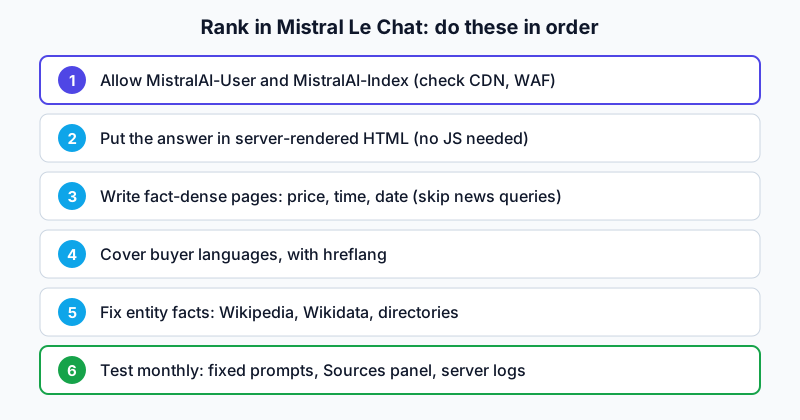
The order is deliberate. Access comes before content because a blocked page cannot be read, and content comes before testing because testing an unready site produces misleading results.
| Priority | Action | Evidence level | Effort |
|---|---|---|---|
| 1 | Allow MistralAI-User and MistralAI-Index | Documented by Mistral | Low |
| 2 | Make answers visible in server-rendered HTML | Documented limits of Open URL; standard SEO practice | Medium |
| 3 | Write fact-dense pages for non-news queries | Judgment, consistent with agency advice | High |
| 4 | Cover the languages your buyers use | Mistral's AFP and Wikimedia posts stress multilingual data | Medium to high |
| 5 | Fix entity facts on Wikipedia, Wikidata and review sources | Mistral says it ingests Wikimedia snapshots | Variable |
| 6 | Run a fixed prompt test monthly | Method, not a ranking factor | Low |
Step 1: let the right crawlers in
Mistral's crawler documentation defines three user agents, and the overview explains what each one does. For this checklist the point is operational: MistralAI-User and MistralAI-Index relate to answers and search, while MistralAI-Training only relates to model datasets.
Blocking the wrong token can remove you from the one place that would have cited you, so read your robots.txt before you touch anything else.
Many pages written about Mistral SEO mention only MistralAI-User. The Archipel page does exactly that, so it should not be treated as current. Mistral's own list has three entries. Start by finding out what your server already does with them:
grep -E "MistralAI-(User|Index|Training)" access.log | awk '{print $9}' | sort | uniq -c
A column of 200s means access works. A column of 403 or 429 means something upstream is rejecting the crawler, whatever robots.txt says.
A robots.txt you can adapt
User-agent: MistralAI-User
Allow: /

User-agent: MistralAI-Index
Allow: /

# Optional: opt out of model training only
User-agent: MistralAI-Training
Disallow: /
Whether to disallow training is a policy call. No statement from Mistral links training exposure to citation likelihood, so neither choice should be expected to move visibility.
Check the layers above robots.txt
A robots.txt that says Allow does nothing if something upstream rejects the request. Work through this list:
- CDN or WAF rules that challenge unknown bots with JavaScript or CAPTCHAs.
- Rate limits that return 429 to bursts from a single IP range.
- Geo blocks that reject non-local traffic.
- Cloudflare or similar "AI crawler" toggles that block categories by default.
- Server logs: search for
MistralAI-UserandMistralAI-Indexand confirm a 200 status.
Mistral says it publishes IP address lists for each crawler. If your firewall works by IP, use those lists to verify traffic instead of trusting the user-agent string, which anyone can fake. This guide did not fetch the lists, so check the current versions on the crawler page.
One more control exists for enterprise customers. The websearch tool docs say an organization admin can allowlist or blocklist domains, and filtered results are removed silently. That is outside your control, but it explains why a page may be absent for one company's staff and present for another's.
Step 2: make the page readable on the first fetch
Mistral's own help text lists limits for the Open URL tool. It fetches a single page, it cannot reach pages behind a login or paywall, and "some highly interactive websites may not load fully, which can result in incomplete content". The same page says web search can return outdated or incomplete content depending on what the source page exposes.
Those are the retrieval failure modes you can fix.
| Problem | What a fetcher sees | Fix |
|---|---|---|
| Client-side rendered content | Empty shell, maybe a loading spinner | Server-render or pre-render the main text |
| Answer buried below a long intro | Intro, not the fact | Put the direct answer in the first 2 sentences under each heading |
| Paywalled or login-gated body | Teaser only | Expose a summary or key facts in public HTML |
| Content inside images or PDFs | Little or nothing | Provide a text version near the file |
| Tabs and accordions loaded on click | Hidden text | Render the text in the DOM at load |
A fast sanity test: open your page with JavaScript disabled, or run curl against it, and ask whether the answer you want cited is in the response. If not, an assistant that fetches the page may not see it either. This is general technical SEO, and nothing here claims Mistral's fetcher behaves in any particular way beyond what its documentation says.
Step 3: write for the questions Le Chat actually receives
Because Mistral says news queries are served by AFP and AP, chasing news-style questions is poor value. Better targets are the evergreen kinds of question where an assistant needs a clear, checkable source:
- Definitions and how-it-works explanations.
- Comparisons between named products or approaches.
- Prices, timelines, requirements and specifications.
- Local or sector-specific provider questions ("which firm in Munich...").
- Step-by-step procedures.
The Archipel agency lists levers that include precise facts, "prices, timelines, methods, references: verifiable content". That is advice from a vendor, not data. It is included because it is consistent with how retrieval-augmented systems tend to work, and because it costs nothing to follow.
A before and after
Here is a realistic rewrite of a service page opening. The first version is vague; the second can be quoted.
Before: "We offer a full range of accounting solutions tailored to your needs, delivering excellence at every stage."
After: "We prepare annual accounts for limited companies in Germany. A standard filing for a company with fewer than 10 employees takes 10 working days and costs from EUR 900 plus VAT. Prices updated 1 October 2026."
The second version gives an assistant a scope, a duration, a price and a date. Replace the numbers with your real ones. Never publish figures you cannot back up, because a wrong price quoted in an answer is worse than silence.
Structure that helps retrieval
Short sections with descriptive headings make it easier to lift a passage. A sample page skeleton:
- H1 with the topic and a one-sentence definition.
- A "Key facts" list of 4 to 6 items with numbers and dates.
- H2 sections each opening with a direct answer.
- A comparison table where choices exist.
- A short FAQ with real customer questions.
- Author, date and a link to your sources.
Short paragraphs and Q and A sections are also advice from the Keyword.com article, last updated 7 May 2026. Treat it as common-sense formatting, not as Mistral-specific evidence, since that piece mixes up tracking brand mentions in apps built on open weights with ranking in Mistral's own assistant.
Step 4: cover your buyers' languages
Mistral's January 2025 post on the AFP deal says Le Chat would use AFP's wires in six languages: French, English, Spanish, Portuguese, German and Arabic (Mistral AI). The January 2026 Wikimedia announcement quotes Mistral's public-affairs lead on training "on many languages", and says daily snapshots are taken in several languages (Wikimedia Enterprise).
Neither statement says translated pages rank better. They show the company's data strategy is multilingual, so a buyer asking in French will not be looking only at English pages. The practical rule:
- Translate or, better, originally write the pages that answer your commercial questions into each market language you actually serve.
- Use hreflang so engines see the language relationships. Keyword.com recommends this too, and it is standard guidance for any search engine.
- Do not machine-translate and publish thousands of thin pages. Quality beats coverage.
Archipel claims Le Chat's audience is "largely European and multilingual" and strongly used in France. Neither Mistral nor an independent source supplies a usage figure, so treat this as plausible but unmeasured.
Step 5: fix entity facts outside your own site
An assistant answering "what is Company X" leans on facts that are consistent across sources. Mistral says it receives Wikimedia project data daily as an information source for its models. If you qualify for a Wikipedia article or Wikidata entry under their notability and neutrality rules, make sure the facts there are accurate, cited and current. Do not edit these projects to promote yourself; that violates their rules and can backfire.
Other places an assistant may look for corroboration, based on general retrieval practice and agency advice:
- Industry directories and association member lists.
- Review and comparison articles on third-party sites.
- Your own About page with legal name, address, founding year and leadership.
On structured data, adding Organization and Article markup makes facts unambiguous for any parser. There is no evidence that Mistral reads JSON-LD specifically.
{
  "@context": "https://schema.org",
  "@type": "Organization",
  "name": "Example Treuhand GmbH",
  "url": "https://example.com/",
  "foundingDate": "2014",
  "address": {
    "@type": "PostalAddress",
    "addressLocality": "Munich",
    "addressCountry": "DE"
  },
  "sameAs": [
    "https://www.wikidata.org/wiki/Q000000"
  ]
}
Everything in that snippet is a placeholder. Replace the name, year and Wikidata ID with real values, and drop sameAs if you have no entry.
Step 6: test with a protocol, not a hunch
Since there is no rank tracker built into Mistral, you have to measure manually or with a third-party tool. Keyword.com says its AI Visibility Tracker supports Mistral and reports visibility score, sentiment and citation data. That is a vendor description and the tool's accuracy is unverified. A manual protocol works without paying anyone.
The protocol
- Write 10 to 20 questions a real buyer would ask. Mix generic ("best accounting firm in Munich") and specific ("cost of annual accounts for a small GmbH").
- Open Vibe, enable web search, and start a fresh chat for each question.
- Record: date, exact prompt, language, whether the globe icon showed, and every domain in the Sources panel.
- Mark whether your domain appears, and whether your brand is named in the answer text.
- Repeat monthly with the same prompts. Change only one variable at a time.
A logging template
| Date | Prompt | Language | Globe icon | Your domain cited | Brand named | Competitors cited |
|---|---|---|---|---|---|---|
| 2026-11-01 | cost of annual accounts for a small GmbH | EN | Yes | No | No | competitor-a.de, competitor-b.com |
| 2026-11-01 | Jahresabschluss GmbH Kosten | DE | Yes | Yes | No | competitor-a.de |
The rows are illustrative, not real results. Expect variation: the same prompt can return different sources on different days. For that reason, never act on a single run. Look for patterns across a month.
Also watch your server logs. If MistralAI-User hits a page right after you ran a test with that URL, you have confirmed the fetch path works. If it never appears, revisit Step 1.
What not to do
Some advice you will see online deserves skepticism.
- Do not rely on "open weights ignore robots.txt" as an excuse to do nothing. The Keyword.com article makes that claim, but it describes third-party apps built on Mistral's open models. Mistral's own assistant uses documented crawlers with robots.txt tokens.
- Do not pay for backlinks to chase citations. Archipel itself says "never buy backlinks", and there is no evidence they help here.
- Do not publish invented statistics to look citable. A fabricated figure that gets quoted harms you.
- Do not expect quick effects. Mistral does not publish a re-crawl schedule for MistralAI-Index.
- Do not copy an Archipel or Keyword.com plan wholesale. Both sell services tied to the advice.
For perspective on neighbouring engines, Perplexity AI search shows citations more prominently and is easier to test, while Brave Search AI is worth watching because TechCrunch reported in 2025 that Mistral had announced a Brave partnership for search results. Whether that is still the case is unconfirmed. How evidence is weighed is explained on the methodology page.
A 30-day plan
Starting from zero, a sensible split of the month is:
- Week 1: audit robots.txt, CDN and logs; fix blocks; confirm 200s for the Mistral crawlers.
- Week 2: check rendering without JavaScript on your top 20 commercial pages; fix the worst offenders.
- Week 3: rewrite openings of those pages with concrete facts and dates; add or update tables.
- Week 4: run the 10 to 20 prompt protocol, log the baseline, and decide which languages to extend next.
Then repeat the test monthly and adjust. The overview of the engine is at Mistral Le Chat explained, and this checklist lives at how to rank in Mistral Le Chat for future reference.
Frequently asked questions
Does Mistral Le Chat have an official ranking guide?
No. Mistral publishes crawler documentation and help pages for web search, but not a list of ranking factors. Anything beyond access, readability and clarity is inference.
Which robots.txt tokens matter for Mistral?
MistralAI-User and MistralAI-Index relate to live fetches and search indexing. MistralAI-Training relates to model datasets. Mistral documents each separately, so you can treat them differently.
Will my site appear if I only allow MistralAI-User?
It may be fetched when a user pastes a link or when a query leads there, but Mistral says MistralAI-Index builds the search index. Blocking the index crawler could limit discovery. This is untested, so check your logs.
How long does it take to appear after fixing access?
Mistral does not state a re-crawl schedule. Test monthly rather than daily, and rely on server logs to see when crawlers return.
Do I need separate pages for each language?
Not necessarily for every page, but for commercial questions your buyers ask in their own language, a native page is likely to serve better than an English one. Mistral's partnership posts show multilingual data sourcing; they do not prove ranking effects.
Can I track Mistral citations with a tool?
Keyword.com and other vendors say they support it. Their accuracy is unverified, and a manual protocol with the Sources panel is a good baseline.
Limits of this guide
- Verified against Mistral's own pages (read 29 October 2026): the crawler tokens, the Open URL limits, the AFP and AP news lane, the domain allowlist and blocklist, and the Wikimedia partnership. The Vibe rebrand has already changed names in the docs, so recheck before acting.
- Reported, not confirmed: the Brave search arrangement (TechCrunch, 2025), and the Archipel and Keyword.com claims, which are marketing sources used only for advice labelled as such.
- Missing: no video walkthrough of Mistral was available (the two reviewed sources are vendor web pages), Mistral's IP lists were not fetched, and no measured citation results back any step beyond access and readability.
Sources
- Mistral crawlers, Mistral Docs
- Search the web, Vibe Work, Mistral Docs
- Websearch agent tool, Mistral Docs
- Vibe gets to work, Mistral AI, 28 May 2026
- Purr-fectly informed, Mistral AI, 16 Jan 2025
- Mistral AI partners with Wikimedia Enterprise, 27 Jan 2026
- Anthropic appears to be using Brave to power web search for Claude, TechCrunch, 21 Mar 2025
- Mistral SEO: Get Cited by Le Chat, Archipel GEO Agency (vendor page, updated 12 Oct 2026)
- How to Track and Optimize Your Brand Mentions in Mistral AI in 2026, Keyword.com blog (vendor page, last updated 7 May 2026)
- Le Chat is now Vibe, Mistral Help Center, 12 Aug 2026