To rank in YandexGPT you first have to rank in Yandex Search, because the generative answers are assembled from pages that Yandex has already indexed and ordered.

Before you start: who this is for
This guide is for sites whose readers use Yandex, mostly in Russia and nearby markets. Yandex states that quick answers generated with YandexGPT are produced only for the Russian region; the overview of YandexGPT search covers the region limits and the Neuro launch conditions. If Russia is not your audience, the effort will pay back mainly through ordinary Yandex search traffic.
For the background on how the system works, read that overview. This page is the action list.
The recommended order, and why:
| Step | Action | Why it comes here |
|---|---|---|
| 1 | Verify the site in Yandex Webmaster | You need the data and the visibility report |
| 2 | Make pages indexable and not blocked | No index entry, no citation |
| 3 | Pick queries that trigger AI answers | Effort goes where answers appear |
| 4 | Show real expertise | Yandex's first selection criterion |
| 5 | Make pages truly useful and relevant | Matches the user's task |
| 6 | Add original value | Rewrites are discounted |
| 7 | Structure for summarisation | Cleaner passages get used |
| 8 | Feed Yandex more site data | Business, Metrica, Schema.org |
| 9 | Measure Share of Voice and iterate | The only first-party signal |
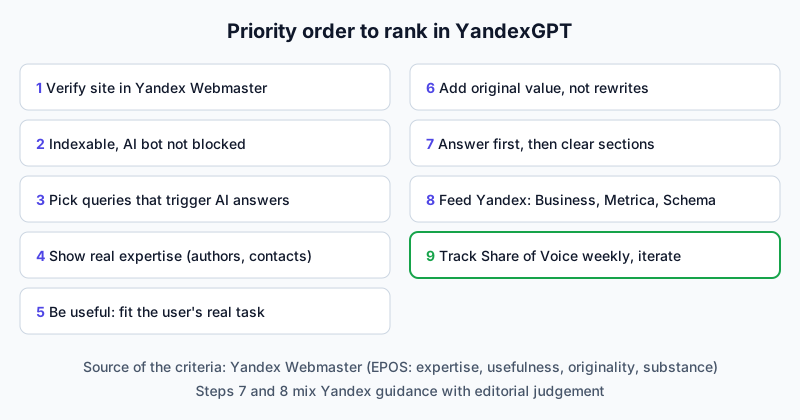
The nine steps to rank in YandexGPT
Step 1: Verify your site in Yandex Webmaster
Everything measurable starts here. Yandex's visibility tool states that to see statistics you must add the site to Yandex Webmaster and confirm rights to it. Do it before you change a single page, so you capture a baseline.
Checklist for the setup:
- Add the site and confirm ownership.
- Open the search queries reports and note which queries already show the site.
- Open "Site visibility in Alice AI" and record what it says. It may say "not enough data". That is a valid baseline too.
- Save a dated screenshot of the report and of your top 20 queries.
Do this for each domain or subdomain you care about. The baseline is the step most often skipped, and without it nobody can tell whether later changes did anything.
Step 2: Make sure Yandex can index and use the page
Yandex's help is direct: answers are generated from pages indexed by Yandex. A page that is not in the index cannot be a source. A page that is in the index but blocked for the AI bot can be a source for classic results only.
Check robots.txt for the AI bot.
Search your robots.txt for YandexAdditional, YandexAdditionalBot, a blanket Yandex record and a blanket * record. Yandex's robots.txt documentation says a robot looks for records containing Yandex or *, and if a User-agent: Yandex record exists the * record is ignored. A broad Yandex block therefore overrides everything you wrote under *.
A safe configuration for a site that wants to be cited:
User-agent: Yandex
Disallow: /cart/
Disallow: /search/
Disallow: /admin/

Sitemap: https://example.com/sitemap.xml
Note what is absent: no Disallow: / for YandexAdditionalBot. Yandex documents that disallowing YandexAdditional or YandexAdditionalBot keeps content out of AI answers. The Webmaster blog adds that the older directive also removes the site from quick answers below the search bar. The change applies after a recrawl, usually 2 to 14 days, which also means an accidental block takes that long to clear after you remove it.
Basic crawl hygiene.
Yandex's own optimisation steps in its EPOS page link to indexing control, hiding unneeded pages, duplicate handling, title and description, and page speed. Work through them in that order:
- Check indexing status in Webmaster and fix pages that are excluded.
- Hide cart, filter and internal search pages from crawling.
- Merge duplicates so one URL carries the signals.
- Write a clear title and description for each target page.
- Keep the page fast on mobile.
Step 3: Choose queries that actually trigger AI answers
Yandex says Alice AI answers appear when the search algorithms judge that an AI answer would be useful. They are not on every query. The Neuro help page gives the flavour: questions that normally require studying several topics. Its example is comparing flight durations from Moscow to Beijing and to Hanoi, which the system splits into two sub-questions.
So pick queries by shape:
- Comparisons and "which to choose" questions.
- Multi-part how-to questions.
- Questions where the user would otherwise open several tabs.
- Topics where the answer needs a short summary plus detail.
Yandex's Alice AI help shows the system rewriting a terse query into sub-questions. That implies your page should answer the likely sub-questions, not only the head query. Write them down before drafting: for each target page, list three to five sub-questions a user is really asking.
A worked example for a page about boiler servicing in one city (illustrative):
| Head query | Likely sub-questions to answer on the page |
|---|---|
| boiler service price | What does a standard service cost in this city? What is included? Which parts are charged extra? |
| how often service a boiler | How often per the manufacturer? What happens if a year is skipped? |
| service or replace | At what age or fault list does replacement make more sense? |
Each sub-question becomes an H2 with the answer in its first sentence. Neuro's own flight-duration example is the model: one terse query, split into parts that each need an answer.
Use Webmaster's own query tools for discovery. The visibility page points to "Search query monitoring", "Search query statistics" and "Query selection and market analysis" for this purpose.
Step 4: Show real expertise (the E in EPOS)
Yandex lists expertise first. Its Webmaster page says reputation, proven expertise and the author's experience, plus site specialisation, often strongly affect user choice. It is most important for queries where it is hard to figure things out quickly and the cost of a mistake is high, such as medicine, law and personal finance.
What to put on the page:
| Signal | What to publish |
|---|---|
| Author | Name, specialisation, certifications, verifiable experience |
| Company | Real address, requisites, all contacts |
| Proof | Portfolio, customer reviews, evidence of market reputation |
| Method | How you tested, measured or sourced the claim |
Yandex's own self-check question is useful: would an ordinary user trust this author, this content and this business? Run that test on every target page before publishing, because it is the one criterion no markup can fake.
A practical warning. Do not invent credentials or reviews. Yandex's guidance asks for verified information and for authors with real experience. Anything you cannot document is a liability.
Step 5: Make the page useful and relevant to the real task
Yandex defines relevance as fit to the user's real task, not formal keyword match. Its examples are blunt. A page with many offers where only some match the query, buried below the scroll, is less relevant than a precise list. A product page marked out of stock, or without delivery to the user's region, loses to one that is in stock and delivers.
Usefulness, in Yandex's wording, means the page helps solve a task: understand a topic, decide, choose, order. Practical checks:
- Compare effort: how many steps does a visitor need on your page versus a competitor's?
- Test that all key functions work and nothing interferes with the task.
- Confirm the content is comfortable on every popular device.
- Define the conversion that signals task completion, such as an order, an application or reading to the end.
- Track it with web analytics. Yandex suggests setting goals in Yandex Metrica.
If you sell locally, state delivery regions and stock status clearly in text, not only in images or scripts. This follows Yandex's own relevance example. No Yandex statement reviewed says regional landing pages boost AI citations in general, so create them only where users really differ by city.
Step 6: Add original value
This is the criterion that hurts most sites. Yandex's page says unique text does not by itself prove value. Text may be written by a non-professional, rewritten, or generated by AI from existing content without adding anything. By contrast, material with an author's expert commentary can be valuable even if it quotes other sources.
It also says generative tools can be a good assistant, but should not replace the author or strip the text of novelty, style and expertise.
What counts as original, in practice:
- Your own measurements, tests, prices, benchmarks or survey results.
- First-hand photos, screenshots and field notes.
- A clearly stated opinion with reasoning.
- Case details from your own work.
What does not:
- Paraphrased competitor articles.
- Generic lists with no stated source or method.
- Model output published without editing or checking.
An example of the difference. Weak: "Choosing a laptop depends on your needs. Consider performance, battery and price." Stronger: "Battery life was measured on five office laptops with the same 150-nit brightness and a looping spreadsheet task. Two lasted under six hours. Here is the table and the method." The second can be cited because it contains something that does not exist elsewhere. (The numbers in that example are illustrative, not data.)
Step 7: Structure the page so passages can be summarised
Yandex says Alice AI does not copy page text word for word, and that its answers are split into semantic blocks. Yandex's own example answer starts with a short one-or-two-sentence reply and then moves through paragraphs on sub-topics. Yandex's help for webmasters also says your page is more likely to be used if the information is well structured, informative and grammatically correct.
The editorial reading is that a page mirroring that shape is easier to use. This is judgement, not a documented rule. A reasonable template:
- A direct answer in the first two sentences.
- A heading for each sub-question you listed in step 3.
- Under each heading, the claim first, then the evidence.
- A table where you really compare options.
- A short list of steps where order matters.
- A dated "last reviewed" line.
Before and after, for a page about a service price:
| Version | Opening |
|---|---|
| Before | "Welcome to our company, a leader in quality service since many years. Prices depend on many factors." |
| After | "A standard boiler service costs from X to Y in our city and takes about two hours. Price rises if the unit needs parts; the list below shows which." |
The "after" version states a checkable claim in sentence one, then supports it. Fill X and Y only with real figures you can defend.
Avoid padding. Yandex's substance guidance warns against general words, filler and formal comparisons that do not help choice, and notes that not every long text is substantive.
Step 8: Give Yandex more information about the site and business
Yandex's SEO outline for these answers includes a step it phrases as passing Search as much information about the site and business as possible. The options it names:
- Register the site in Yandex Business.
- Install Yandex Metrica.
- Send data to Yandex Products where relevant.
- Use the extra display features for sites in Search.
- Apply Schema.org microdata.
Schema.org is a documented option in that list. No Yandex statement reviewed says markup guarantees an AI citation, so use it for accuracy, not as a trick. An example Article block with a real author:
{
  "@context": "https://schema.org",
  "@type": "Article",
  "headline": "How we measured boiler service prices in Kazan",
  "author": {
    "@type": "Person",
    "name": "Ivan Petrov",
    "jobTitle": "Heating engineer"
  },
  "datePublished": "2026-10-01",
  "dateModified": "2026-10-20"
}
Match every field to what is visible on the page. Do not add ratings, reviews or FAQs that users cannot see.
One commercial article, a June 2026 piece from the mobile proxy vendor MobileProxy.Space, also recommends FAQ blocks and regional pages for AI inclusion. Yandex's documentation does not say this, and the article promotes the vendor's own products, so it is not used as a basis for any step here.
Step 9: Measure with Share of Voice and iterate
Open "Site visibility in Alice AI" in Webmaster weekly. Yandex describes four things in it:
- A mention-range notice, such as top-3, top-10 or top-20, if you are mentioned often enough.
- A Share of Voice graph: queries with your site in Alice AI answers divided by all queries with an Alice AI answer, in percent.
- Examples of queries and pages mentioned.
- Examples of competitor sites often cited on the same queries.
Know its limits. Data is for the last 3 months and refreshes weekly. It counts only queries where your site already ranks fairly high. It shows no clicks or impressions. Yandex says it cannot be used to manage inclusion. Yandex also argues SoV is less sensitive to seasonal swings than raw counts.
Recommended use: open the examples tab, filter to "Queries with my site" and compare against queries where you are absent. For the absent ones, look at which competitor pages are cited and ask what they contain that you lack. Yandex itself suggests this comparison.
Interpretation Yandex offers for a SoV drop: not all pages are in Search, content is outdated, or better sites appeared. A rise suggests recent SEO work is paying off.
Then iterate on one variable at a time. Change one page type, wait several weeks, compare. Because answers change between days and hours, and personalisation may affect them, a single manual search proves little. For how testing and evidence are handled on this site, see the methodology.
Common mistakes
| Mistake | Why it hurts | Fix |
|---|---|---|
Blocking YandexAdditionalBot for a whole site by copy-paste |
Removes pages from AI answers after recrawl | Audit robots.txt, allow the bot |
| Publishing rewritten competitor content | Yandex says rewriting adds no value | Add data, tests, experience |
| No author or company details | Weak on the expertise criterion | Add real author pages and contacts |
| Stale prices, stock or schedules | Fails relevance and usefulness | Add review dates and maintenance |
| Treating one check as a ranking | Answers vary by day or hour | Track weekly trends |
| Expecting guarantees from markup | No Yandex source says so | Use markup for accuracy only |
A 30-day plan
| Week | Focus | Output |
|---|---|---|
| 1 | Webmaster setup, robots.txt audit, baseline | Baseline report, list of blocks removed |
| 2 | Pick 10 to 20 pages, list sub-questions per page | Query-to-page map |
| 3 | Rewrite openings, add authors, original data and tables | Updated pages with review dates |
| 4 | Add Schema.org, check Business and Metrica, re-measure | SoV snapshot and notes |
Keep expectations modest. Yandex says it cannot give timelines for manual error fixes, and its reports lag by design. If you are working across several engines, the same structural habits help elsewhere, for example in how to rank in Perplexity or how to rank in Brave Search, though the opt-outs, bots and region rules differ.
When you finish the cycle, compare results with the YandexGPT search overview to check you addressed the region, bot and EPOS points.
Frequently asked questions
Can I guarantee a place in YandexGPT answers?
No source reviewed offers a guarantee. Yandex says answers are generated where algorithms find them useful, and that the sources relied on are pages that rank high in search with strong content. Plan for probability, not certainty.
Is there a special markup for Yandex AI answers?
Yandex does not document one in the pages reviewed. It lists Schema.org microdata among the ways to give Search more information about your site. Use it accurately, and do not expect it to force a citation.
How long does a robots.txt change take?
Yandex says an AI-related directive applies after its robots recrawl the page, typically 2 to 14 days. Plan for that delay in both directions: blocks and unblocks.
Do I need a separate page for each region?
Only where users differ by region. Yandex's relevance example says a product without delivery to the user's region loses to one with delivery, so regional facts matter. No statement reviewed says regional landing pages boost AI citations on their own.
Does using AI to write pages hurt?
Yandex says neural networks can be a good assistant, but should not replace the author. Content generated from existing material without added value is not seen as valuable. Edit, add original data and verify facts.
Where can I see how often I am cited?
Yandex Webmaster, under "Site visibility in Alice AI". It reports Share of Voice over the last 3 months, updated weekly, but not clicks or impressions.
Limits of this guide
- Verified: indexing prerequisite, EPOS criteria, the robots.txt opt-out and its 2 to 14 day delay, link behaviour and the Webmaster visibility report, as stated on the Yandex pages listed below.
- Reported, not verified: nothing from third parties is used as a factual basis here; the MobileProxy.Space article on YandexGPT is mentioned in the body only as a commercial source whose claims were not relied on.
- Missing: ranking weights for AI citations are not published, and no hands-on video transcript exists for this engine, so there is no walkthrough analysis and no Yandex queries were run for this guide. Structures such as answer-first openings are editorial judgment, labelled as such. Availability outside Russia is not confirmed. Yandex's help pages can change, and Russian pages sometimes lead the English ones.
Sources
- Search with Yandex AI, Yandex Webmaster help (English)
- Quick answer, Yandex Webmaster help (English)
- Yandex launches Neuro, Yandex company news, 16 April 2024
- Yandex launched Neuro: how it works, Yandex Webmaster blog (Russian), 16 April 2024
- How Alice AI answers are formed, Yandex Webmaster help (Russian)
- Which aspects influence ranking and inclusion in Alice AI answers (EPOS), Yandex Webmaster help (Russian)
- Site visibility in Alice AI, Yandex Webmaster help (Russian)
- Search with Neuro, Yandex Search help (Russian)
- The User-agent directive, Yandex Webmaster help
- How to check that a robot belongs to Yandex, Yandex Webmaster help
- YandexGPT in Search 2026: New AI Results, Ranking Factors, and How to Adapt Your SEO Now, MobileProxy.Space, 5 June 2026 (commercial; claims unconfirmed)