If you want to rank in Meta AI, start by accepting that nobody outside Meta can show you a ranking formula, and that the useful work is a short list of defensible actions rather than a clever trick.

Decide what success means before you touch the site
The first step is not technical. It is deciding what you will count as a win.
Meta AI lives in the search bars of Meta's apps. When Meta launched the Llama 3 version on April 18, 2024, it said people could use it on Facebook, Instagram, WhatsApp and Messenger "to get things done" and "access real-time information from across the web" (Meta newsroom). Those are private or semi-private chat surfaces. A citation inside a WhatsApp conversation does not behave like a link on a results page.
We The Flywheel, in a May 2026 playbook, calls Meta AI a brand-visibility surface rather than a referral channel, and warns that attributable traffic is unlikely. Customer Impact reaches a similar verdict for B2B, saying Meta AI is mainly a channel for awareness and validation, not leads. The recommended approach is to write the goal down: "be a named, accurate source when someone asks about our topic", not "get N visits".
Two consequences follow. First, keep the effort proportional. Second, give the same weight to what you can verify (crawl access, indexing in Google and Bing) as to what you can only hope for (mentions in answers).
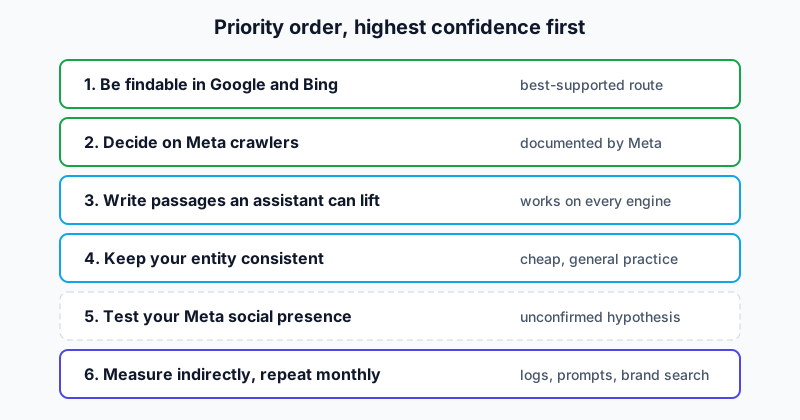
Step 1: Be findable in Google and Bing
This is the best-supported lever, and it is boring.
At launch, Search Engine Journal reported that Meta's assistant would "incorporate real-time search results from Google and Bing". Its author tested it and could only get Bing results, and said he did not know what decides between the two. Meta's own post mentions real-time information from across the web without naming a provider (the overview covers the evidence in full). The current provider mix is unconfirmed. What is reasonable to infer is that if neither engine can find your page, there is little for a search-grounded answer to retrieve.
Customer Impact makes the same argument and calls the mechanism grounding: anchoring an AI answer in external, findable sources. It adds that Meta is reportedly building its own crawler and search technology, so the sources could shift. A plan should therefore not depend on one partner.
Checks to run this week:
- Confirm your key pages are indexed in Google (Search Console) and in Bing (Bing Webmaster Tools).
- Search the exact question you want to answer in both engines and note who ranks.
- Make sure the page loads its main text in the initial HTML. If the answer only appears after heavy JavaScript, many crawlers will not see it.
- Check there is no accidental
noindexand that the canonical URL points to the page itself. - Keep the sitemap current so new pages are discovered quickly.
The Bing side deserves attention if you have neglected it. The guides to Microsoft Copilot search and how to rank in Microsoft Copilot cover Bing hygiene, and it transfers directly.
Step 2: Make a deliberate crawler decision
This step is the one place where Meta gives you real, documented controls. Use them on purpose.
Meta's "Meta Web Crawlers" page describes the agents below (full explanation in the overview); the wording matters for the decision:
| Crawler | What Meta says it does | robots.txt behaviour | Your decision |
|---|---|---|---|
| Meta-ExternalAgent | Crawls the web for training foundation AI models or improving products by indexing content directly | Follows robots.txt rules | Allow to stay eligible, block to opt out |
| Meta-ExternalFetcher | Fetches individual links at a user's request, supports agentic AI features | Meta says it may bypass robots.txt | Cannot rely on a block |
| Meta-WebIndexer | Navigates the web to improve Meta AI search result quality | Not stated in the excerpt reviewed | Allow if you want search eligibility |
| FacebookExternalHit | Fetches shared links | May bypass robots.txt for security or integrity checks | Leave alone |
The Meta-WebIndexer entry was seen only in a search excerpt of the French-locale version of Meta's page, because Meta's page returned an error to the fetcher used for this guide. Open the official page and confirm the list before writing rules. Sources also disagree about FacebookBot: Business Insider called it an older crawler used to gather data for training, while We The Flywheel describes it as handling link previews. Server logs show how it behaves on your site.
The trade-off
Meta-ExternalAgent combines two jobs in Meta's description: training and indexing. That means you cannot, from Meta's wording alone, allow indexing while blocking training. Business Insider made the same observation in 2024, noting that the bot performs two functions. So the decision is a licensing one. If you publish content for reach, allowing it is consistent with wanting AI visibility. If your content is the product, blocking is a legitimate choice, and you accept that you may be less eligible.
A MetaPilot page reports that Meta caches robots.txt for up to 24 hours. That figure is third-party, so treat it as a rule of thumb: after you edit the file, wait before you judge the effect.
Sample robots.txt
Allowing the AI crawler while protecting one private directory, in the style Meta shows on its own page:
User-agent: meta-externalagent
Allow: /
Disallow: /private/
To opt out of the training and indexing crawler instead:
User-agent: meta-externalagent
Disallow: /
Neither snippet covers Meta-ExternalFetcher. If you must prevent user-requested fetches, you need server-level controls, and you should weigh whether that is worth blocking real people from sharing your page with an assistant.
Step 3: Write passages an assistant can lift
Assistants answer in a few sentences. The page that makes a clean sentence easy to take has an advantage, whichever engine is retrieving.
Both agency guides reviewed push this point, and it is consistent with how short chat answers work. We The Flywheel says clear answers, sourced claims and clean server-rendered content are the baseline that helps everywhere. Customer Impact says to write content that answers a clear question in a few sentences, with a clean structure and facts an AI can take over. The practical rule: the opening of each section contains the answer, and the rest supports it.
For context, the GEO study (Aggarwal et al., 2024, arXiv 2311.09735) reports visibility improvements of up to 40% in the paper's benchmark for such content methods. That benchmark did not include Meta AI, so it is a general signal and not a Meta result.
A worked example
Take a page about a payroll tool. Here is a weak and a stronger opening for the same section.
Before:
Payroll can be complicated, and there are many things to think about when choosing the right approach for your business, including your size, your budget and your goals.
After:
A business with fewer than ten employees can usually run payroll in-house with software. Larger teams, or teams paying in several countries, normally need a payroll provider. The deciding factors are headcount, number of pay countries and who carries the filing risk.
The second version states a claim, gives a boundary and names the criteria. An assistant can quote one sentence of it and still be correct. The example is invented for illustration, so do not treat the payroll rule itself as fact; the point is structure.
Practical writing rules
- Put the direct answer in the first one or two sentences under each heading.
- Use one idea per paragraph and name things plainly.
- Use numbered steps for processes and bullets for parallel features.
- Cite your own sources inline, with names and dates, so claims can be checked.
- Show the author and the last-updated date on the page.
WP SEO AI's guide suggests HowTo and FAQPage markup. Structured data is cheap and harmless, but no Meta document says Meta AI reads it, so add it for Google and Bing and do not expect Meta-specific lift. A minimal FAQ block looks like this:
{
  "@context": "https://schema.org",
  "@type": "FAQPage",
  "mainEntity": [{
    "@type": "Question",
    "name": "How many employees can use in-house payroll?",
    "acceptedAnswer": {
      "@type": "Answer",
      "text": "Teams under ten people can usually run payroll in software."
    }
  }]
}
Step 4: Keep your entity consistent
Customer Impact puts weight on this, and it is easy to do. Its argument is that AI systems trust brands that give the same accurate picture everywhere, so your name, claims and figures should match across your website, LinkedIn and external mentions.
Audit it with a simple table. Pick eight facts and check each in each place.
| Fact | Website | Directories | Press or profile pages | |
|---|---|---|---|---|
| Legal and brand name | ||||
| Founding year | ||||
| What you sell, in one line | ||||
| Headquarters location | ||||
| Key figure you quote (customers, years) | ||||
| Author names and titles | ||||
| Product or service names | ||||
| Contact details |
Fill each cell, then fix every mismatch at the source. It sounds trivial. It is also the type of problem that quietly makes a model hedge or skip you.
A short "About" page and an editorial note, with named authors and dates, are worth adding. We The Flywheel and WP SEO AI both stress credentials and trust signals. Meta does not document how it uses them, so this rests on general practice, not on a Meta rule.
Step 5: Treat your Meta social presence as a hypothesis
Customer Impact reports that Meta says Meta AI also draws recommendations from Reels, maps and public posts, with credit back to the creators. That statement was not found on a Meta page, so it is a reported claim. We The Flywheel goes one step further and suggests an active, credible presence on Facebook and Instagram is the most plausible lever for influencing what Meta AI says about you. It labels that informed inference, not confirmed mechanics.
Treat this as a cheap experiment, not a strategy:
- Make sure your Facebook Page and Instagram profile exist, are public and use the exact brand name from your entity audit.
- Post useful, factual content that matches your site, not teasers that contradict it.
- Link the profiles to the site and the site to the profiles.
- Do not buy engagement. There is no evidence it helps and it can damage trust.
Social effort is worth it only if it already earns its keep with your audience; Meta AI is a bonus, not the reason.
Step 6: Measure indirectly and keep notes
No Meta publisher report for AI citations was found, and We The Flywheel states that outright. So build a small system out of imperfect parts.
| Signal | How to collect it | What it proves | What it does not prove |
|---|---|---|---|
| Server log hits | Filter for meta-externalagent, meta-externalfetcher, meta-webindexer |
You are reachable | That you were cited |
| Manual prompts | Ask Meta AI your target questions monthly and log the answer | Whether you appear for that prompt, that day | Stable ranking |
| Referral traffic | Watch for meta.ai or app referrers in analytics | Some clicks happen | The full picture |
| Branded search | Track brand queries in Search Console | Possible awareness lift | Cause |
| Citation trackers | Some tools say they probe Meta AI | Rough coverage | Reliable data, per We The Flywheel |
A log entry of the fetcher is interesting for a particular reason. Meta-ExternalFetcher acts when a user asks, so a hit may mean a real person asked Meta AI about your URL. That is a signal, but a weak one: it tells you someone triggered a fetch, not what the answer said.
For manual testing, keep the method tight. Use the same set of 10 to 20 questions each time, write down the date, the country and the app you used, and record whether your domain or brand was named. A spreadsheet is enough. Repeat from another country if your audience is international, since Customer Impact reports the EU gets a more limited version than the United States.
Mistakes and claims to distrust
Some advice in circulation does not survive a check against sources.
- A promised timeline. WP SEO AI says Meta AI optimisation takes 6 to 12 weeks to see initial citations. We The Flywheel says timing is undocumented. Meta says neither. Plan without a date.
- Technical claims stated as fact. The same WP SEO AI guide describes dense retrieval and "query fan-out" inside Meta AI. No Meta document confirms this, so it is a hypothesis.
- "Meta AI penalises optimisation". One FAQ in that guide says forced optimisation may be penalised. Again, no Meta source. Write naturally anyway, because it reads better.
- Big user numbers without a source. Meta said 400 million monthly users in September 2024. A 2026 article claims over a billion with no Meta citation. Do not quote the larger figure in a deck without checking.
- Assuming robots.txt covers everything. Meta itself says the fetcher may bypass it.
Paying for a "Meta AI optimisation" service is hard to justify: with no analytics and no documented signals, nobody can prove a result.
A 30-day plan
If you want a concrete schedule, here is the shortest version that still covers the ground.
Week 1: foundations. Index checks in Google and Bing, fix noindex or canonical problems, confirm server-rendered text, and review robots.txt. Decide on Meta-ExternalAgent and write it down with the reason.
Week 2: content. Rewrite the opening of your ten most important pages so each section starts with its answer. Add author and date lines. Add FAQ markup where the page has real questions.
Week 3: entities and social. Run the entity table, fix mismatches, tidy Facebook and Instagram profiles, and cross-link them with the site.
Week 4: baseline and review. Create the prompt spreadsheet, run your first set of questions in Meta AI, pull log hits, and record branded search numbers. Then stop and wait. Repeat monthly.
After that, move your marginal hours to engines you can measure. The overview of what Meta publishes and what it leaves out is in the Meta AI search guide, and the similar social-platform engine is covered in how to rank in Grok. The methodology page explains how sources of this quality are weighed.
Frequently asked questions
How long does it take to rank in Meta AI?
No source reviewed gives a verified timeline. One agency says 6 to 12 weeks, another says it is undocumented, and Meta publishes nothing. Plan on a monthly check rather than a deadline.
Do I need to allow Meta-ExternalAgent?
It is your call. Meta describes it as crawling for training foundation AI models or improving products by indexing content directly. Allowing it keeps you eligible, blocking it opts out, and Meta's wording does not let you separate the two jobs.
Does blocking Meta-ExternalAgent stop Meta AI from reading my page?
Not entirely. Meta says Meta-ExternalFetcher fetches pages at a user's request and may bypass robots.txt. A user can still paste your link into Meta AI.
Does schema markup help me rank in Meta AI?
No Meta document says so. Schema helps Google and Bing understand a page, and if those engines feed Meta AI, there may be an indirect benefit. Treat that as inference.
Should I post on Facebook and Instagram to be cited?
It is a plausible but unconfirmed idea. Customer Impact reports Meta draws on Reels and public posts for some recommendations. Keep the presence accurate and consistent, and do not expect a guaranteed effect.
Can I track Meta AI citations in analytics?
Not directly. Check server logs for Meta user-agents, look for meta.ai referrers, and run manual prompts. Citation trackers claim partial coverage, but We The Flywheel rates it as the weakest of any engine.
Is Meta AI worth the effort compared with ChatGPT?
For most publishers, a little effort goes a long way and a lot goes nowhere. Do the foundations once, then favour engines with visible referrals such as ChatGPT Search or Gemini.
Limits of this guide
- Verified: Meta's April 2024 launch post, the Search Engine Journal report on Google and Bing (April 2024, possibly out of date), the Business Insider crawler article, and the GEO paper's "up to 40%" claim.
- Reported, not verified on a Meta page: the Meta-WebIndexer entry (search excerpt only), Reels and public-posts sourcing, the Muse Spark model and EU dates (Customer Impact), the FacebookBot role (We The Flywheel), the robots.txt cache time (MetaPilot), and the 6 to 12 week timeline (WP SEO AI, rejected as unsupported).
- Missing: no video walkthrough transcript exists for Meta AI, so there is no analysis section and no prompts were run for this guide. The playbook steps are editorial judgment built on these documents, not a tested formula, and Meta may change its crawlers and products without notice.
Sources
- Meta Web Crawlers, Meta for Developers
- Meta Web Crawlers, French-locale page listing Meta-WebIndexer
- Meet Your New Assistant: Meta AI, Built With Llama 3, Meta Newsroom
- Meta Integrates Google & Bing Search Results Into AI Assistant, Search Engine Journal
- Meta's AI Products Just Got Smarter and More Useful, Meta Newsroom, September 2024
- Meta Has New Web-Crawling Bots, Business Insider
- Meta-ExternalAgent profile, MetaPilot
- GEO: Generative Engine Optimization, Aggarwal et al., arXiv 2311.09735, 2024
- Meta AI SEO: how it works, Customer Impact, updated 18 October 2026
- How to Rank in Meta AI: The Per-Engine GEO Playbook (2026), We The Flywheel, 26 May 2026
- How to rank in Meta AI, WP SEO AI, 3 July 2025