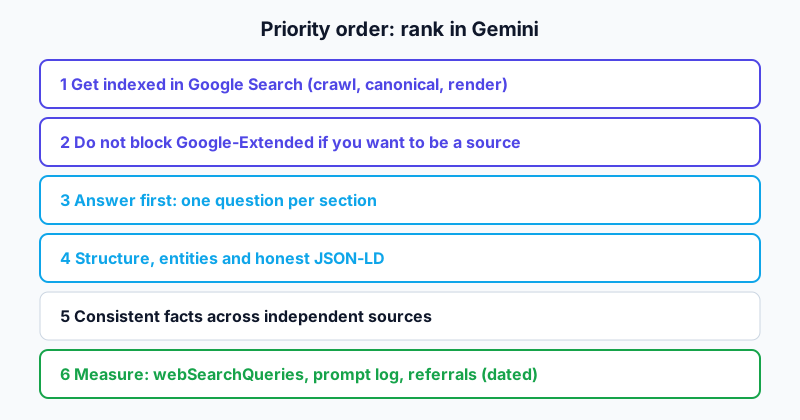
To rank in Gemini you first have to be eligible to be retrieved, because Gemini's web answers are grounded in Google Search results rather than in a separate index. That makes this a sequencing problem more than a trick. Fix crawling and indexing, then make single passages easy to quote, then build corroboration outside your own site, and only then worry about markup.

Before you start: what it means to rank in Gemini
There is no results page with positions in a Gemini answer. What exists is a response with a few cited sources. The API documentation shows how this is structured: groundingChunks list the web sources (URI and title), and groundingSupports connect segments of the answer text to those chunks by start and end index. In plain terms, you are trying to be one of the chunks and to be attached to the sentence that matters.
Two details shape the work. First, the model decides whether to search at all, and it writes its own queries. Second, the surface you care about must be clear. This guide is about the Gemini app and grounded Gemini answers. If your goal is Google's Search features, use the separate pages on how to rank in Google AI Overviews and how to rank in Google AI Mode. For the background on how Gemini works, see the companion Google Gemini guide.
What you will need
- Google Search Console access and the ability to edit robots.txt and templates.
- A list of the ten to thirty questions your customers ask.
- A spreadsheet to log test prompts with dates.
Step 1: Make sure Google can crawl, index and show the page
Everything starts with Google Search. Gemini's grounding feature "connects the Gemini model to real-time web content" through Google Search, according to Google AI for Developers. A page that is blocked, noindexed, or buried behind scripts that Googlebot cannot render has no route in.
Work through this short audit:
- Open Search Console and inspect the URL. Confirm it is indexed and that the rendered HTML contains the text you want quoted.
- Check robots.txt for rules that block Googlebot from the section.
- Search for a distinctive sentence from the page in quotation marks to see whether it is retrievable.
- Confirm the canonical points to the page you want cited, not a parameter version.
- Verify the page loads fast enough that Googlebot is not timing out, and that content is not hidden behind interaction.
If the page fails any step, you do not have a Gemini problem. You have an indexing problem, and the fix is ordinary technical SEO.
One transcript (the Rank Expander Academy contest for brand-new microsites) makes the same point: after six days only some domains were indexed in the top 50, and heavier queries were dominated by established profile platforms. Grounding inherits Google's competitive reality, and an unindexed page cannot be a source.
Add two extra checks that the basic audit misses. First, test the page with JavaScript disabled and confirm the answer text is still present. Second, look at the Search Console "Pages" report for the status "Crawled - currently not indexed" on the URLs you care about; a page stuck there will never reach the grounding pool, however good the copy is.
Step 2: Decide your Google-Extended policy
Google-Extended is a robots.txt product token. Google's common crawlers page says it manages whether crawled content may be used to train future Gemini models and for grounding in Gemini Apps and Grounding with Google Search on Vertex AI. It adds that the token does not affect Search inclusion and is not a ranking signal.
Many "block all AI bots" templates include this token, so a copy-paste can silently remove you from Gemini grounding. The definition and the Search-unaffected statement are covered in the overview. If you want to remain a possible source, leave it alone. If you have a policy reason to opt out, here is the exact syntax:
# Opt out of Gemini training and grounding use
User-agent: Google-Extended
Disallow: /

# Keep Search crawling untouched
User-agent: Googlebot
Allow: /
A middle path exists. Google's own example shows allow and disallow lines with paths, so you can exclude a members area but leave articles open. Marie Haynes, in April 2025, reads the effect of a block as losing the links recommended in the Gemini app. That reading is hers, not Google's, so treat it as a likely consequence rather than a documented one.
Note what this token does not do. Google's AI features guide says robots.txt rules for Googlebot are the control for how your site is crawled for Search, and that nosnippet, data-nosnippet, max-snippet and noindex limit what is shown. Blocking Google-Extended will not remove you from AI Overviews or AI Mode.
| Goal | Rule or tag | Affects Gemini app? | Affects Search? |
|---|---|---|---|
| Be a possible Gemini source | No Google-Extended block | Allows | No change |
| Opt out of Gemini training and grounding | Disallow under Google-Extended |
Yes | No |
| Remove page from Google entirely | noindex or Googlebot block |
Indirectly yes | Yes |
| Limit shown snippet text | nosnippet, max-snippet |
Not stated by Google | Yes |
Step 3: Write answer-first passages
This is where most of your effort should go. Google has not published a rule saying Gemini selects passages, so this is framed as an editorial method with good reasons rather than a guaranteed lever. The reasons are: the model writes sub-queries, retrieval returns pages, and groundingSupports attach citations to individual sentences. A page that answers a sub-question in a clean block gives the synthesis step something quotable.
Mintec Blog (July 2026) states the test well: ask whether any section could be quoted in isolation and still make sense. The test is sound; little else in that article is specific to Gemini, since it concerns AI Overviews.
A before and after
Here is a weak opening for a section and a stronger one. The topic is a small-business accounting question.
Before:
There are many factors that businesses consider when thinking about when to register for VAT, and it can depend on a number of circumstances worth exploring.
After:
A business must register for VAT once its taxable turnover passes the national threshold. In the UK that threshold is set by HMRC and changes over time, so check the current figure on GOV.UK before you rely on any number.
The second version answers in the first sentence, names the actor, and refuses to invent a figure. Put the answer first, then the qualification, then the detail. That structure survives being quoted in part.
Recommended rules for every section
- One question per H2 or H3, phrased the way a person would ask it.
- The direct answer in the first one or two sentences.
- Names and entities spelled in full once, not only pronouns.
- No claim without a source or an honest hedge.
- A date on anything time-sensitive.
Gravitate (May 2025) recommends similar formats for LLM readability: Q&A, lists, how-to steps, TL;DR summaries and FAQs, with short paragraphs and plain language. Those are sound for readers too, which is why they are recommended here.
Step 4: Research the queries Gemini actually runs
You can see sub-queries if you test through the API. Because grounding returns webSearchQueries, a developer can send a prompt with the google_search tool and read the list of queries the model generated. Here is a small workflow:
- Take your ten most important customer questions.
- Send each to a Gemini model with grounding enabled.
- Record
webSearchQueries, thegroundingChunkstitles and URIs, and which of your pages (if any) appear. - Group the generated queries by theme and map each to a page or a gap.
This gives you a map of sub-questions, which is far more useful than a keyword list. Two video presenters among the reviewed transcripts describe the same idea loosely as "query fan-out", where one question splits into sub-questions and the model looks for content covering all of them. The idea is plausible. What Google documents is simpler: the model may generate one or several search queries.
Outputs vary between runs, so log the date and repeat before changing a page.
Step 5: Add structure and markup that mirrors the page
Structured data is where agencies promise the most and Google commits to the least. Google's AI features page says best practices for SEO remain relevant and that there are no additional requirements to appear in AI Overviews or AI Mode. That page concerns Search, but it is the only official guidance located, so markup should not be oversold.
Even so, schema is cheap and describes what the page already says. Gravitate lists Person, Organization, Article and FAQ as common types, recommends JSON-LD in the <head>, and suggests validating with Google's Rich Results Test. Here is a minimal Article block you can adapt:
{
  "@context": "https://schema.org",
  "@type": "Article",
  "headline": "How to register for VAT: a plain guide",
  "datePublished": "2026-10-29",
  "dateModified": "2026-10-29",
  "author": { "@type": "Person", "name": "Mohamed CISSE" },
  "publisher": { "@type": "Organization", "name": "Example Co" }
}
Two rules keep it honest. The markup must match visible content, and every date must be true. One agency article (Mintec Blog) claims pages with FAQ markup are cited "roughly 2-3x more" in internal tests. The method could not be verified and it concerns AI Overviews, so it is not relied on here.
Page structure that helps without schema
| Element | Why it helps | Evidence level |
|---|---|---|
| Descriptive H2s phrased as questions | Matches likely sub-queries | Editorial reasoning |
| Short answer paragraph under each H2 | Gives a quotable block | Editorial reasoning |
| Tables for comparisons | Easy to parse and cite | Gravitate recommends lists and structure |
| Visible author and date | Supports trust signals | General SEO practice |
| Internal links between related pages | Builds topical depth | Gravitate (topic clusters) |
Step 6: Build entities and topical depth
Gravitate explains the difference between keywords and entities with a simple example: a keyword is a phrase people search, an entity is a specific named thing such as a brand or product. It argues that clear entities help models understand what a page is about, and that topical authority comes from writing about one subject from several angles and keeping it updated.
In practice:
- Name the brand, product, person and place in full on first mention.
- Cover a topic cluster instead of one page per keyword.
- Link related pages with descriptive anchor text.
- Keep one canonical, factual "about" page that states what the organisation does and for whom.
One video presenter adds a tactic: write about your own brand in the third person, so that it reads as an entity rather than a voice. His reasoning is that models understand named entities better than "I" or "we". It is a harmless habit for a brand profile page. Do not take it as proven.
Corroboration outside your site
The same presenter argues that content in several formats, on several sites and platforms, reinforces a claim better than a single article. He reports traffic growth, but figures from presenters are self-reported, differ between videos and are not quoted here; the mechanism is unconfirmed.
Here is the defensible version. Be consistent about who you are and what you offer across your site, your profiles, your directory listings and your press. Where independent sources mention you accurately, that gives retrieval more places to find you. Do not create fake sites or fake reviews to simulate it. That is a spam policy risk in Search, and it would not make a fabricated claim true.
Step 7: Use more than one format
The same presenter noticed that on one tested query his AI Mode result showed two videos and one article among the sources. His advice is to make several formats for a keyword. Whether that generalises is unknown, but there is a sensible, evidence-light reading: Google Search indexes video, images and pages, and a topic with strong video and text coverage offers more routes to retrieval.
Practical options: a written guide with an answer-first structure, a short video on the same question with a transcript on the page, and a comparison table that can stand alone. Do not duplicate text across formats. Each should add something, such as a demonstration or a worked example.
Step 8: Keep it fresh, honestly
Mintec Blog reports that, in its tracking of more than 40 pages over three months, pages older than 90 days saw their AI Overview citation rate drop by roughly 40%, and it recommends refreshing every 60 days. That is a single agency's observation about AI Overviews, not Gemini, and the data is not published.
What holds up regardless is simpler. Outdated pages mislead readers, and Search values helpful current content. So set a review schedule based on how fast your topic changes. A VAT threshold page needs checking when rules change. An evergreen explainer may need an annual look. When you update:
- Change something real: a figure, an example, a step.
- Update
dateModifiedonly when the content changed. - Re-check outbound links and sources.
- Re-run your question tests and note differences.
Mintec says changing a date without changing content resets nothing. It is also a trust problem.
Step 9: Measure what you can
Measurement for Gemini is rougher than for Search. Combine three sources.
| Method | What it shows | Limits |
|---|---|---|
| API runs with grounding | Queries and cited sources for sample prompts | Developer effort, run-to-run variation |
| Manual prompt log | Whether your brand or page appears, with dates | Small samples, personalisation |
| Analytics referral data | Visits that came from AI tools | Not every visit is labelled |
Gravitate notes that Google Analytics does not show exactly where AI traffic comes from, but you can look for traffic spikes after your content appears in AI tools and drill into session source and medium. Which referrer names Gemini sends is unverified, so inspect your own data rather than relying on a list.
Mintec Blog says AI sources make up 1% to 5% of total sessions for most sites it analysed. That is its own sample. Your share may differ, and it is worth establishing a baseline before you judge the effort.
A simple log looks like this:
date, prompt, grounded?, queries run, your page cited?, competitor cited, notes
2026-10-29, "what drill for ceramic tile", yes, 3, no, brandX, add hammer-mode section
Step 10: Mistakes that waste time
- Copying a blanket AI-bot block. It can include Google-Extended and remove a surface you wanted.
- Treating schema as a switch. Google's guidance gives no basis for that.
- Chasing a one-off result. Variation between runs is normal.
- Publishing unreviewed AI drafts at scale. One video chains five prompts to produce outline, article and schema. Drafting with AI is fine; invented examples are not. Edit, source, and add what only you know.
- Confusing surfaces. AI Overviews, AI Mode and the Gemini app overlap, but their controls and evidence do not.
Analysis of the reviewed walkthroughs
Three video transcripts were reviewed for Gemini (see the overview for the per-video summary). Their claims were consistent in tone and thin on proof. One presenter shows AI Mode answering "best AI community" with his own sites among the sources, then lists tactics: several formats, listicles, third-person writing, and multiple sites. Another recommends schema, FAQ sections, organised headings and a chain of five prompts. The third covers a Google organic ranking contest and is not about Gemini. None isolates a variable, each presenter promotes a service or community, and any traffic figures are self-reported and differ between videos. They are used here to identify ideas worth testing, not as evidence of effect.
Frequently asked questions
Can I submit my site directly to Gemini?
No. Gravitate states that you cannot directly submit content to LLMs. For Gemini, your route is Google Search: crawlable, indexed, relevant pages. Search Console helps with that, and nothing replaces it.
Should I block Google-Extended?
Only if you have a policy reason. Google says it governs Gemini training and grounding and has no effect on Search. Blocking it means opting out of those uses, which works against the goal of being cited.
How long does it take to appear?
No official timeline was found, and none is invented here. Time to appear depends on Google indexing, query competition and the model's decision to search. Track your tests weekly and keep dates.
Does FAQ schema get me cited?
It may help machines read your page, and Gravitate recommends it. The "2-3x" lift reported by one agency is unverified. Add FAQ markup only for questions that are visibly answered on the page.
Is Gemini the same as AI Mode?
They are related but distinct. Google's AI features page describes AI Overviews and AI Mode as features in Search, while the Gemini app is a separate assistant. One video claims a newer model powers AI Mode, which this guide could not verify. See Google AI Mode for that surface.
Limits of this guide
- Verified: the grounding fields, the Google-Extended definition and the "no additional requirements" statement (Google documentation, read October 2026; recheck, as documentation changes).
- Reported: the 2-3x FAQ effect, the 90-day citation drop and the 1% to 5% AI-session share (Mintec Blog, an agency; the first two concern AI Overviews), the Marie Haynes reading of a Google-Extended block, and all presenter claims, which are self-reported.
- Missing: Google publishes no rule for how Gemini chooses among retrieved sources, so the passage-level advice is editorial reasoning. No controlled Gemini tests, referrer names or traffic-share data were available. A model name in one transcript could not be confirmed and is not repeated.
The evidence grading is explained on the methodology page.
Sources
- Grounding with Google Search, Gemini API, Google AI for Developers (read October 2026)
- Grounding with Google Search overview, Google AI for Developers (read October 2026)
- GroundingMetadata reference, Google Cloud, Vertex AI documentation (read October 2026)
- Google's common crawlers, Google for Developers, last updated 15 October 2026
- AI features and your website, Google Search Central, last updated 10 December 2025
- Should you use Google-Extended in robots.txt?, Marie Haynes Consulting, April 2025
- AI Search SEO: How to Rank on ChatGPT, Perplexity, & Gemini, Chad Stoecker, Gravitate, 19 May 2025
- How to Rank in Google AI Overviews: The GEO Framework for AI Citation, Mintec Blog, 25 July 2026
- Video walkthrough transcript, "This Gemini 3.0 SEO trick is insane", Julian Goldie / Goldie Agency (third-party creator), reviewed 2026; no public URL confirmed
- Video walkthrough transcript, "how to rank number one inside Google Gemini", Julian Goldie / Goldie Agency, reviewed 2026; no public URL confirmed
- Video walkthrough transcript, microsite SEO contest case study, Rank Expander Academy (third-party creator), reviewed 2026; no public URL confirmed